
April 22, 2026

The Senior Project is an independent, student-led culmination of our high school experience. After three years of academic preparation, our seniors are ready to spend the last trimester of their high school careers applying the skills and knowledge they have gained to develop a project that is insightful, academically rigorous, and professional in nature. This year, we are proud to showcase a senior from one of our neighboring campuses, BASIS Independent Fremont, Patrick Z.
Week 5: Traffic Lights
If you remember, last week concluded with me going back to the MNIST dataset after my disastrous attempt at working with the Fashion-MNIST dataset. I was talking about how I might consider working with traffic light datasets as something that might be more useful on a practical level. So, this week I’m glad to report that I did find a dataset that is more practical. The dataset is called the Bosch Small Traffic Lights Dataset, or BSTLD. This dataset is composed of many images of traffic lights taken by dashcams in real-world driving situations. I preprocessed these images the same way I did for the MNIST dataset, binarizing them and downscaling them to 4×4 resolution for the fair CNN and QNN. In doing this, I was able to successfully train all of my models as classifiers to determine whether an image was a red light or a green light. Unlike clothing items in the Fashion-MNIST dataset, there is now enough visual distinction in color, position and brightness distribution between red and green lights that even 16 pixels of resolution is enough to highlight this difference.
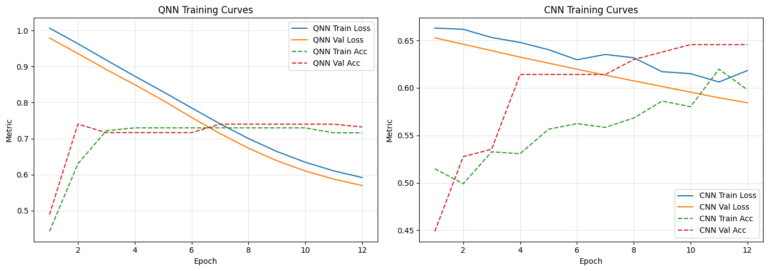
The results were quite exciting. After training all of my models on my new dataset, I was able to run noisy versions of my images of traffic lights through all of my models. The QNN was able to achieve better classification accuracy than my fair CNN in the classification of the noisy images. This is the first practical experiment in which I’ve been able to provide concrete proof of the quantum architecture’s advantage in the real world. On a separate note, this week I also tested out a different noise injection algorithm called Binarized Gaussian Noise. It basically works by forcing every pixel to snap to pure black or pure white instead of anything in between. This will not show in the noisy images that I have displayed below because the binarization happens only right before the QNN and fair CNN actually evaluate the images. This is different from my previous approach of Additive White Gaussian Noise (AWGN). Here is a graph showing how my QNN compares to my fair CNN in classification accuracy of noisy traffic light images.
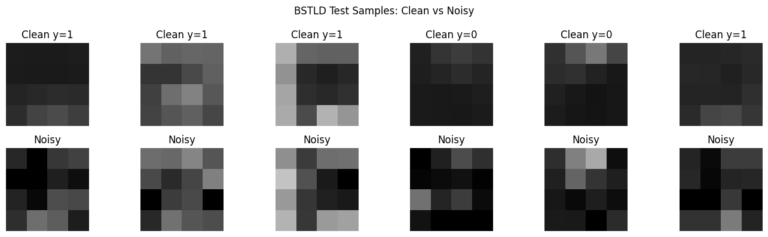
To give you a better idea of what these models were actually looking at, here is a comparison of clean traffic light samples and their corresponding noisy samples after Binarized Gaussian Noise is applied. As you can see, some features that a classical model may have relied on are obscured in the noisy samples, which is why I hypothesized that this quantum model would handle them better.
I think this week has been a turning point for my entire project. After weeks of debugging, server migrations, and slow quantum simulations, I have finally tested my theory on some actual data that points towards answering my original research question. While the BSTLD results do not necessarily prove anything alone, I think combined with my previous experiments with Noisy MNIST, I am seeing patterns that point towards a definitive advantage for the quantum architecture. Next week, I will compile all of this data into my final paper. I will also continue to work on more experiments and variations of quantum circuits. I will see you then!
Week 6: Ctrl+Z on the ZX Gates
Last week, I had an amazing breakthrough on the traffic light dataset, so I had a lot of momentum going into this week. I had decided I was going to test different quantum circuit architectures to see if I could further improve the noise resistance of the QNN. I tried switching up the XX and ZZ entangling gates for other combinations like ZX, YY, and some other combinations I came across in some of the latest research on variational quantum circuits. I was hoping that different gate combinations could pick up on different correlations in the data, potentially further increasing the accuracy. Unfortunately, none of them really worked. Some of them did not converge at all. The loss simply plateaued right off the bat, and the model just started spitting out completely random predictions no matter what I did in terms of the learning rate or the number of entangling layers. One of them was working well for a little while but ultimately just started classifying every instance as the same class, which is called barren plateaus, where the gradients in the quantum circuits are so small that the model is essentially just stuck. I spent three days trying different combinations, watching training after training fail, which was really disappointing after last week’s high.
Rather than continuing to throw circuit designs against the wall and hoping one sticks, I’ve decided to refocus my efforts on really making significant headway on my research paper. I’ve already been putting together pieces of my paper over the past week or so, but this week I’ve had a chance to sit down and really flesh out my introduction section now that I have hard data for both my MNIST and BSTLD experiments. Writing out my ideas forced me to really think critically about all of my design choices, from why my original XX and ZZ gate combination worked while all my other attempts didn’t to why my 4×4 binarization threshold is important. I have to say, I’ve come to realize that while my design choices were probably good ones instinctively while I was writing my code, I really need to be able to justify those choices on paper. I’ve also had a chance to organize my accuracy and loss graphs, which has really given me a sense for the overall story my data is trying to tell. While my recent attempts at designing new circuits were unsuccessful, analyzing these runs for the paper has given me a much clearer direction for my next wave of testing. This is far from the end of my experimental phase. After Spring Break, I’ll be diving right back into a new series of targeted experiments using these fresh insights, while continuing to refine my paper in parallel. Stay tuned!
BASIS Independent Dublin is a Grades 6 – 12 private school, providing students with an internationally benchmarked liberal arts and sciences curriculum, with advanced STEM offerings. Considering joining the BASIS Independent Dublin community? To join our interest list for the next school year and receive admissions updates and more, please click here.