
January 6, 2026
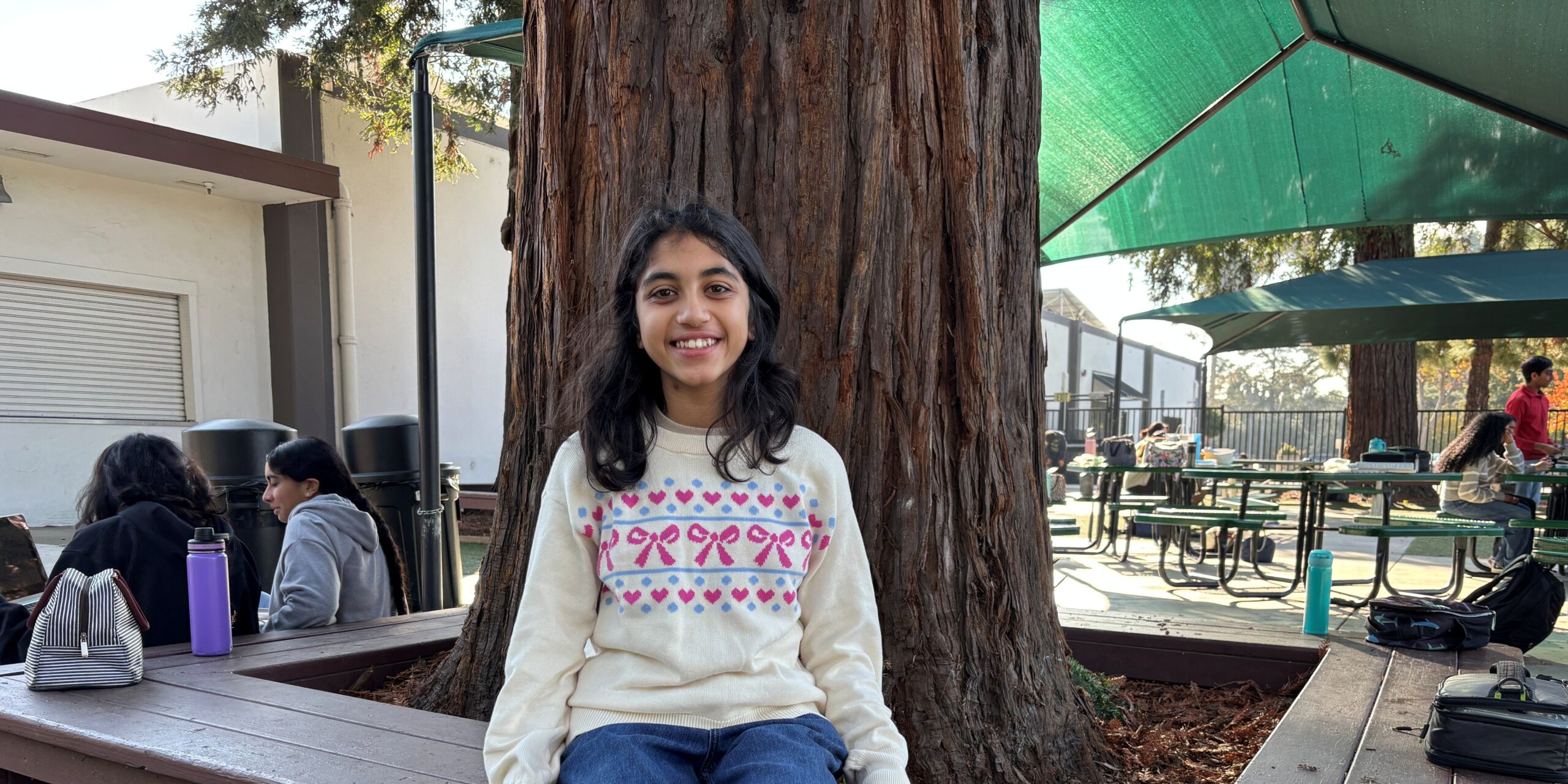
Transferring schools is never easy—but transferring into a rigorous high school where AP courses and college-level expectations are standard starting in grade 9? That can feel especially daunting. At BASIS Independent Schools, grade 9 students dive into college-level coursework, manage demanding schedules, and navigate new social dynamics. But as Siddhi J. discovered this year, the reality is far less intimidating than the reputation suggests.
Meet Siddhi
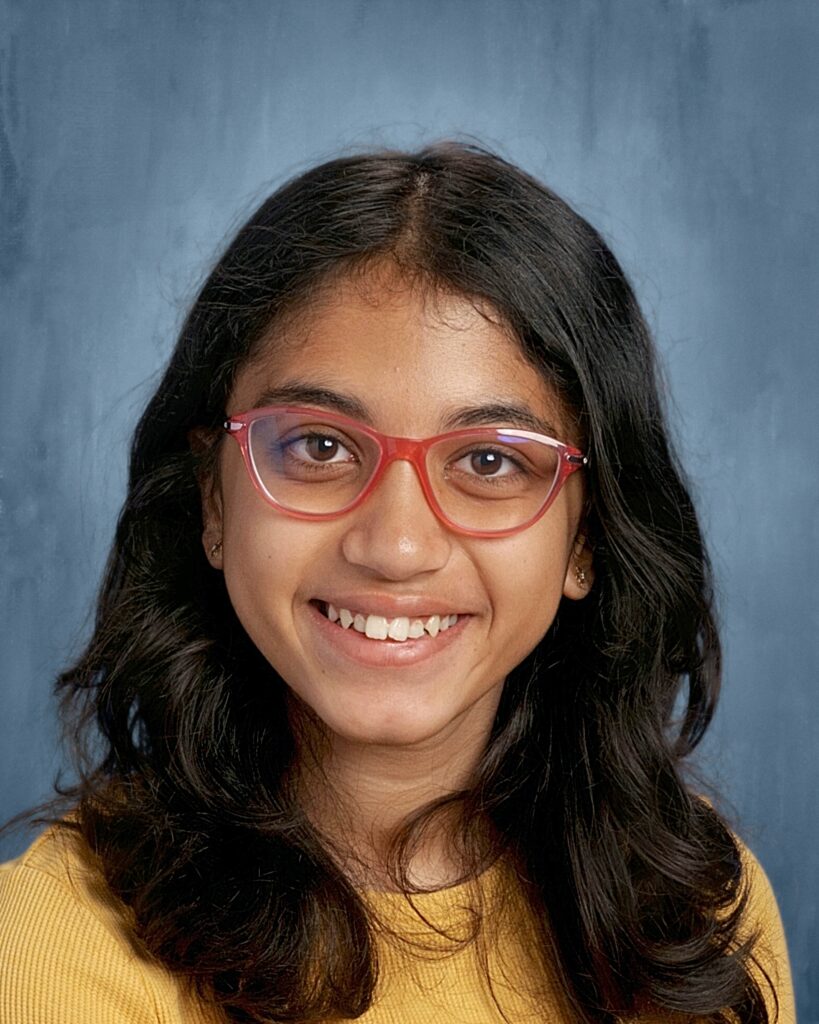
Siddhi joined BASIS Independent Fremont this year in grade 9, transferring from a private school in the area after attending several schools throughout her academic journey. Outside the classroom, she’s an avid badminton player and has a particular passion for murder mysteries—she reads them “excessively,” in her own words. At BASIS Independent Fremont (BIF), she’s already deeply involved in Student Council, Speech Club, and Math Club.
Coming into grade 9 at a school known for academic rigor brought natural concerns. “I originally thought that it’d be really scary because everybody thinks that BIF is extremely academically challenging, but it’s actually not that bad,” Siddhi reflects. “There’s more homework than I’m used to, but I think that’s just mainly the middle school to high school jump.”
The adjustment required some recalibration, particularly around time management. “I was able to handle it. I just needed help with time management, but after I figured that out, I was able to go from there.” The growth has been noticeable: “Academically, before I used to procrastinate everything until the last minute, but now, in high school and in BIF, I need to time manage things better. So I’ve gotten a lot more organized.”
Perhaps most surprising? The community itself. “On my first day, I’d already made a lot of friends. It’s a really close-knit community since there are only 40 [grade 9] students in total, so everyone knows everyone.” The reality proved very different from her expectations. “Most people think it’s really cutthroat and really competitive, because that’s what I thought before I joined here. I thought it would be everybody focused on academics and everyone hates each other, but the community is actually really friendly. Everyone talks a lot, jokes a lot. It’s a lot more friendly than I thought.”
Her advice for families considering a grade 9 transfer? “It may seem incredibly scary, but the teachers are really helpful, and they explain the AP things really well, so it’s not that scary.”
Let’s follow Siddhi through a typical day to see what grade 9 at BIF really looks like in action.
Period 0 (7:35-8:20): Computer Science & Programming with Ms. Shahin
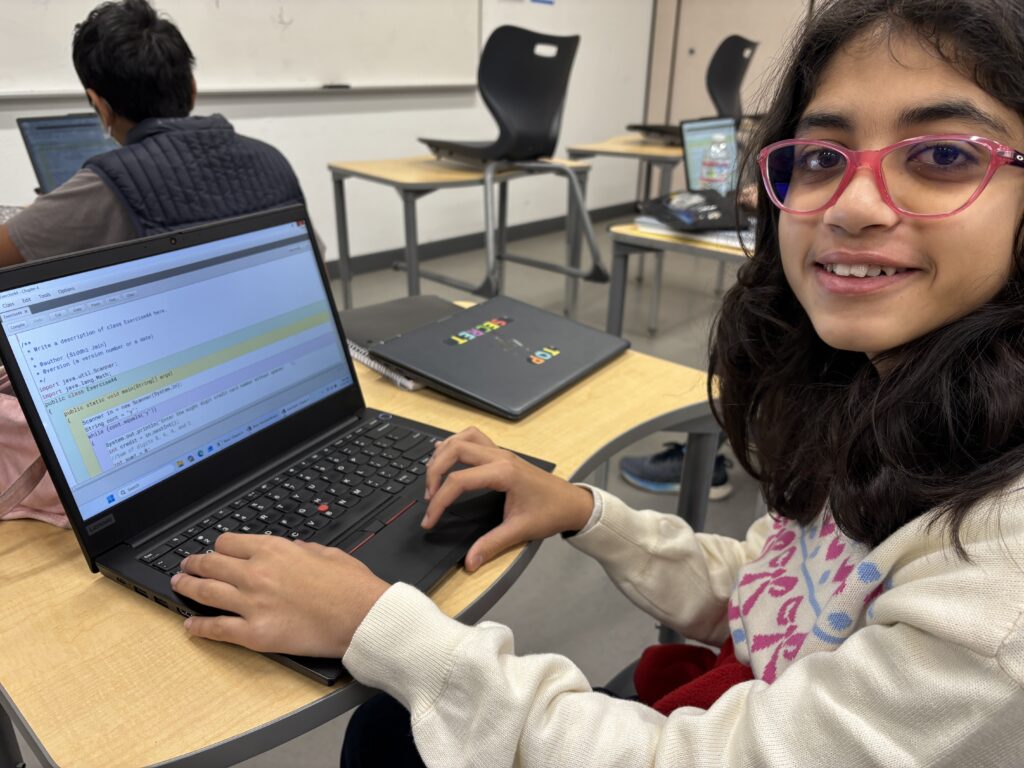
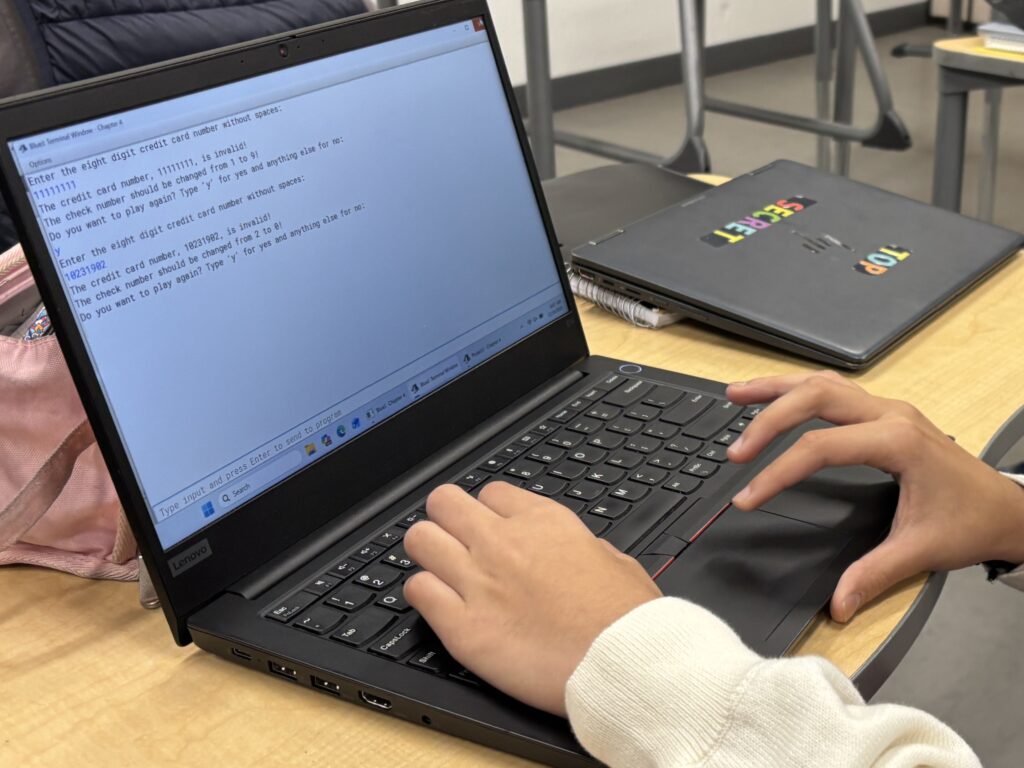
Siddhi starts her day early—before most students arrive on campus. Computer Science & Programming is an elective course that teaches Java, introducing students to the Java development cycle, object-orientation, and control structures. Students work with primitive data types, operators, and data structures such as arrays and lists, with a strong emphasis on the problem-solving aspects of programming.
Today, students are finishing individual coding projects, using Java to write a program that calculates loan payment amounts and payment durations. “I really like computer science, so I thought it was worth it to wake up a bit early and participate in programming,” Siddhi explains. “Principles is more focused on exactly how computers work and different components—the CPU, binary, that stuff. Programming is more focused on the actual Java–loops and different things to get code done. And that’s more interesting to me.”
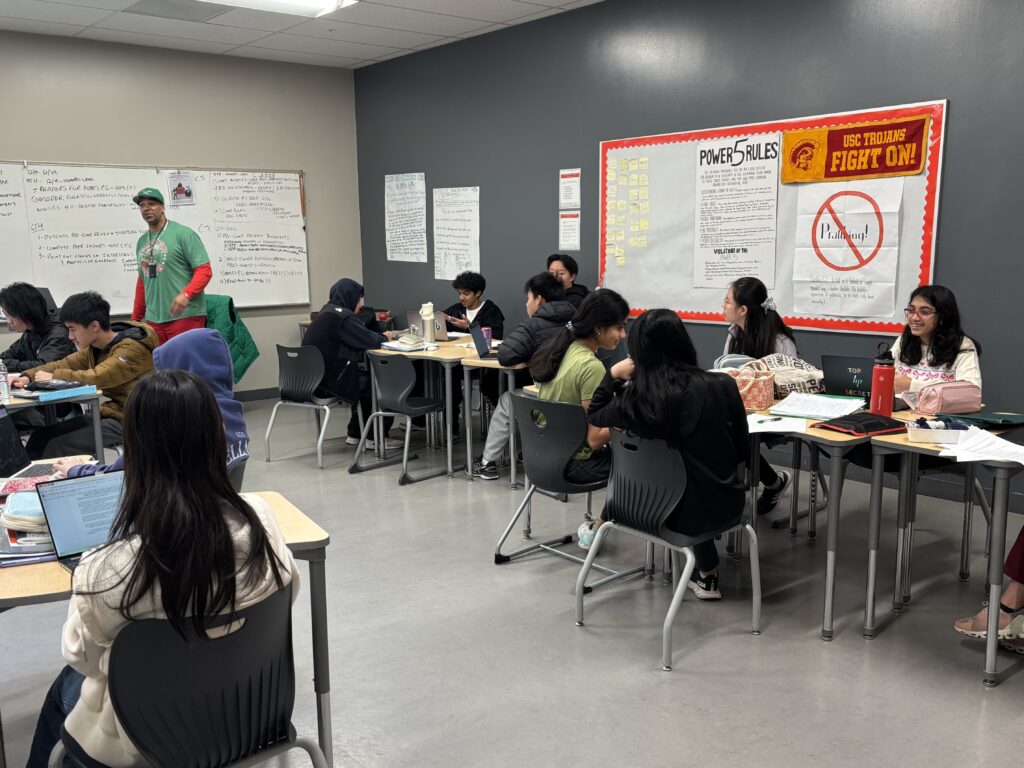
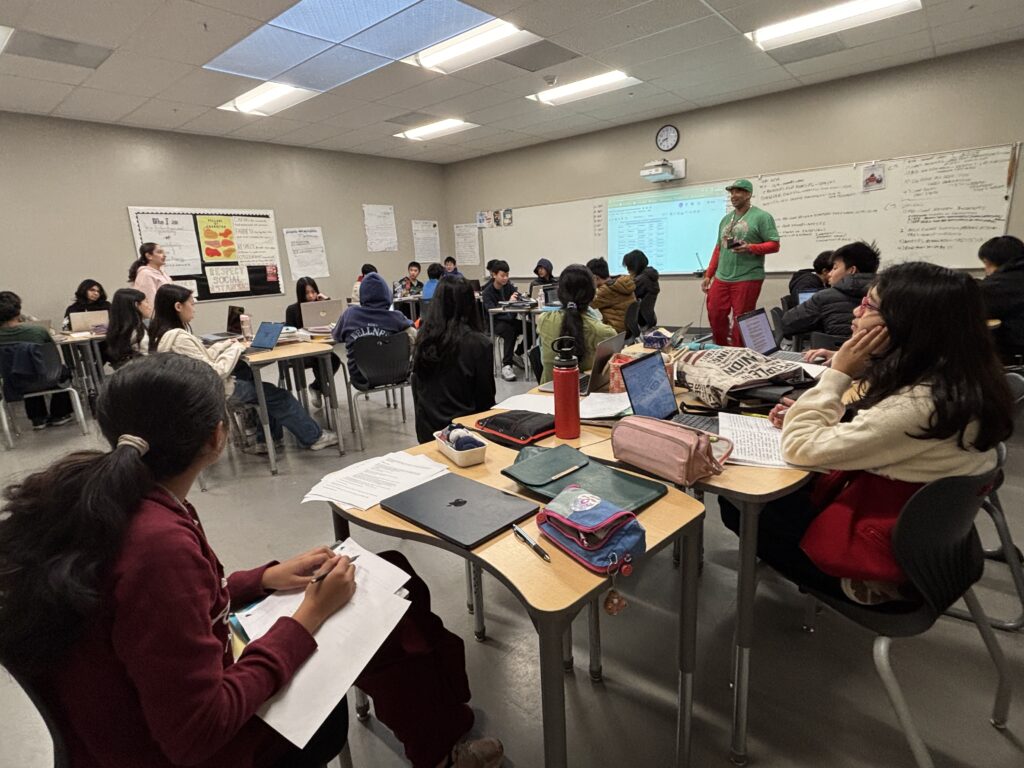
Period 1 (8:25-9:10): Honors English Language & Composition with Mr. Gailliard
Honors English Language & Composition provides an introduction to rhetoric, research, and composition. Students analyze nonfiction texts, develop evidence-based analytical and argumentative writing, and learn to evaluate and cite sources. The course deepens understanding of how communicators make choices based on rhetorical situation and audience.
Today, students split into teams to research and debate: Is AI Beneficial in Education? After researching in groups, teams face off with opposing arguments, delivering opening statements, rebuttals, and closing arguments. At the end, the class votes on which group successfully swayed their opinion—rhetoric and persuasion in action.

Academic Enrichment (9:15-9:25)
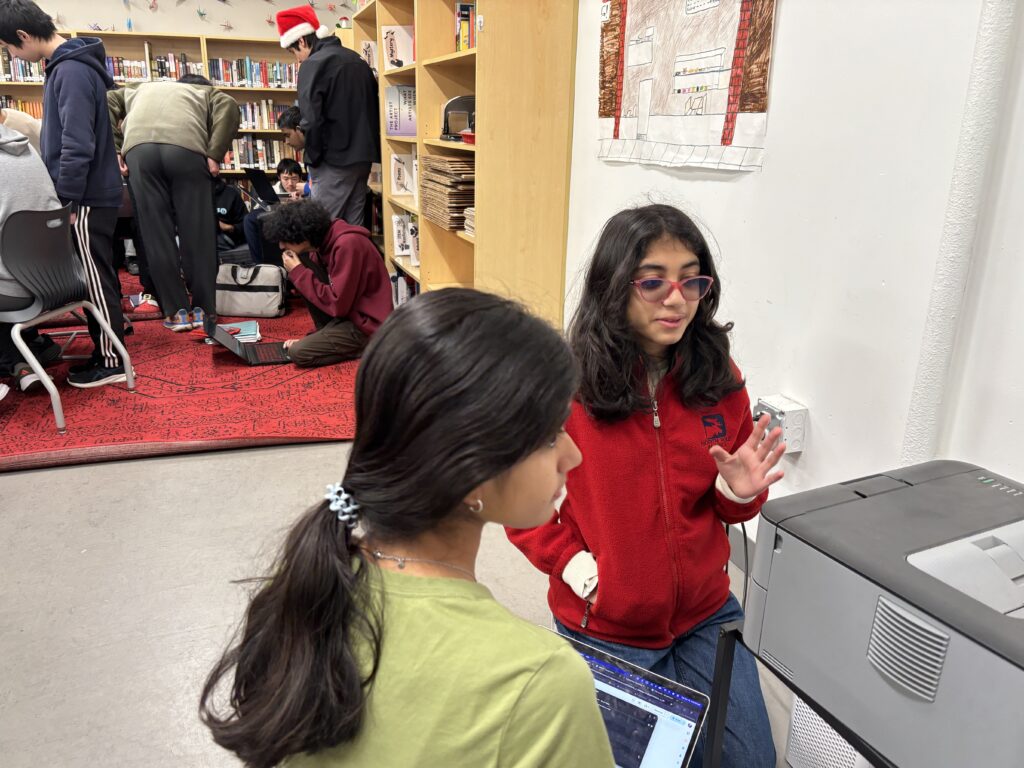
Siddhi and a classmate head to the student library to catch up on work and print materials for their next class. This brief period gives students flexibility to prepare for their day however they need.
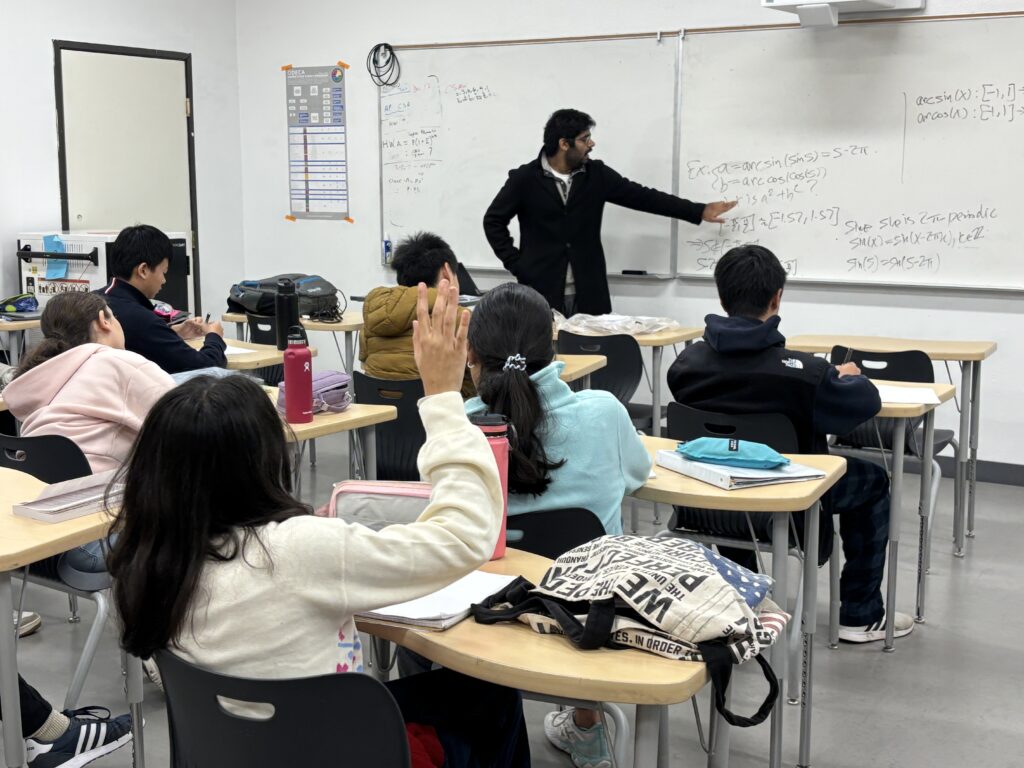
Period 2 (9:30-10:15): Pre-Calculus AB with Mr. Sharma
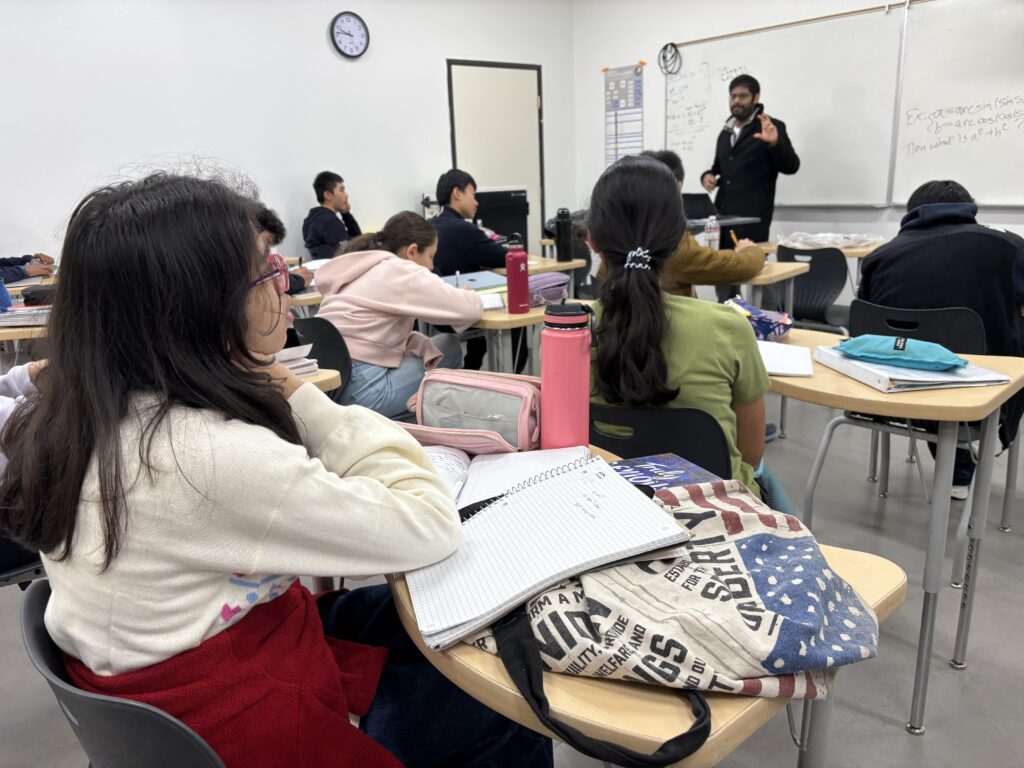
Pre-Calculus provides in-depth coverage of major functions, including polynomial, exponential, and trigonometric functions, before moving into matrices, discrete mathematics, and statistics. The course concludes with an introduction to calculus concepts—limits, derivatives, and integrals.
Today, students review for their upcoming Pre-Comprehensive Exams, going over questions and topics from a recent practice exam. They work through problems involving properties of inverse trigonometric functions, domain, and range. Another example has students applying trigonometric identities—including product-to-sum formulas—to simplify expressions in order to find an upper bound, then solving trigonometric equations. It’s a focused preparation for the assessments that measure student progress throughout the year.
Period 3 (10:20-11:05): AP Physics 1 with Dr. Dixit
AP Physics 1 is an algebra-based, introductory college-level physics course where students explore kinematics, dynamics, circular motion and gravitation, energy, momentum, simple harmonic motion, torque and rotational motion, electric charge and force, DC circuits, and mechanical waves and sound through inquiry-based investigations.
Today is test day—students demonstrate their understanding of energy, work, and power. “Dr. Dixit and AP Physics are my favorite,” Siddhi says. “She’s really fun, and she makes sure everybody has everything and is up to speed.”
Period 4 (11:10-11:55): AP Environmental Science with Ms. Covert
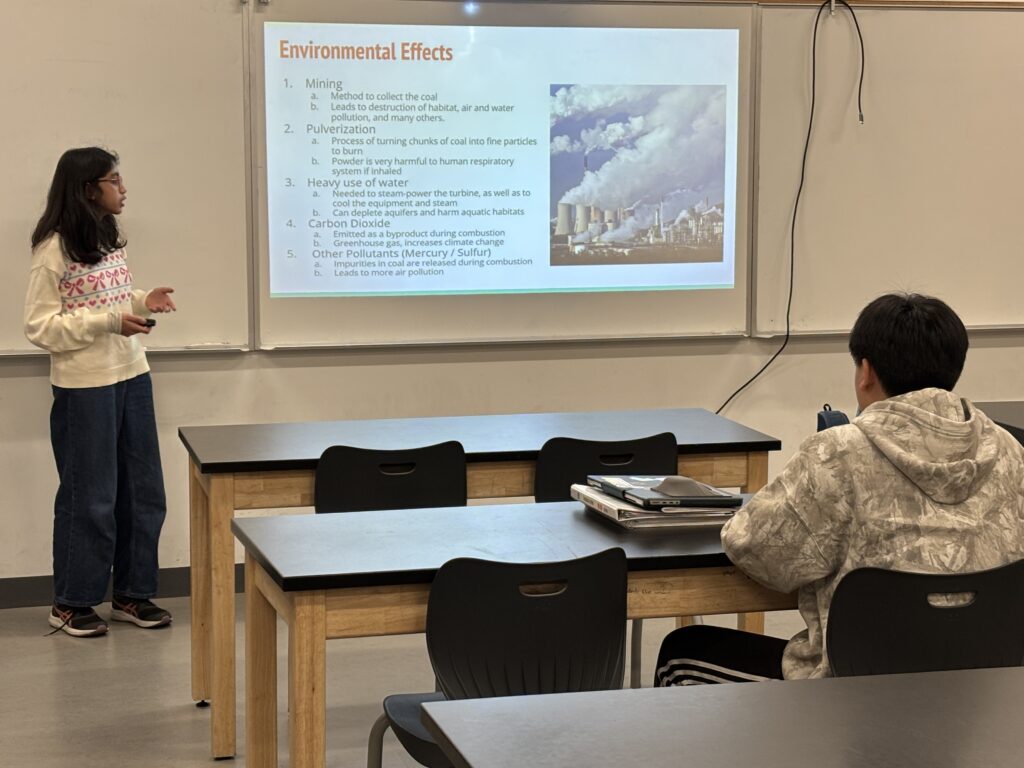
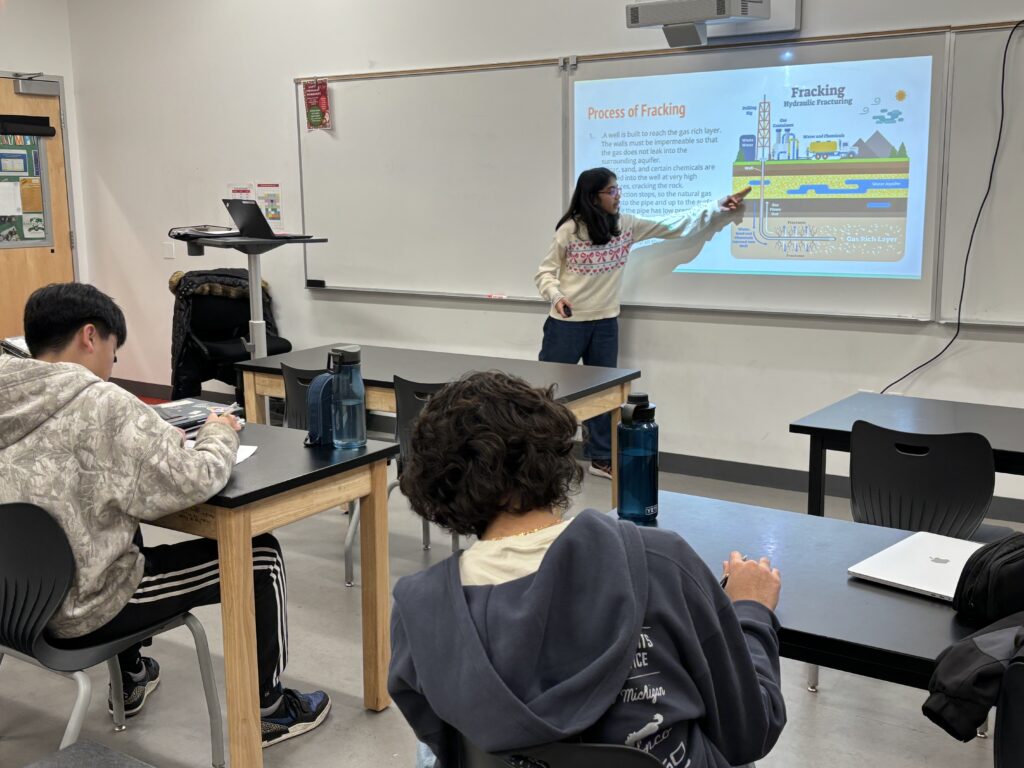
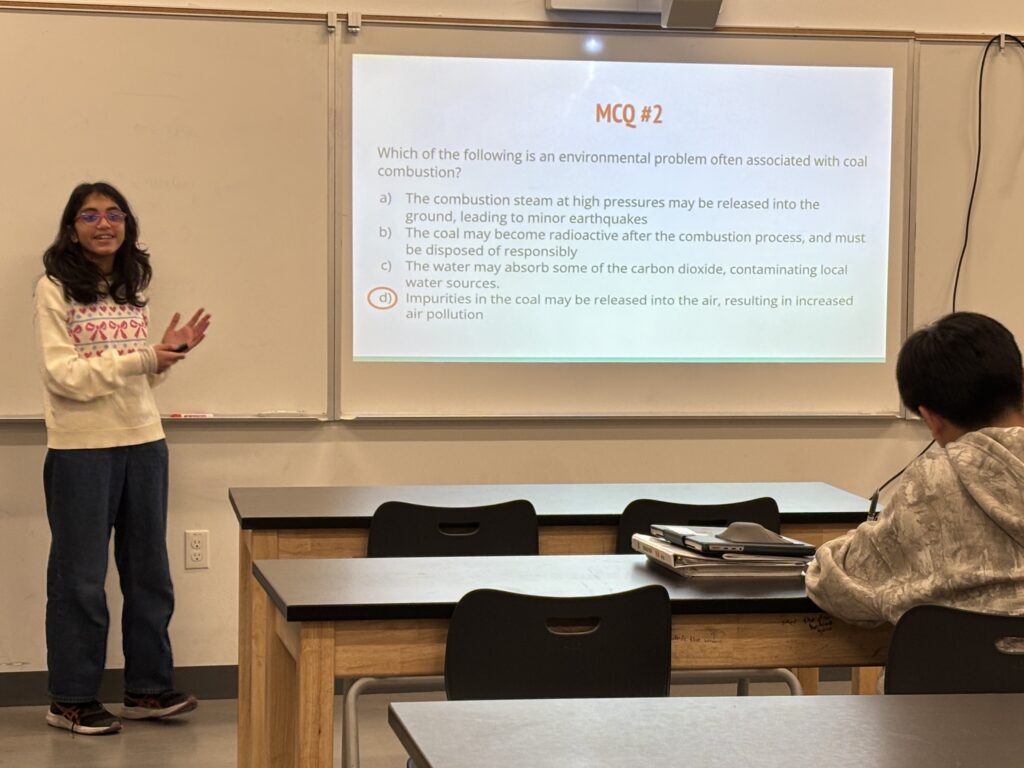
AP Environmental Science cultivates an understanding of the interrelationships of the natural world through inquiry-based lab investigations and fieldwork. Students explore energy transfer, interactions between earth systems, interactions between species and the environment, and sustainability.
Today, students become teachers. Each student researches one section from the current unit and teaches it to their classmates. Siddhi presents on fossil fuels, diving deep into the topic before sharing her expertise. “It was really fun. Teaching your classmates—you also get to research really in-depth on certain topics, so it feels like you’re really smart and you know a lot. Teaching is fun.”
Period 5 (12:00-12:45): Lunch
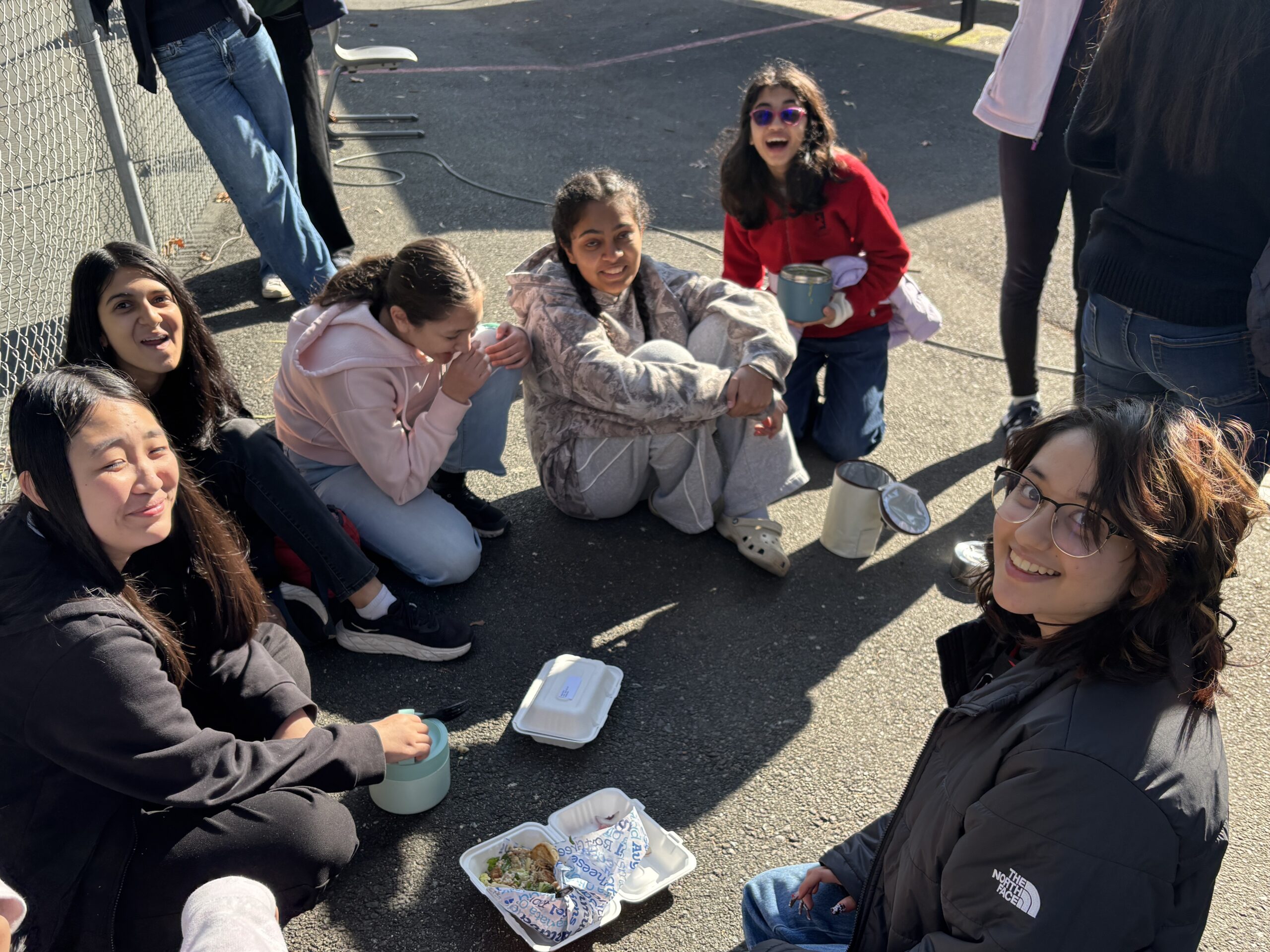
Siddhi eats her packed lunch and chats with friends—a chance to recharge before afternoon classes.
Period 6 (12:50-1:35): Honors English Literature & Composition with Mr. Bradshaw
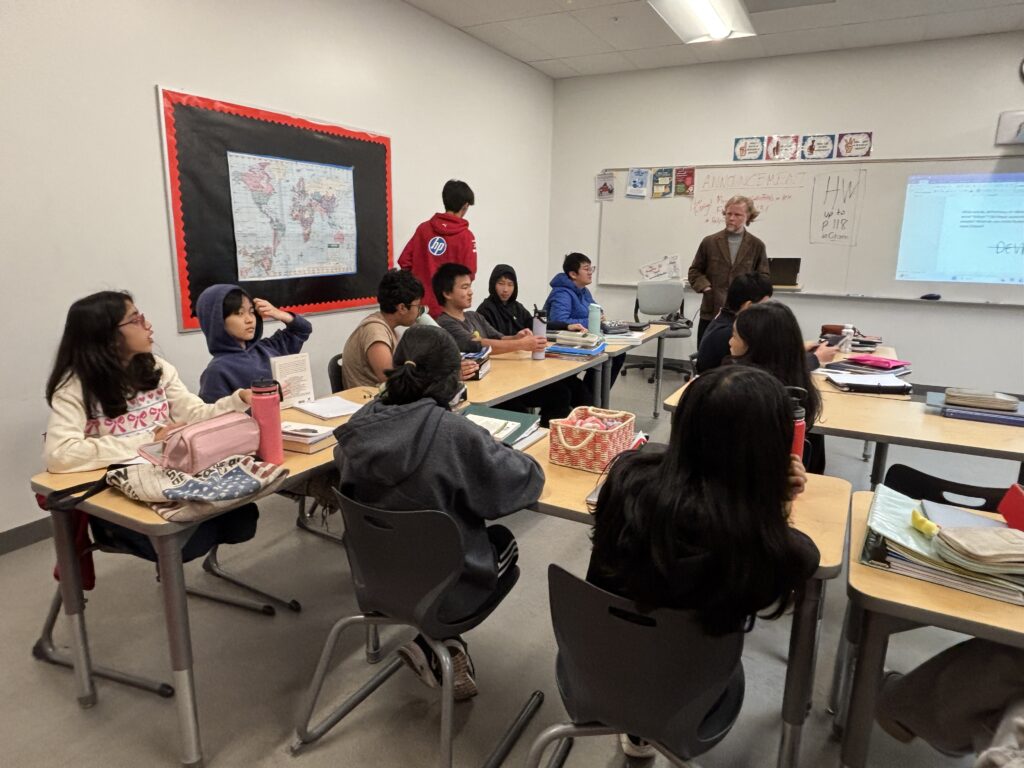
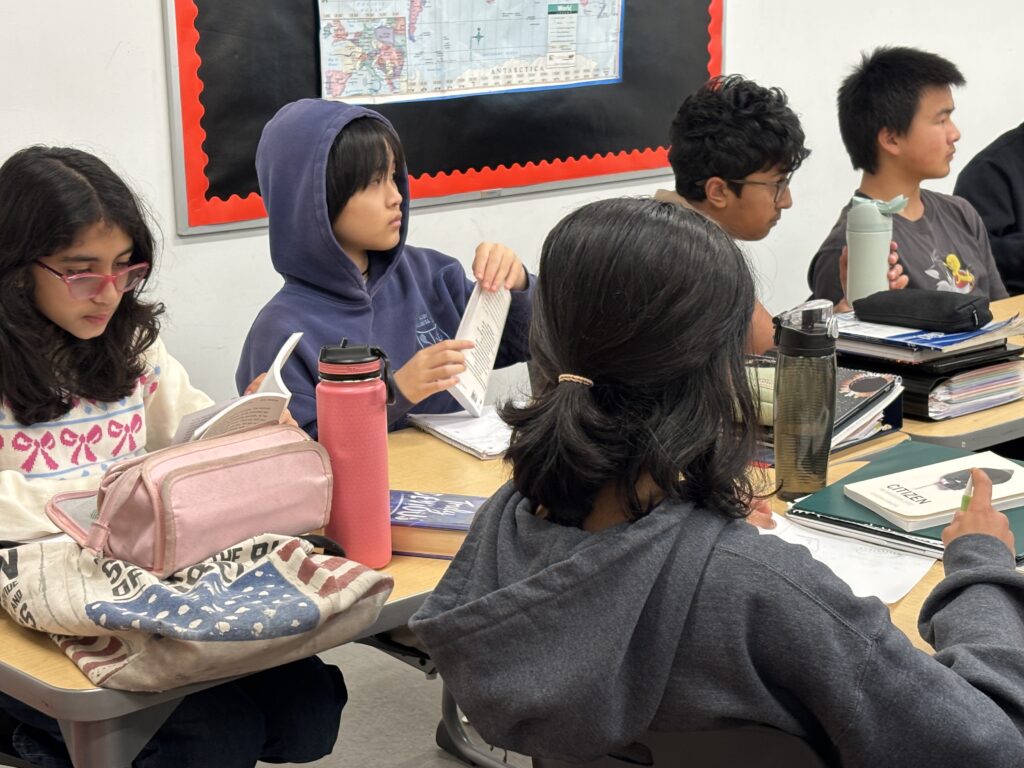
Honors English Literature & Composition prepares students for AP English Literature. Students analyze various literary forms—short stories, poetry, plays, novels, and nonfiction—assessing character, setting, structure, narration, figurative language, and historical context.
Students are reading “Citizen,” by American poet Claudia Rankine. Class begins with a discussion of words and ideas they associate with the term “citizen” and how these associations align with particular groups. They explore Rankine’s intention in titling the work, then tackle a writing prompt: “How does ‘Citizen’ relate to ongoing debates about race and policing?” Literature meets contemporary social issues.

Period 7 (1:40-2:25): AP U.S. Government & Politics with Mr. Loero
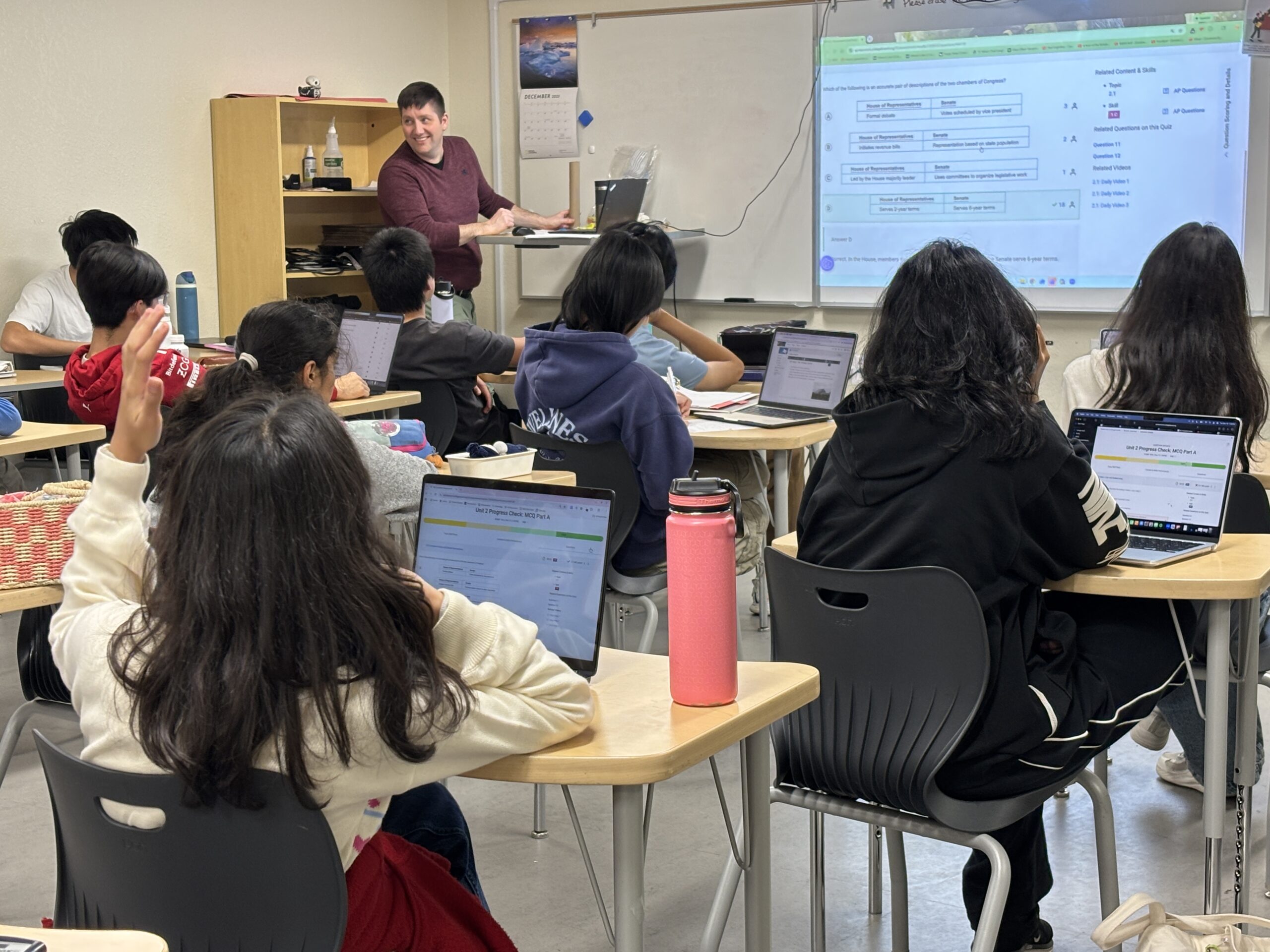
AP U.S. Government & Politics provides a college-level, nonpartisan introduction to key political concepts, institutions, policies, and behaviors that characterize the U.S. constitutional system. Students study foundational documents, Supreme Court decisions, and other texts to understand relationships among political institutions and processes.
Today’s unit review covers the relationship between the president and Congress, the descriptions and powers of the two chambers, and the constitutional responsibilities of the House and Senate.
With three AP classes and two honors courses, Siddhi has learned to manage the workload. “It’s slightly more difficult, but the teachers usually stagger things. Most of the homework I’m used to being due the next day, but now most of it’s long-term, or at least due a week later. So you have more time to organize things out and plan to get everything done.”
Period 8 (2:30-3:15): Spanish II with Mr. Sanders
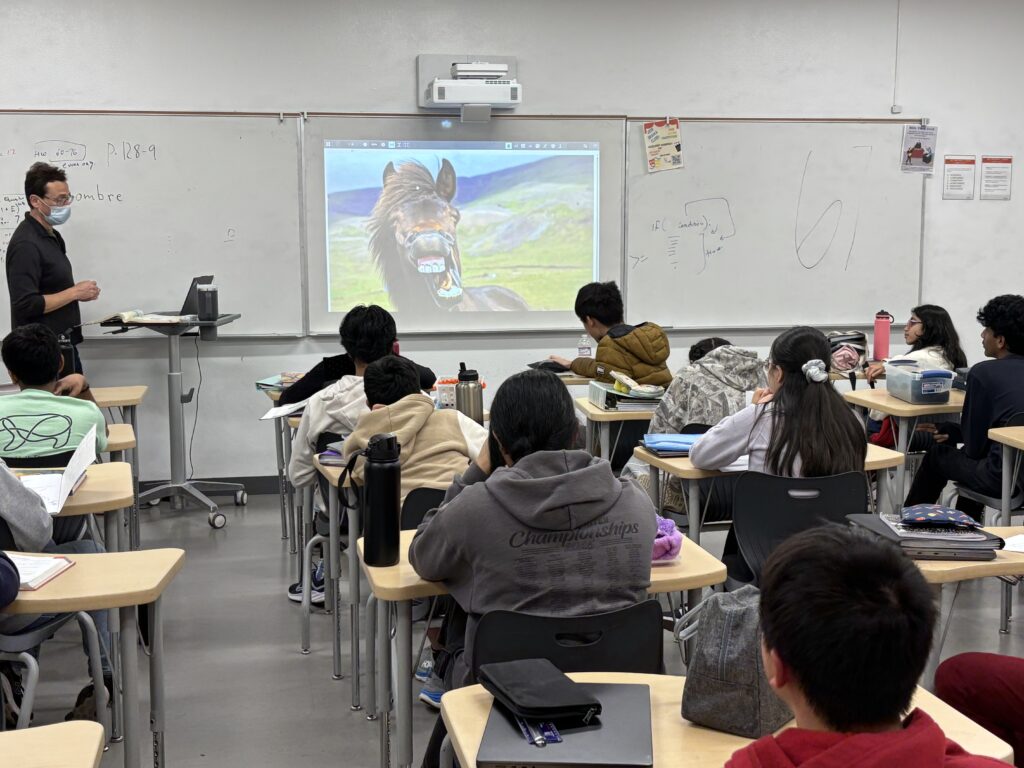
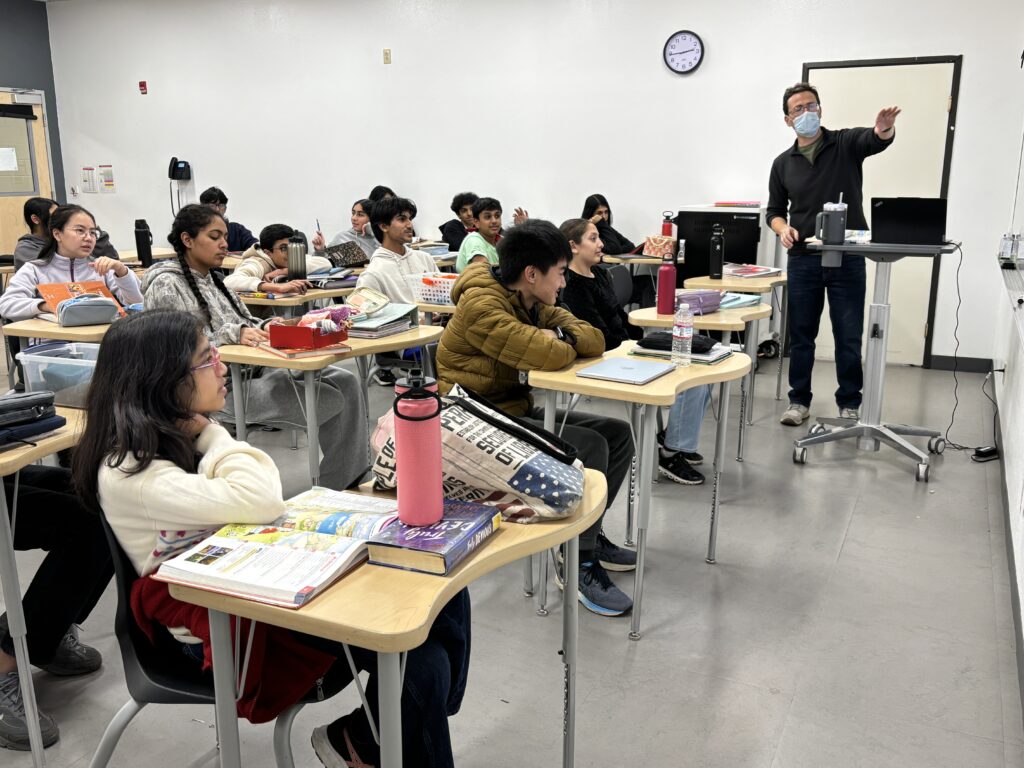
Spanish II builds on skills from the previous year, developing mastery in listening, speaking, reading, and writing. Students expand vocabulary and grammar while exploring Hispanic cultures, geography, and history through authentic resources, including literary works, audio recordings, videos, songs, and articles.
Today, students submit photos displayed on the whiteboard, then practice describing what each depicts to the class—working on vocabulary and pronunciation. Depending on the photos chosen, some silliness and giggles follow. Language learning doesn’t have to be serious all the time.
Office Hours (3:20-4:00)
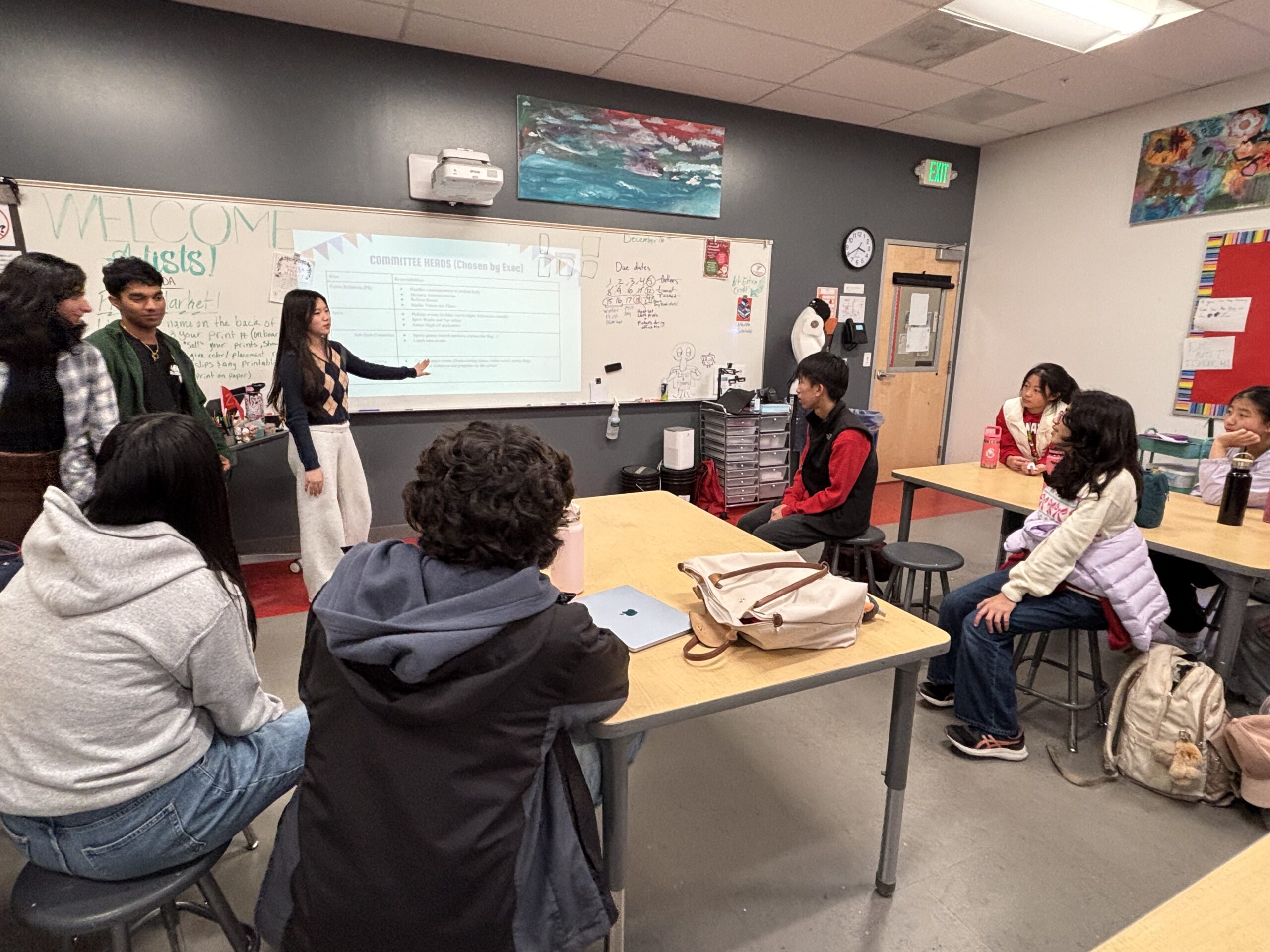
Today, Siddhi uses Office Hours to attend a Student Council meeting, where members advocate for their peers and organize meaningful campus events. The agenda includes preparing materials for an upcoming school holiday celebration and reviewing committee head elections.
Most days, though, Siddhi uses this time strategically. “I normally spend them doing tasks that don’t require textbooks, because I prefer to finish those and then just leave my notebooks in my locker. So I prefer to do the small assignments during Office Hours and the longer ones at home. I used to spend them in Dr. Dixit’s class because that was the class that I needed the most help in.”
After School: Leadership and Competition
Siddhi’s involvement extends beyond Student Council. In Speech Club, she practices as an impromptu speaker and competes in tournaments with a team she describes as “excessively spirited.” The Math Club focuses on preparing for competitions and sharpening problem-solving skills in collaborative settings.
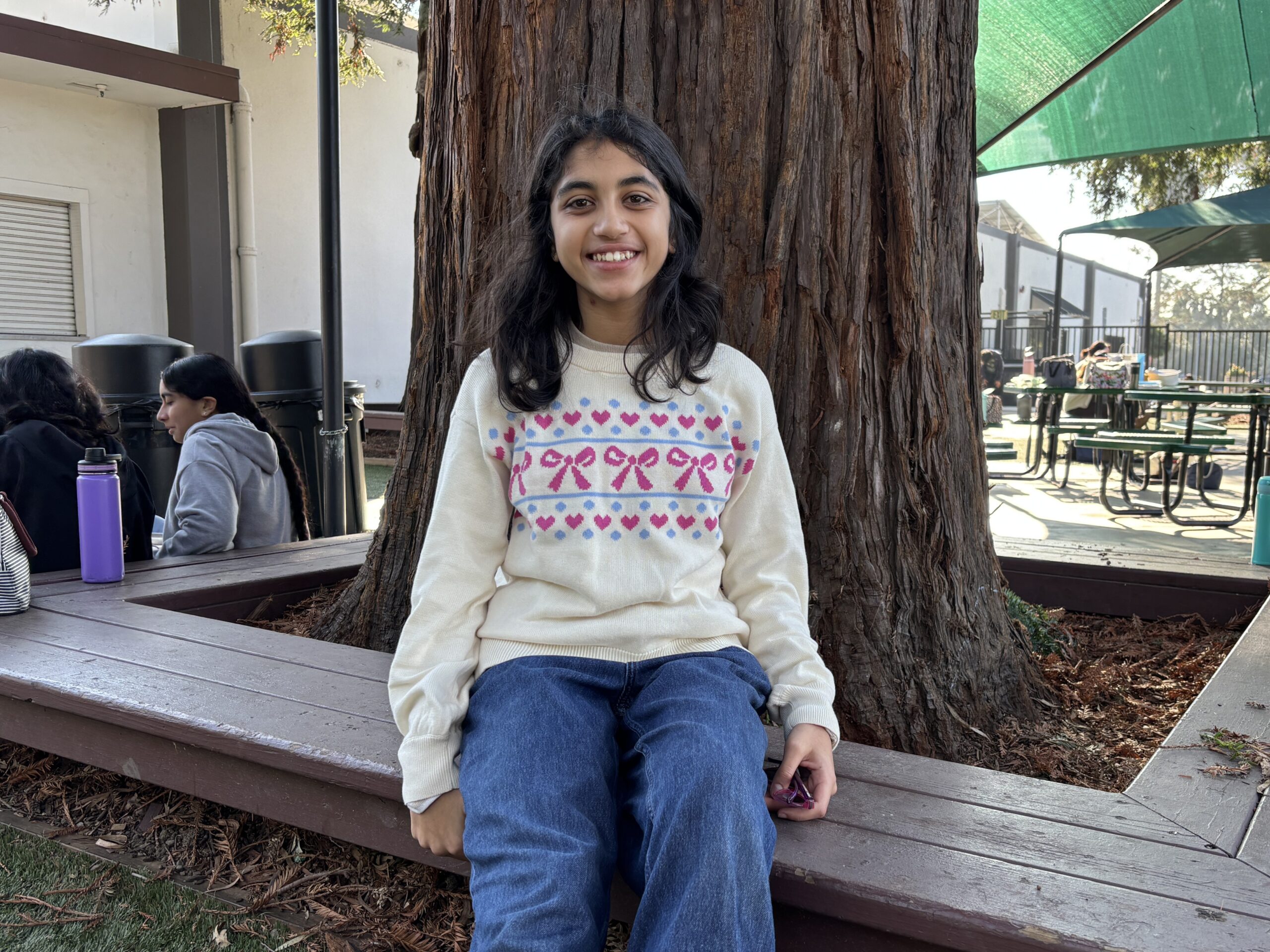
From AP Physics to English Literature, from teaching her peers about fossil fuels to competing in speech tournaments, Siddhi’s first year at BASIS Independent Fremont showcases what’s possible when students transfer into a supportive academic community. The coursework is demanding, yes—but the teachers are helpful, the community is welcoming, and the skills students develop extend far beyond any single subject.
As Siddhi discovered, stepping into BASIS Independent Schools’ academically rigorous environment was far less overwhelming than she’d anticipated. With organization, engaged teachers, and a close-knit community, grade 9 at BASIS Independent Schools isn’t about surviving—it’s about thriving.
BASIS Independent Dublin is a Grades 6 – 12 private school, providing students with an internationally benchmarked liberal arts and sciences curriculum, with advanced STEM offerings. Considering joining the BASIS Independent Dublin community? To join our interest list for the next school year and receive admissions updates and more, please click here.