
Week 9: Data, Data, and more Data
May 15, 2026
Hello everyone! For this week’s updates, I’ll just be sharing some of the data I’ve collected and plots I’ve created, as well as talking about heterogeneity and what the implications of it are for my specific study. Firstly, heterogeneity in meta-analyses refers to the variability in study outcomes beyond what is expected from sampling error alone. It signifies that studies differ in populations, interventions, or designs, affecting how results are combined. My studies are from all around the globe and have slightly different study designs, so it would makes sense that my heterogeneity would be extremely high (the ideal value for heterogeneity/I2 is 50-75%). Last week, I ended with a heterogeneity of around 99%, which was way too high, causing my HR to not really be significant. After reflecting, I found the heterogeneity to be largely affected by a few Mendelian Randomization (MR) studies that I decided to include in my sample.
MR studies are epidemiological analyses that use genetic variants as instrumental variables to determine if a specific risk factor (exposure) causes a health outcome. Essentially, they don’t use real cases to measure occurrence, but rather assign occurrence (at conception) to model what a population would be like. In the end, I decided not to include them in my final HR value calculation (which I believe is statistically justified, and I will explain more about this in my paper) because they overstate the occurrence of schizophrenia (when compared to actual cases in a real population).
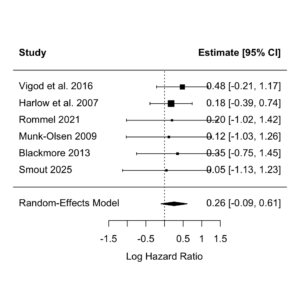
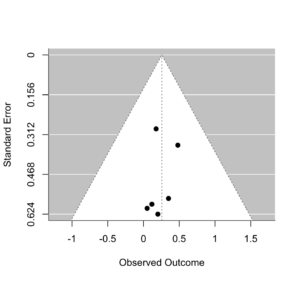
To illustrate some of my findings for the Schizophrenia (SZ) to Postpartum Disorders (PPD) directionality, which ultimately produced an HR ≈ 1.29–1.71, depending on what studies were included after leave-out sensitivity analysis. This indicates that schizophrenia precipitates a 29-71% higher risk of postpartum disorders. This result may seem lackluster because of the huge range, but the reason for this is due to one study in particular, Hippman 2025, which had a large HR value of 41.31 and accounts for most of the heterogeneity because it is an outlier, and most of the other studies are in agreement with their HR values. However, the result does not reach conventional significance (p-val < .0001 in any model, primarily due to small k and one highly influential outlier whose inclusion substantially changes the estimate. The 95% prediction interval also ranged from HR = 0.49 to HR = 5.99, indicating that while the average effect was positive, considerable variability exists in the true effect across settings, consistent with the high between-study heterogeneity observed (I² = 72.46%).
To sum it up, there is evidence of a positive association between SZ and PPD (in that directionality), but the application is much more nuanced. Due to the nature of schizophrenia and how different contexts apply diagnoses and treat postpartum disorders, the effect of SZ on postpartum illness is genuinely heterogeneous across real-world contexts, meaning there is not one universal risk ratio that can be assumed for everyone. I’ll talk more about the final write-up and the other directionality in the next blog post, since this one is already quite lengthy.
Till next time,
Yalini Kathamuthu
Leave a Reply
You must be logged in to post a comment.