
Refining Snow Depth Detection: Enhancing Accuracy with Advanced Image Processing | Week 3 | Shashwath Senthil
March 15, 2025
Hello all, and welcome to my Week 3 update on my senior project!
This week, I focused on refining my image processing pipeline to improve snow depth detection accuracy and extract more meaningful data from the images collected at our Colorado site. Specifically, I implemented a more robust line detection method using the Line Segment Detector (LSD) and the Probabilistic Hough Line Transform to improve snow reference marker identification.
To begin, I used the LSD algorithm to detect line segments in the images. By converting images to grayscale and applying this detection method, I was able to highlight potential snow depth markers more effectively than in my previous attempts. However, some inconsistencies in detection remained, especially in images with poor contrast due to lighting conditions or partial obstructions.
To address this, I implemented a secondary processing step using the Probabilistic Hough Line Transform. After applying Canny edge detection, this technique allowed me to refine the detected lines and ensure that only the most relevant ones were considered for analysis. This significantly improved my ability to extract snow depth information from the images.
Once the relevant lines were detected, I cropped the images to isolate the snow reference markers. Using predefined pixel values derived from red-intensity data, I defined a cropping function that removed unnecessary portions of the images while retaining the key areas of interest. This step not only streamlined the analysis but also reduced potential sources of error in subsequent computations.
After refining the image processing steps, I developed a method to count red pixels in the cropped images. Since the snow reference markers are designed with red indicators, this allowed me to quantify the number of red pixels and estimate the snow depth with greater accuracy. The computed red pixel count was then used to generate an alpha value, providing a standardized metric for comparison across different images.
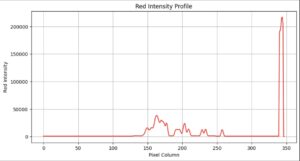
To better visualize the red intensity variations across the images, I created red intensity profiles by summing the red channel values for each column in the processed images. Plotting these values helped identify potential inconsistencies in snow reference marker detection and provided insights into snow accumulation trends at different burn severity levels.
Next steps include further optimizing the detection algorithms, refining the red pixel extraction technique, and integrating this data into a predictive model for snow retention analysis. Excited to see how these refinements enhance my final results—stay tuned for more updates!

Leave a Reply
You must be logged in to post a comment.