
Week 9: Introducing a Model
May 21, 2025
Welcome back! In this blog, I attempt to introduce nonlinearity into the grating described by Bonod et al. [1]
The Structure
The following is replica of the image used in [1].
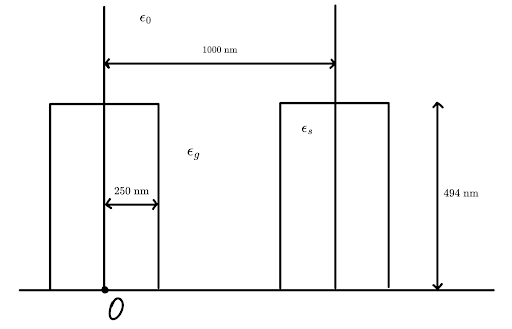
Here we’re modeling gratings that stretch off to infinity in both directions. The distance between the gratings is 1000 nm, with each grating modeled by a rectangle of height 494 nm that extends into the page. There are three materials in play here: the vacuum, substrate, and groove material. These materials are described by the permittivity, each subscripted with the letter 0, s, and g respectively. Each of these values can be found in [1]. There are three regions: a semi-infinite layer of vacuum, a layer of groove material with thickness 494 nm, and a semi-infinite bottom layer of substrate material. The groove layer contains the rectangles made of substrate material. We use p-polarized light (refer to Week 4 for definition of p-polarization).
In the next blog, I’ll demonstrate how I used S4 to construct this system and how the results compared with those on the paper. Look forward to it!
[1] N. Bonod, E. Popov, M. Nevière. Fourier factorization of nonlinear Maxwell equations in periodic media: application to the optical Kerr effect. Optics Communications, 2005, 244, pp.389-398. ⟨hal-00015523⟩
Leave a Reply
You must be logged in to post a comment.