
Week 3: Niche Analysis with Paneling and Manga Practice
March 18, 2026
Hello again! It is Week 3.
This week, in order to reduce workload compared to Week 1, I decided instead to only analyze 3 works from the niche category. This decision was made, primarily because of the heavy workload from the 5 works in Week 1, and in order to avoid burning out, I decided to reduce it down to 3. These three works were The Summer You Were There by Yuama, Rainbows After Storms by Ruka Kobachi, and Mietemasu yo! Aizawa-san (I See You, Aizawa-san!) by Odoroo Doroshii (Odoroo Dorothy).
However, overall it was not just the workload that was the deciding factor. In fact, that was one of the secondary reasons. The biggest one was that I had trouble identifying niche works that had an extensive author/artist interview. The author or artist interview is a very important part of my analysis in order to complete and round out my thoughts of the work. Without it, I feel a little more lost on what the artist is trying to convey. I do not believe this reduction from 5 to 3 made a significant change on what I was trying to get out of this category. Mostly, it was to see what smaller artists were doing as well as how less discovered works were pushing the frontier of the genre.
Art tends to be something that is a little more slow-moving in terms of changes. Much of the niche works I found were somewhat similar to the popular ones. They often shared similar art styles or drew inspiration from popular works. However, many artistic techniques or unique habits that the artists have, such as specific rendering or halftones, I felt were very cool and worth looking at. I don’t believe the nicheness of these works affected the quality of the work, and instead only introduced new ideas that have not yet become mainstream.
On a different note, I noticed that displaying my work in the previous blog received much appreciation and attention. As such, I will continue to share my works as I create them. This way, you all can experience my art progression, as I continue to work on improving my art.
This week, since I was mostly spending time on analysis, I was only able to complete one set of 2 panels. However these are, in my opinion, detailed and large panels. Specifically, not only was I playing around with paneling, but I was also trying to incorporate specific manga techniques, especially in shadows and texturing. Once you take a look at the art, it should become quite obvious what I mean. I did not really focus on creating a cohesive plot, and mostly threw the reader into one very short snippet of a scene, mostly because I really was only able to capture one moment in the limited 2 panels I had.
However, even without the relevant context, a careful choice of plot, nor a deliberate thought in creating the perfect dialogue, I believe it is a good demonstration of my practice in more manga-specific styles. Also this was quite quickly done again. Even I will say, I did not plan the anatomy so I have not spent a huge amount of time ensuring everything is correct. However, a lot of this is stylistic intuition and often manga does not have true human anatomy anyways. Without further ado, here is my panel below!
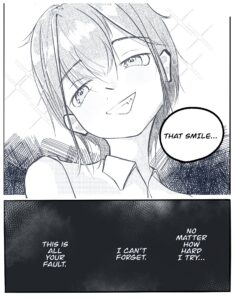
I apologize if the quality has been messed up by the automatic compression. That makes it quite hard to see the intricacies of the style. I have tried my best to enlarge the image for viewing. However, it is not perfect, so I will provide some guidance. Hopefully allowing you to be able to notice the details
Firstly, and probably my favorite detail, the halftones and shadows used are actually dotted. The shadows can be seen especially lightly on the skin, the clothing, the neck, the face and parts of the hair, especially towards the bottom behind the neck. The hair itself also uses a different, dotted halftone that is quite similar to the shadow but is more uniform. This is mainly used to color the hair rather than for shadowing purposes. The crosshatching of the background shadow is still quite visible despite the compression, but I thought I should also talk about it since it is also quite used in manga works. The sparkles were added mostly on a whim but I felt they work quite well here to create a dreamier feel.
The second panel contains far less overall visual detail, however I did not slack on this one either. Firstly, there are soft faded white sections in the darkness. If you look closely, you may notice that these white sections, are not just cloudy, but also have very fine small repeating scratchy grids, especially visible in the top left of the panel and the top middle. Again this was to create a somewhat dreamlike or thoughtful feel, yet also darker, more tense, as well as have a little bit of that scratchy texture from the white.
If anyone is interested in seeing these details as they are intended, please feel free to reach out. I am always willing to send any of the original files to enthusiasts.
Reader Interactions
Comments
Leave a Reply
You must be logged in to post a comment.
I’ll be curious if you find anything different about the niche pieces/interviews. Is there anything that stands out that makes these pieces more “niche” or that helps to define why the authors did what they did.
As for the artwork, it’s an interesting piece and very different from what you posted last week. This one seems a lot more purposeful, and the background textures are standing out a lot as potentially part of the meaning or intent.
I’ve seen these “blacked out” boxes before in manga and comics and I understand that they are meant to convey a darkened sense of emotion. I’m wondering how you personally feel about this style. Is it a trope? Something that people just expect? Could these emotions be conveyed in a different way? Just some thoughts.
Hey Leo! Great blog post as always. I’m wondering: how exactly do you define “niche”? Does it have to do with number of views or likes a particular work has or is it more subjective? In other words, what’s the line between popular and niche?
Hi Rinisha!
To answer your question, simply speaking, niche is just something that is not as widely known. To provide a bit of perspective, the most popular works can have different degrees of popularity. Some works may have very large dedicated and consistent viewers but be rather obscure outside that fanbase. However, others may be very recognizable to a large amount of manga enjoyer, but not have as many consistent viewers.
Using this metric, I defined niche more as a work that have not received as wide of a reach, and yet does not lack in the consistency, engagement or quality of the fanbase. This leads to works that are different, or do not contain many cliche dynamics, and yet are still of high quality and are still valuable to analyze.