
Week 1: Straight Into the Fray
March 22, 2026
Welcome back everyone! While I’ve been waiting for responses for any potential on-site placements (fingers-crossed!), I’ve jumped into starting the quantitative research portion of my project. And right off the bat, one of the issues I was expecting to happen came through immediately: since these are private companies, and because the titles I am looking at are pre-2010 and Japanese, the custom to publish fiscal data regarding a specific game isn’t really available online at the moment. So, I opted to leave this issue for next week, when I can decide the best way to approach the budget. Instead, I gathered other data, like initial release windows, initial sales metrics, gross revenue, and developer statements.
Out of these, gross revenue is the most interesting statistic, as it, like the budget, is not publically released data, though it is easier to surmise. This was a matter of estimating lifetime sales data using estimates across various platforms (like SteamDB or other aggregate sources) and applying a multiplier based on the various versions of the game available at different price points. Reading through a new article I found (https://generalistprogrammer.com/tutorials/game-development-cost-analysis-complete-budget-guide-2025) by the GeneralistProgrammer, as well as Richard Harris’s “Game Development Process: Mastering the Art of Game Creation“, I was able to learn more about the work and effort behind the creation of a game title. I also managed to read a little bit of the paper (https://doi.org/10.1016/j.teler.2023.100100) on the Video Game Industry as a business venture, which gave me some insight on the economic prospects of the creation (and by extension, recreation) of a video game.
And, my efforts did come to fruition: I did find out some fiscal data with effort and a little bit of digging. The most interesting case I’ve encountered is actually that of Persona 3 Reload‘s lifetime sales data. For context, companies typically don’t publish their sales statistics (it would be bad for business), but these companies (specifically Japanese companies) do occasionally hold public press conferences and board meetings to discuss investment prospects to shareholders, often releasing the slideshow online later. What was so interesting about the one I looked at (SEGA Sammy Management Meeting 2025) is that the producers of this slideshow actually made a formatting blunder that became useful for this project. In an archived version of the document (which you can view here [page 25]), it’s actually possible to highlight the grey box and copy and paste the sales data for SEGA’s data for certain titles since the fiscal year of 2023. This document inadvertently reveals that Persona 3 Reload has a staggering 2.07 million copies sold in its lifetime.
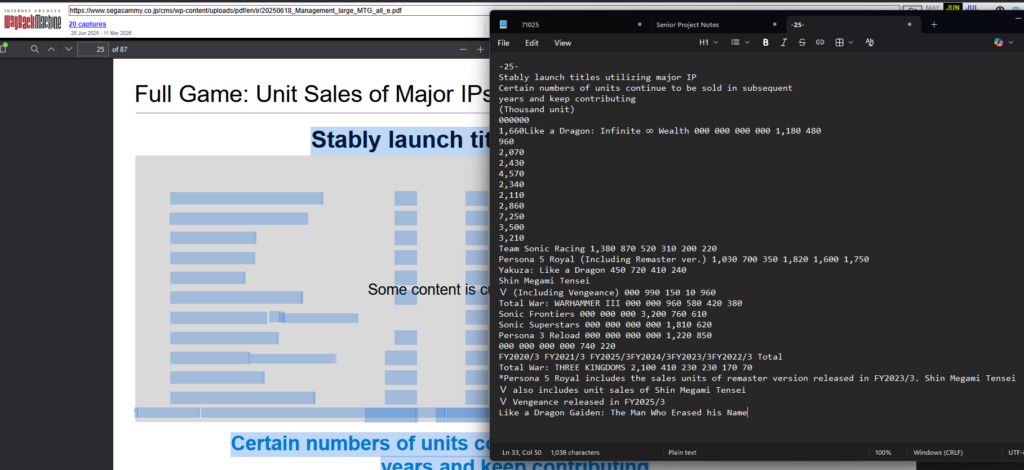
Anyways, I have now compiled the necessary data aside from the estimated budgets for each game, which I will continue to work on into Week 2. Luckily, I have been reaching out to several individuals and organizations regarding an on-site placement, and I will be updating status as soon as possible! I’ve also begun to draft up some polls to distribute for the qualitative side of my project in preparation for next week.
Thanks for keeping up, and I’ll see you again next week!
Reader Interactions
Comments
Leave a Reply
You must be logged in to post a comment.
This seems really interesting and I hope you find an on-site placement soon. By the way, where do you think you might be able to find the data that you’re looking for?
Hello, and thank you! I’ve just been scouring the internet for credible sources like milestone announcements to get lower boundaries for sales data, and I’ve also been keeping track of data through various third-party estimation sites and cross-referencing their estimations with my own formulas. Thankfully, the newer game titles I am looking at are more involved with social media and are more prone to releasing information.
Hi Archie,
I thought your research process and decision to analyze gross revenue were justified and creative. How do you plan on validating these statistics? And how do you plan to address limitations, including privatized fiscal data? I look forward to seeing how your project progresses, and good luck with your on-site placement search.
To validate these statistics, a lot of effort has gone into creating a working formula to calculate gross revenue. I don’t have exact numbers, but I can provide a range that is reasonable to assume. For context, I have a working formula of: (Copies Sold * (Base Price*0.65 + Deluxe Price*0.25 + Premium Price* 0.10) * Regional Price Weight * Sales
Let’s dissect this: Most games these days come in various versions, ranging from basic to premium, so I weigh each price point differently based on distribution. Next, I need to account for regional pricing (where product price varies over different regions) and the demographic spread of who purchased the game where. Lastly, Sales is where I take into account when the game gets discounted for events like holidays or general sales. All of this is then multiplied to the copies sold that I either get from official sources or estimations across platforms.
This formula provides me with a general range I can use to estimate the Gross Revenue produced by a given title.