
Week 1: Building Smart, Not Just Fast
February 27, 2026
It’s officially Week 1 of my senior project at SideShift! When you’re sitting in a fast-paced startup environment, the temptation is to immediately open up your code editor and build the biggest, flashiest feature possible. Initially, I wanted to build an all-in-one super-dashboard that did absolutely everything. But after doing my research, I realized that’s exactly how startups waste time, burn through engineering resources, and build things nobody actually wants.
Instead of falling into the over-engineering trap, I spent this week laying down a strategic foundation using the “Build-Measure-Learn” loop from Eric Ries’s Lean Startup methodology. Rather than coding a massive ecosystem right out of the gate, I’m restricting myself to a Minimum Viable Feature (MVF). I want to isolate the single biggest overlapping headache between our creators and brands—which currently looks like campaign deliverable tracking and payout visibility—and build a lightweight version of that first. To measure if it actually works, I won’t just look at button clicks. I’ll be tracking a much more real metric: the reduction in panicked Slack messages and support tickets asking, “When is this content due?” or “Did my payment go through?” If the rollout shows that users love the workflow tools but ignore the analytics, I’ll know exactly where to pivot my engineering hours for the next iteration.
But to confirm I’m building the right MVF, I have to get inside the users’ heads. This week, I designed two distinct interview protocols for the two sides of our marketplace. For the creators, I want to map their exact journey from the moment a campaign is accepted to the second the money hits their bank account, pinpointing every administrative nightmare along the way. For the brands, I’m digging into the bottlenecks that prevent them from scaling up their influencer campaigns. To get past surface-level answers, I’m employing a classic product management trick called the “5 Whys.” If a user says tracking deadlines is hard, I will ask “why” repeatedly until we hit the root cause (which is usually that their data is scattered across several different email threads). I’m also making a highly actionable ask at the end of every call: having them share their screen to show me the (often messy and chaotic) spreadsheets they currently use. Seeing how they duct-tape their workflow together is going to be my best blueprint for my future features.
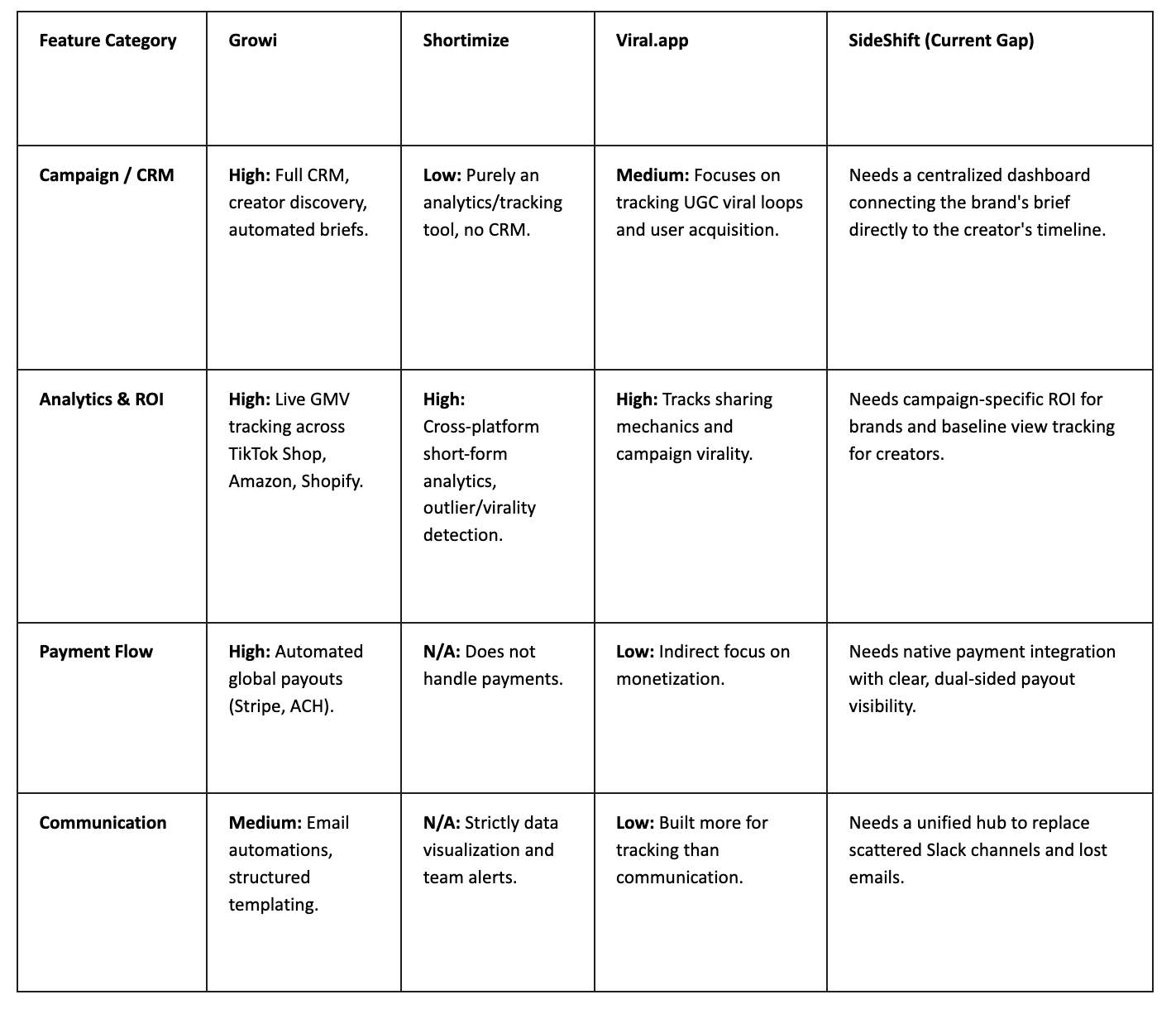
Finally, I couldn’t ignore the competition in the industry. I mapped out a competitive analysis matrix looking at other platforms in the space, like Growi, Shortimize, and Viral.app. While some have incredible analytics or CRM tools, there is a glaring gap in the market for a unified hub that natively connects a brand’s brief directly to a creator’s timeline and payment flow. That gap is exactly where SideShift can win.
With the research framework built and the competitive landscape mapped out, I’m ready to dive into the practical side of my project. Next week, the real fun begins: actually talking to the users.
Reader Interactions
Comments
Leave a Reply
You must be logged in to post a comment.
Hi Neev, I like that you didn’t just jump straight into building something huge and instead took the time to figure out the main points first. Not falling for the over-engineering trap will really help with the progression of your project. I also really like the competitive analysis matrix you put together, as it clearly shows where existing platforms fall short and highlights a real opportunity for SideShift to stand out. Taking the time to map this out before building anything big will really help guide which features matter most moving forward.
Looking forward to hearing about your experience talking with users next week!
Hi Neev! Your approach to building a minimum viable feature at SideShift is super smart and totally avoids the classic over-engineering trap. I love that you are asking to see their messy spreadsheets to find the root problems instead of just guessing what they need. Can’t wait to hear how those user interviews go next week!
What a fantastic start! I love how you approached Week 1 with such a clear strategy, focusing on a Minimum Viable Feature and using the “Build-Measure-Learn” loop. Your detailed user research plan and competitive analysis show a lot of thought and preparation. Excited to see how your conversations with users shape the next steps of your project!
Hi Neev! I’m really inspired by how you lined out your progress and your strategy so effectively. I think I should also start using visual mediums. I’m really enamored by how you humanize technical information for widespread audiences, and I’d like to emulate that!