
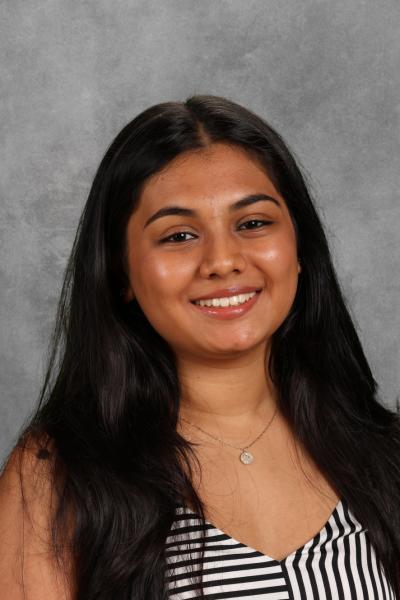
Aanya G. 2026 | BASIS Independent Silicon Valley
- Project Title: Clinical Decision Support LLM in Immunology
- BASIS Independent Advisor: Bhattacharya
- Internship Location: Stanford University
- Onsite Mentor: Dr. Holden T. Maecker, Professor of Microbiology and Immunology at Stanford University
The main goal of this project is to build an interpretable decision-support large language model that assists clinicians in immunology cases in hospitalized/ICU patients. While existing LLMs like BioGPT and Med-PaLM achieve near-expert performance on medical exams, they lack application in real-world clinical support. This research will help work toward creating an LLM that provides actual support in clinical decision-making by focusing on diagnosis and suggesting the next best steps and treatments for the patients. This work is significant because it could help future physicians rapidly narrow down potential causes for symptoms (especially in high-stress situations), improve diagnostic precision, and reduce medical error rates, which are currently estimated to contribute to up to 10% of all deaths in the U.S.. Conducted as remote computational research, I will complete this project at the Maecker Lab at Stanford University, with my External Advisor Dr. Holden Maecker, a Professor of Immunology and Microbiology.
To address this topic, I will utilize the Demo MIMIC-IV clinical dataset to build a transformer model that uses a self-attention mechanism to process the interconnected patient data. Initially, I will investigate the dataset and guideline documents, followed by implementing baseline models. I will then integrate RAG and SHAP into GPT-OSS for reasoning and recommendations by retrieving clinical guideline passages and passing them with structured patient features to the model, ensuring both credibility and interpretability. Finally, I will optimize the model through hyperparameter optimization and evaluate its performance through multiple metrics. I expect this work to produce an interpretable prototype capable of suggesting likely diagnoses and treatment steps given patient hospital notes and laboratory data, contributing to a vision of much more effective and personalized healthcare that also relieves the burden of clinician burnout and physician shortages.