
Blog #3: Learning and interpretations
April 6, 2026
This week was full of learning. I spent most of my time reading research academic papers and working my way through Michael Sipser’s MIT course on YouTube “ Theory of computation” ( He is an amazing lecturer, and he has really given me a strong intuition on the principles of computing. I have some hypotheses I want to test later in this project related to cellular automata and deterministic finite automata, so his course has been very helpful)
Besides building intuition for later projects, the general goal was to create an interpretation of the GWAS hits I had previously found on the HLA DRB1 locus. Essentially, I found that when certain parts of the genome are mutated, a patient can become up to 3x more likely to develop adrenal insufficiency ( when they are on an immunotherapy). However, I want some way to describe this set of locations beyond just saying that they are on the HLA heterodimer ( the molecule that all of these amino acids are part of) . If I could back up a claim saying that, for example, all of the significant amino acid changes are in the peptide binding groove of the HLA ( For context, if a peptide binds to a HLA molecule, the cell is signaled to be killed by a T cell, so the shape of the groove of the HLA molecule determines what peptides can bind to it, and therefore what factors will cause the immune system to attack a cell), I could then associate the structure of the binding groove with autoimmune adrenal insufficiency on ICIs. This would be a very interesting clue for researchers who want to know the mechanism of ICI adrenal insufficiency. After reading the current literature, especially many papers from Soumya Raychaudhuri
and Sasha Gusev’s lab, I made this plot to analyze where exactly the significant hits are. This is incredibly useful information as we can now investigate the peptide binding groove of the HLA as a determinant of ICI autoimmunity.
I also laid out the experimental design for early iterations of any IrAE call. When discussing with colleagues, we were unsure what the best architecture is, so we needed to design an experiment comparing a dynamic RAG system to some sort of agentic system. We also need to see how the performance of that compares to a system where the LLM reads all of the clinical notes, rather than notes being filtered through a machine learning model. After starting to engineer the prompts for these two sets of experiments, I started learning how to run large scale LLM pipelines on AWS bedrock, so that we can scale this system in the future. 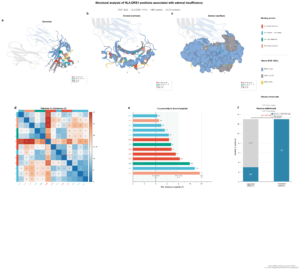
Leave a Reply
You must be logged in to post a comment.