
Week 10: The End Part Two - Measured Results
May 21, 2026
Hello!
This is part two of three in the finale of the extendable helical antenna blog series. Today, I will go over the measured results of SWR and S21 vs angle via NanoVNA.
Measured results of the dipole antennas are below:
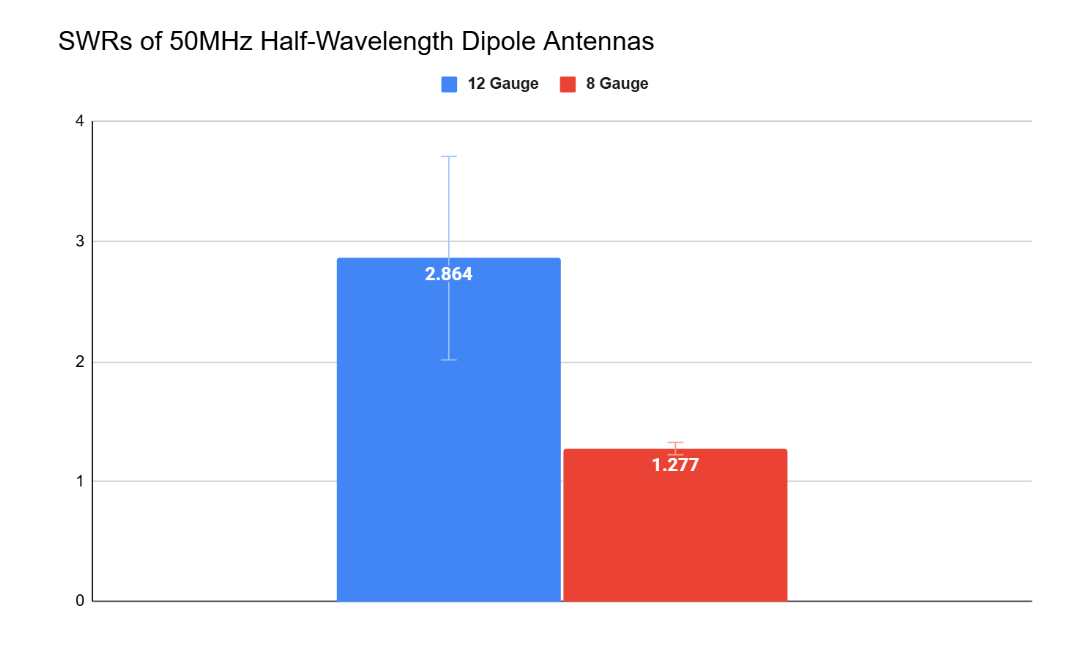
10 different measurements of the same two antennas were taken, and their averages were plotted on the bar graph above. The 8-gauge dipole had a statistically significant lower average SWR value than the 12-gauge at the 90% confidence level (p=0.0806); however, this was due to three high outliers in the 12-gauge measurements. The majority of other measurements were around 1.3.
Measured results of the helical antennas are below:
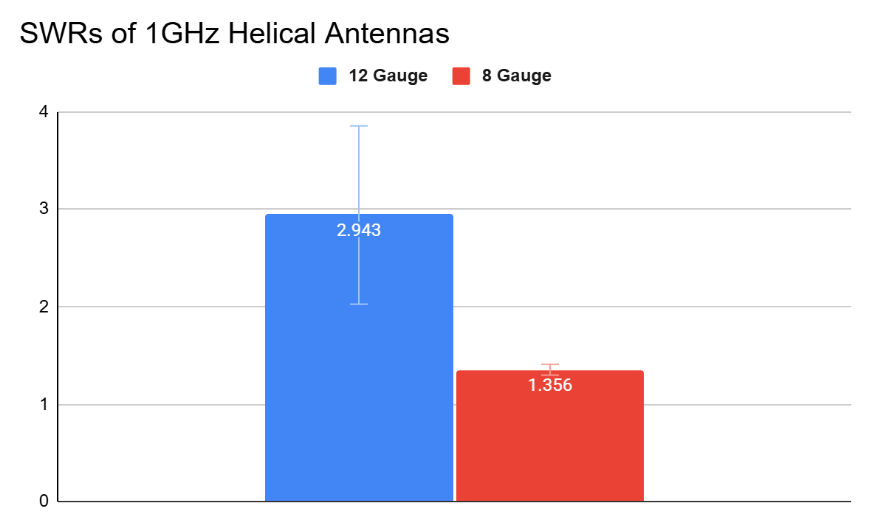
10 different measurements of the same two antennas were taken, and their averages were plotted on the bar graph above. The 8-gauge dipole had a statistically significant lower average SWR value than the 12-gauge at the 90% confidence level (p=0.0996); however, this was due to two very high outliers in the 12-gauge measurements. The majority of other measurements were around 1.4.
Helical antennas have higher directivity than dipole antennas, so their peak gains are far greater. However, similar to the dipole antennas, the thinner the wire, the greater the SWR due to high fluctuations. This measured data is confirmed by a S21 vs angle NanoVNA measurement, where the 12-gauge helical antenna measured 7.4 dBi gain at its peak and the 8-gauge helical antenna measured 8.7 dBi gain at its peak.
Leave a Reply
You must be logged in to post a comment.