
Blog Post 1 - Week 1 and Deeper Introduction
March 9, 2026
I spent the majority of this week refamiliarizing myself with my programs. It has been a while since I have looked at first my coding draft, but I thankfully remember most of it. Rereading my code also reminded me that commenting is extremely necessary, so I took some time to do so while reviewing.
I also looked at some of my preliminary results, their flaws, and how to fix them.
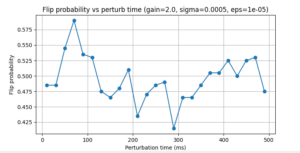
Here were the results that I got for my flip probability experiment. This experiment is supposed to compare the probability a neuron “flips” its decision given a microscopic perturbation at a given time. Originally, I decided to test whether or not a perturbation induces flip probability in a network. I later changed this, however, because agency depends more on when the system is vulnerable to change. If a network is vulnerable forever, it’s unstable, while if it never is, it’s rigid. Agency requires a “decision window” where the system is open to change.
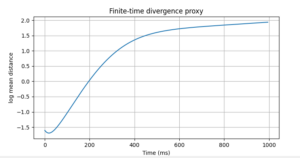
Here were the results for my predictability horizon experiment. This is something I have considered changing. The thing is, while measuring trajectory divergence between one perturbed and one unperturbed network is mathematically sound, it doesn’t necessarily translate to differentiating behavior, as they may diverge in high-dimensional space and yet still land in the same “decision basin.” To prove unpredictability, I need to prove instead that the past no longer influences the future (or influences it less by a significant degree). I am still researching how to do this, but I know that if the network “forgets” its initial state due to noise amplification, it can be said that the network is practically unpredictable.
I was unfortunately unable to recover working results for experiment 3, or my reasons-responsiveness experiment where I compared how a biasing vector could allow two networks to behave differently. What I dislike about this experiment is that a bias vector indicates more of a preference than a “reason.” To claim reasons-responsiveness, I have to allow the network to effectively process given information. To do this, I have discovered a method called Two-Alternative Forced Choice task paradigm which is commonly utilized in neuroscience experiments. This however will require much more research.
I will be working on these things and hope to create a final and concrete plan in the week to come.
Leave a Reply
You must be logged in to post a comment.