
Week 1: Prepare for Liftoff
February 27, 2026
Hi everyone! Welcome to week one of my senior project blog posts! My name is Chloe, and I’m super excited to take you along with me through all of the feats and flops of my project over the next several weeks. This week, I’ll start light and easy so as not to scare any of my readers away. Today, I’ll introduce my project and optimistically describe my goals. So please, grab yourself a cup of coffee or tea, get comfortable, and prepare for liftoff.
For the next several weeks, I’ll use machine learning algorithms to automate and optimize what astronomers call the “pulsar candidate selection” process. These candidates refer to a vast array of possible pulsars, which are highly magnetized, rapidly rotating neutron stars formed from supernova explosions. They emit periodic pulses of radiation, which is how they get their name, and these intervals can range anywhere between seconds and milliseconds!
These cosmic objects are exotic and fascinating to study, but they are also extremely difficult to identify and categorize, due to the noisy nature of massive radio telescope datasets. As modern telescopes produce millions of signals, manual detection is nearly impossible (I’m shuddering just thinking about sitting in front of ten laptops and straining my eyes on hundreds of noise spikes). Researchers have been developing automated machine learning models to distinguish real pulsars from background noise. With these new optimized tools, a process that once took days can now be reduced to mere seconds.
So…What’s the Point?
My project rides on this new wave of automated methods, focusing specifically on the classification between pulsars and other gamma-ray sources in the center of the Milky Way Galaxy. By gamma-ray sources, I mean the most energetic objects in the universe. These objects produce radiation with the smallest wavelengths, often involving high-energy processes. Some examples include black holes, neutron stars, supernova remnants, and pulsars, which are the main focus of my project. Differentiating between pulsars and other types of gamma-ray sources is crucial to understanding the structure of the universe.
With so much talk about pulsars, you might be wondering, “What different types of pulsars even are there?” Fear not, my attentive reader, for I am here to relieve all of your confusion. Today, I will be focusing on the two main types of pulsars I aim to classify: young and millisecond pulsars. While both types of pulsars are extremely exotic and energetic objects, they differ in age, spin speed, and magnetic field strength. These differences are necessary to understand the origins of magnetic fields and pulsar activities.
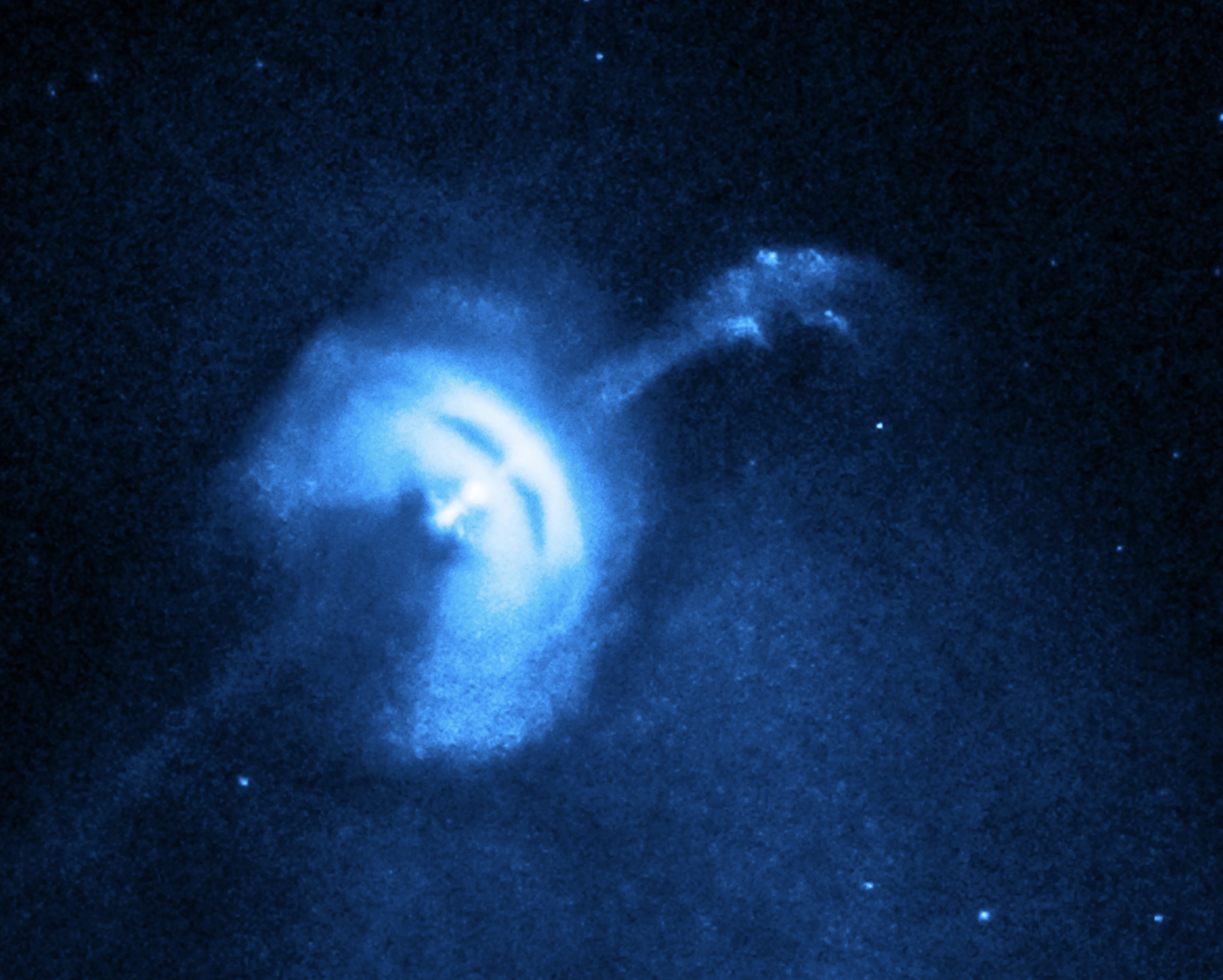
Young pulsars are, quite literally, young. They are newly formed pulsars often found in the center of the Galaxy, near supernova remnants. They have strong magnetic fields and a large amount of energy, but they also lose this energy at a much faster rate. On the other hand, millisecond pulsars are much older, “recycled” pulsars whose periods are in the millisecond range. They start as young pulsars, but are later spun up by accreting material from a companion star. Compared to young pulsars, millisecond pulsars have much weaker magnetic fields and slower rates of rotation decay, making them much more stable.

Looking Forward
Now that you’ve hopefully gotten a better understanding of pulsars, I can introduce you to my project’s ultimate goal. My project aims to contribute to the ongoing endeavor of automated methods by using a Bayesian neural network. Unlike traditional neural networks that provide a simple binary classification, Bayesian neural networks provide an additional layer of information through probability distributions, allowing us to quantify the model’s uncertainty. So, not only will the model reveal what type of gamma-ray source we’re studying, but it will also show how confident it is in its own predictions!
Using these confidence measures, I will create a ranked list of pulsar candidates for researchers to pursue in future studies. With high-confidence pulsars at the top, this list will hopefully act as a foundational benchmark in pulsar research. Just like Neil Armstrong said, even if it’s just a small step for one high school senior, it could be a big leap for pulsar discovery.
This week, I’ve officially started my journey by gathering and organizing my data. Given my position as a high school senior with a limited budget, I won’t be using any fancy, expensive instruments to launch my own space telescope. Instead, I’m using two of NASA’s public Fermi Large Area Telescope catalogs–a comprehensive 14-year catalog[1] with many types of energetic, astronomical objects, and another catalog focusing on pulsars[2] –that can be found online to scrape all of my numerical data. After doing some data mining and preprocessing, I’ve been able to curate a clean dataframe of over 200 pulsars.
In the next couple of weeks, I’ll be using this data to develop a reliable framework for classifying pulsars. This could advance our understanding of high-energy astrophysical phenomena and contribute to machine learning in modern astronomy. I’m sure there will be so many ups and downs throughout this project, but I’m excited to show you the unfiltered journey. And with that, I must bid you farewell for now. I hope to see you very, very soon in next week’s blog post!
References
[1] NASA Fermi-LAT Collaboration. (2024). LAT 14-year Source Catalog (4FGL-DR4). Version 4, Fermi Science Support Center, 24 Jul. 2024, fermi.gsfc.nasa.gov/ssc/data/access/lat/14yr_catalog/. [Dataset].
[2] NASA Fermi-LAT Collaboration. (2025). LAT Third Catalog of Gamma-ray Pulsars. Version 3, Fermi Science Support Center, 21 Jul. 2025, fermi.gsfc.nasa.gov/ssc/data/access/lat/3rd_PSR_catalog/. [Dataset].
[3] Berry, Dana. “Accretion of Material Spins Pulsar to Millisecond Range.” Wikimedia Commons, 7 Sep. 2013, commons.wikimedia.org/wiki/File:Accretion_of_Material_Spins_Pulsar_to_Millisecond_Range.jpg. Public Domain.
[4] NASA Chandra Team. “A new Chandra movie of the Vela pulsar shows it may be “precessing,” or wobbling as it spins.” NASA, 7 Jan. 2013, www.nasa.gov/image-detail/a-new-chandra-movie-of-the-vela-pulsar-shows-it-may-be-precessing-or-wobbling-as-it-spins/. Public Domain.
Reader Interactions
Comments
Leave a Reply
You must be logged in to post a comment.
Hi Chloe,
Pulsars seem pretty cool! My project is similar to yours, in that I am also using publicly available datasets to develop a classification model(brain scans to detect/identify patterns of head trauma). I do have a few questions however. What specific methods will you use to train your model(train/test split, cross-validation, etc), and if there are multiple methods you intend to use, in what order will you use them?
Hi Aditya! Thanks for your comment, I’m really happy to hear that our projects share some similarities. To answer your questions, I’ll be using all of the methods you mentioned, like applying an 80/20 train-test split and using 10-fold cross-validation. I also plan to experiment a little bit with data augmentation on a toy model and to test different probabilistic machine learning models other than Bayesian neural networks if I have time.
The implications of this project are really interesting! It’s exciting to see machine learning being applied to astrophysics. I imagine the final model could become a strong foundation for many types of space exploration research, in addition to helping detect different pulsars. I’m curious about the NASA database you mentioned. Does it already contain labeled data, or will you be labeling and differentiating the pulsars yourself? I’m excited to see how this project develops, and I wonder if you’ll be able to identify different pulsars by the end of this, too!
Hi Archita! Thanks a lot for your comment! To answer your question, the NASA data is already labeled, with the pulsar names, types, and various spectral characteristics, so the training will basically be supervised. Hope that answers your question!
Hi Chloe, this is such an interesting project, and I’m excited to see how it goes in your 10 weeks! I love the depth in your explanations. Since you’re using a neural network, what kind of features are you looking for in the young / milisecond pulsars to tell them apart, or which do you expect it the BNN to pick up on? Also, you mentioned that you chose a BNN for the probability distributions. Did you consider other machine learning models other than BNN for your task, and if so, which ones?
Hi Chloe! This project on pulsars looks really cool, and this intersection of astrophysics with machine learning seems very promising. The pictures of pulsars you included were also quite nice! I have a few questions that I’m curious about. First, why did you choose to identify and distinguish between millisecond and young pulsars, rather than some other classifications like magnetars and binary pulsars? Additionally, why did you select a Bayesian Neural Network out of all the different types of machine learning models?
Hi Lucas!!! Thanks for your questions. I focused on classifying millisecond/young pulsars because I wanted to focus on being able to identify globular clusters (GCs) from these classifications. Since millisecond pulsars are often found in GCs, I thought that being able to classify them would be a good indicator. I discussed a little more with my external advisor, and I’ve decided that I might also include other types of sources like blazars in my training process so that the model understands what is truly contributing to GCs. I’ll talk a bit more about that in my next post. As for why I chose to use a BNN, it’s because it can estimate the model’s confidence in its predictions by providing a distribution of probabilities rather than a single point estimate. If time allows, I plan to test out other uncertainty-aware models, like Gaussian processes, normalizing flows, etc.