
Week 5: Two Left Feet
March 29, 2026
The discourse about the most recent Winter Olympics is all about Alysa Liu. Of course, she has become an emblem of American resilience on ice. The reception of her performance brought about a massive cultural schism in the skating world—some thought her joyful programs were a breath of fresh air while others dismissed her artistry as a facade for lacking “elite” technical difficulty.
Let’s extract these talking points from both sides and apply it to ballet.
Court of Public Opinion
My middle school teachers would have a heart attack if they see TikTok citations in this post. Unfortunately, the platform is widely accessible and popular, making it a breeding ground for public opinions.
A video with on-screen text that reads “american ballet dancers >> russian ballet dancers” stirred controversy amongst commenters. Surprisingly, users were able to reach some sort of consensus: Russian technique is unrivaled. The discourse seems to stem from individual interpretation of artistry. Take a look at some of the top comments.
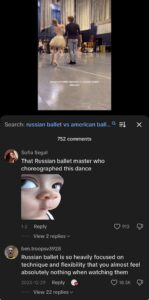
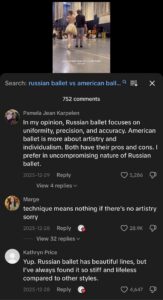
So, the “two left feet” debate is entirely up to the viewer’s discretion.
If you prioritize the mathematical certainty of a body pushed to its absolute limit, the Russian school is your sanctuary; to those fans, the American style looks unpolished, structurally weak, and “messy.” But if you value the humanity of the performance, the Russian machine is the one that seems out of step—a collection of “two left feet” unable to find a pulse as they chase a ghost of perfection. It seems as if a combination of training methods and politics coming from Russia works together to create a cycle of toxicity that American audiences perceive… but perhaps that will be saved for a later blog post.
Works Cited
Femme Felony [@femmefelony] “i said what i said #ballet #nutcracker #abt #americanballettheatre” TikTok, 18 Dec. 2025, https://www.tiktok.com/t/ZTkNrhdkQ/.
Reader Interactions
Comments
Leave a Reply
You must be logged in to post a comment.
Hi Claire, great post as always! Do you think the admiration of uniformity in Russian dance could correlate to foreigners’ sympathy to Russian politics? I personally see a parallel between ‘strong, centralized, top-down government makes citizens better’ and ‘perfectionist, commanding choreographer makes dancers better,’ but what are your thoughts?