
Week 6: Fashionista vs. Ballerina
April 12, 2026
Following World War II, Paris was devastated. The economy collapsed, resources became scarce, and the cultural capital of the world almost lost its creative legacy. However, French fashion had a reputation to maintain even when designers could not afford enough fabric to make full-sized garments for the traditional runway. In response, the Chambre Syndicale de la Haute Couture, the governing body of French fashion, organized the Théâtre de La Mode (Theater of Fashion) in 1945. Designers could conserve textiles, leather, and other scarcities by showcasing their work on a mannequin the size of nine-month-old baby. These “dolls” wore full-functioning pieces with zippers and featured intricate accessories (Maryhill Museum of Art).
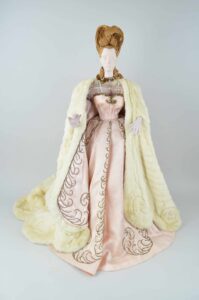
Ever heard of Cartier, Balenciaga, Hermès, maybe Van Cleef & Arpels? All of them were key contributors.
Parisan designers used their “artistic authority” to preserve their global prestige. When resources are scarce and the world starts to question the survival of an art, more concentrated forms of excellence emerge. Even today, some of the most well-known designer brands come from France. In preserving French couture in a miniature form, viewers of the Théâtre de La Mode saw an elite fashion standard that seemed independent from war and politics. Even when the world is starving, the French taste for fashion is untouchable.
Even when the world is starving, the Russian taste for ballet is untouchable.
Endurance in Another “Theater”
Ballet was brought to Russian courts in the late seventeenth century. Sheer luck is not enough to maintain ballet’s reputation amongst political tensions with the rest of the world…
1. The “Blueprint”: Following the 1917 Revolution, Agrippina Vaganova turned ballet into a science. A pedagogy so precise that dancers clung to its technical foundation even after fleeing, the Vaganova method guaranteed a dancer could perform with maximum efficiency and minimal injury. Famously, dancers who train in the Russian method adapt more easily to other ballet forms (Balanchine, Cecchetti, etc.) because of their strong backs and complete control of their limbs.
2. Siege of Leningrad (1941-1944): Training and performance did not stop with the Siege of Leningrad. During the blockades, the Imperial Ballet School evacuated to the Ural Mountains region to keep training in bomb shelters. Performances for soldiers and civilians boosted morale and resisted against cultural “deterioration.” Around the same time, touring “concert groups” took this standard on the go. Because the USSR could not afford to send a 200-person ballet production overseas, they sent out “distilled” squads of their best dancers. Russian ballet was kept alive and relevant through these this “concentrated showcasing” that the Théâtre de La Mode also replicates (Ezrahi 88; Garafola 155).
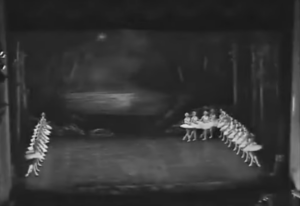
3. The “Swan Lake” Blackout (1991): The August Coup of 1991 refers to a failed attempt to overthrow Mikhail Gorbachev and reverse his reform policies. For the entire three-day duration, television channels looped Swan Lake. The grace of the dancers completely masked the political chaos but calmly signaled to Soviet citizens that the leadership was unstable. Historically, Swan Lake was broadcasted to fill the emptiness during leader deaths or major crisis, becoming a tacit indicator of political upheaval (Morrison 312). When all else fails, artistry remains intact and results in ballet being the only part of the national identity that still looks perfect (Schmemann).
Watch the Pas de Quarte from Swan Lake that played during the August Coup here.
Who knows? Maybe the secret to surviving a global crisis is just wearing Cartier and having a strong back.
Works Cited
baek Blackbeen. “Tchaikovski’s Swan Lake that was broadcasted during August Coup in all Soviet television.” YouTube, 24 Jun. 2023. https://www.youtube.com/watch?v=Tj2c6vJvyPA.
Ezrahi, Christina. Swans of the Kremlin: Ballet and Power in Soviet Russia. University of Pittsburgh Press, 2012.
Garafola, Lynn. Legacies of Twentieth-Century Dance. Wesleyan University Press, 2005.
Morrison, Simon. Bolshoi Confidential: Secrets of the Russian Ballet from the Rule of the Tsars to Today. Fourth Estate, 2016.
Schmemann, Serge. “Gorbachev, Last Soviet Leader, Resigns; U.S. Recognizes Republics’ Independence.” The New York Times, 26 Dec. 1991, www.nytimes.com/1991/12/26/world/end-of-the-soviet-union-the-soviet-state-is-dead-nation-is-dissolved.html.
“Théâtre de La Mode,” Maryhill Museum of Art. https://www.maryhillmuseum.org/inside/exhibitions/permanent-exhibitions/theatre-de-la-mode
Leave a Reply
You must be logged in to post a comment.