
Week 3: Getting Ready for Testing!
March 16, 2026
Hey everyone, and welcome back to my blog!
This week, I focused on having the sensors in my device work together to potentially detect a dehydration risk, and I will do this through code. To make both sensors work in the same program, I used two Arduino libraries: DHT.h for the DHT22 sensor and DallasTemperature.h with OneWire.h for the DS18B20 sensor. In my code, the Arduino will read humidity and temperature from the DHT22 and will request the DS18B20’s temperature reading every cycle. These readings will then be printed to the serial monitor so I can see them in real time. I also added a simple decision system: if the DS18B20 temperature reading rises above a certain threshold and the humidity is low, the program will print a warning to indicate possible dehydration. If only one of these factors is outside the safe range, the program will print a mild risk message, and if both are within normal ranges, it will report normal conditions. I will need to do more research on what “normal conditions” for people are, but this code will allow the two sensors to work together instead of independently, which will help the device identify patterns associated with dehydration rather than just relying on one measurement. Currently, this is the output that the sensors give me:
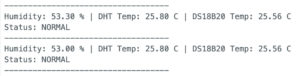
Now, to test the device, I plan to use artificial skin substitutes, which I’ve researched in the past week. Many wearable biosensor papers describe using hydrogel-based materials to simulate human skin when testing sensors. Researchers have also compared synthetic materials, like silicone or polyurethane, with hydrogels that better mimic the water content, softness, and thermal properties of skin. Since my device relies on detecting temperature and environmental conditions near the skin surface, it is important that I test it on a surface that behaves similarly to real skin. Based on the literature, I chose to focus on gelatin and agar as testing materials.
Gelatin is derived from collagen, which is one of the main structural proteins in human skin. Because of this, gelatin hydrogels can replicate the elasticity, softness, and moisture retention of biological tissue. Agar, derived from seaweed, forms stable gels that can also hold large amounts of water and maintain their structure well during experiments. Studies on wearable biosensors frequently use gelatin or agar gels because they allow researchers to simulate skin hydration and thermal behavior in a controlled way. Both materials are also inexpensive, easy to prepare, and safe to use, which makes them practical for repeated testing.
Using gelatin and agar will allow me to create a realistic testing surface for my hydration-monitoring patch without needing to test directly on human skin in the early stages of development. By placing my sensors against these hydrogels and adjusting temperature and humidity conditions, I will be able to observe how the sensors respond to different simulated hydration environments. This will help me evaluate whether the device can reliably detect patterns associated with dehydration.
Next week, I will start creating gelatin/agar gels and testing my device. Stay tuned!
Leave a Reply
You must be logged in to post a comment.