
Week 5: More Bumps in the Road...
March 31, 2026
Hello and welcome back to my blog! Last week, if you may recall, I encountered my first obstacle. This week, I have unfortunately encountered my second obstacle…
As mentioned in my previous blog post, I planned on focusing more on detecting hydration levels through humidity. The idea was that as something becomes more “dehydrated,” the surrounding humidity would decrease, and my DHT22 sensor would be able to pick up on that change. However, after testing this, I realized that this approach didn’t work the way I expected. The humidity levels were not changing enough or fast enough to be useful. Even when I tried to create “drier” conditions, the humidity readings stayed relatively stable and never dropped close to my dehydration threshold of 40% humidity. Instead of showing clear differences, the values changed very slowly over time, making it difficult to use humidity alone as a reliable indicator of hydration.
To further test this, I tried using gelatin hydrogels with different water concentrations. I made one sample using a normal ratio of 1 tablespoon of gelatin to 1/4 cup of water, and another “dehydrated” version using 1.5 tablespoons of gelatin to 1/4 cup of water. My expectation was that the second sample would behave like a less hydrated surface and produce different humidity readings. However, when I tested both samples, there were no noticeable differences in the sensor output. The humidity readings remained almost identical, which showed that simply increasing the gelatin concentration does not significantly change the measurable humidity at the surface.
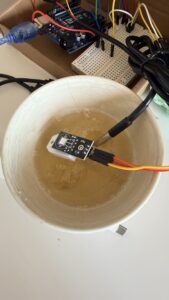
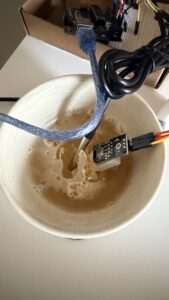
This was definitely frustrating because it meant that my original plan of detecting hydration through humidity alone wasn’t going to work as intended. It also showed me that hydration is more complex than I initially thought—it’s not just about how much water is inside a material, but also how that water interacts with the environment and evaporates over time.
For next week, I plan to adjust my approach by focusing on how humidity changes over time rather than instant measurements. Specifically, I want to try covering the gelatin with Saran Wrap with small holes poked into it to better simulate sweating and controlled evaporation. By doing this, I can create a more realistic system where moisture is slowly released, similar to how sweat leaves the skin. Instead of looking for immediate changes, I will measure humidity over several days (likely across the entire week) to see if gradual trends appear.
Hopefully, this new setup will allow me to capture meaningful changes in humidity that correlate more closely with hydration levels. Even though this week didn’t go as planned, it helped me better understand the limitations of my sensors and pushed me to think more critically about how to simulate real-world conditions.
Leave a Reply
You must be logged in to post a comment.