
Week Seven: Can He Build It?
April 22, 2026
Hello Everyone, and welcome back to Ballistas to Battle Rams.
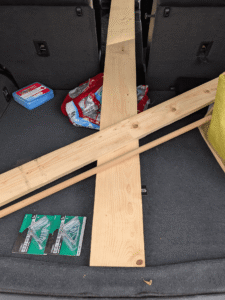
The work has started. As you can see from the pictures, I bought the first rounds of wood and brackets, and will shortly begin cutting and joining. Most of the other supporting beams can be found with scrap wood around the garage, and the more complicated parts will have their own process. As a teaser, you are graced with a crude rendition of the schematic in Tinkercad, minus all the important moving parts as those are a little too complex for my mediocre skills.
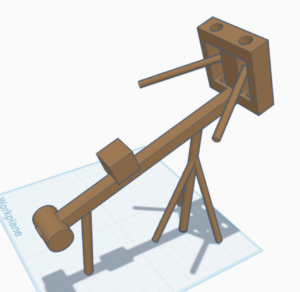
If you’d imagine, the two holes up top would have wound sinew coils where the arms enter. That twists and stores the energy when the arms are pulled back by the slide and handspring (the circle and square on the large beam). Again, it’s crude, you’ll get a better understanding later on.
But more importantly, I have been actually creating those schematics based on Vitruvius’s own descriptions. This did not come easily.
Vitruvius is writing in Latin, which means a lot of the words he’s using I should recognize. But oftentimes, he’ll use a word I am unfamiliar with. Take, “plinthide” for example. The translator uses the word “joist” for it, but that makes no sense. Joists are a term used in roofing contexts and don’t make much sense to be used with supporting columns (as the rest of the passage is about). I take a look at the Oxford Latin Dictionary, and wouldn’t you know it, the use of plinthide comes from the word “plinthis”. A word, when it comes to any column or structural support context, that is only defined in this one text, in this one section. Searching up “plinthis” does pull up the word plinth. Which is a perfectly English good word that describes how it’s related to columns and supporting the ballista. This same thing happened many times over, where the translator uses words that don’t make it clear how the pieces connect, leading to me getting lost in piecing it together.
In addition, it seems I was wrong in my initial conclusion that Vitruvius is working in the scale of 19 feet. In truth, Vitruvius puts all measurements in terms of “foramen”, or the hole where the springs are put through, so Marsden writes all units as fractions of F, for foramen. Therefore, I can completely scale this to what I need it to be, much like Heron. However, I am quickly realizing this will be much more work that I can reasonably do. I may have to pivot to only designing the Scorpio, and doing trials on different versions of it based on small inconsistencies in the translations, as suggested by my faculty advisor.
Signing off,
Aadrit T
Reader Interactions
Comments
Leave a Reply
You must be logged in to post a comment.
Hi Aadrit,
This looks really cool. Amazing how you can go on a whole scavenger hunt just to find what a single word means! It sounds like you’re doing a lot of assumptions, but that is the nature of your work. I look forward to seeing what your finalized product looks like!