
Week 6 & 7: Grab Bag
April 15, 2026
Well folks, Something Finally Happened. We are done with pure research as of this week! Now, the fun part of figuring out principal photography over the next week and spending 15 hours a day editing video for the two-three weeks after. I am a time management wunderkind.
This week was largely an attempt to tie up as many loose ends as possible while getting a head start on video production. The following headers will be an attempt to recap as much of it as possible.
Greyhound, Laidlaw, Chinatown, and bankruptcies (1990-2010)
Thank you to Tom Baker and Eli Bail from the Pacific Bus Museum for helping out massively with this part. One huge, huge problem with this era of Greyhound’s history is all of the corporate mergers and divestments leading the company to constantly throw out its old archival documents. In fact, in Tom’s words, lots of what Pacific Bus had in its archives was, quite literally, rescued from a trash bin. So, with everything that I could find and fact check, here goes nothing:
Approaching the 1990s, Greyhound was the flagship product for the Greyhound corporation, a huge corporate conglomerate that contained everything from meatpacking (Armour & Company), financial services (GFC), and Dial soap! In 1987, Greyhound Lines (as in, the bus company) was split off from the rest of Greyhound and taken private. Confusingly enough, these companies operated independently from each other both with the Greyhound name for several years until 1991, when Greyhound changed its name to Greyhound Dial and then to just simply Dial.
Pacific Bus provided a series of financial reports from Greyhound, GFC, and Dial around this era. In 1992, Greyhound Lines went into Chapter 11 bankruptcy protection, emerging “BETTER THAN EVER” the year after. They were, in fact, not better than ever. CEO Frank J. Schmieder is fired in 1994 after a horrible, no-good, all-bad rollout of an airline-style seat reservation system, and Craig Lentzsch is hired to bring the company back to basics.
Greyhound is hemorrhaging money right now, still for much the same reasons as before. They offered a brand of travel that was being outpriced by airlines and outclassed by railroads on many key routes, cutting deep into their market niche. They’re bought out by Canadian school bus operator Laidlaw in 1999, who, in turn, themselves go bankrupt in 2001.
It’s at this point that Chinatown buses begin to take off with the rise of the internet. These bus lines have some awesome tales behind them from their early days. You’ll never guess how this one ends:
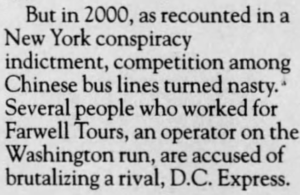
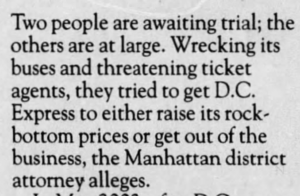
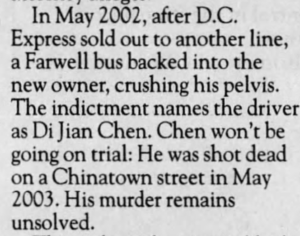
These two clippings are from a 2005 Wall Street Journal article published in the Reno Gazette-Journal. These bus lines were shady operations, and I’m not saying that this murder was directly bus-related and targeted, but I’m also not saying they’re not. I’m imagining a Sopranos-like show with Chinese bus line mafias all along the Northeast.
And, the rest of Chinatown’s stories have been told already in previous blog entries, I do believe.
The British buses
I said to myself at the very, very start of this project that the final part would be comparative: is it only the U.S. with such a failing bus industry? Why do other countries like Mexico and the U.K. have stronger bus service?
Well, from simple intuition…
- Mexico lacks an intercity rail service and as robust of a budget airline network as the U.S., with its buses also being much classier than American buses. They have first class on these buses! It’s impressive.
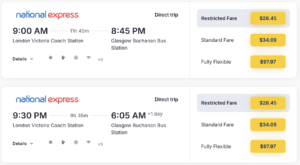
- Britain’s rail is so prohibitively expensive that buses (and budget airlines) can easily sweep up budget travelers. A one-way, nonstop trip from London to Glasgow on Friday, 3 July on National Rail converted to USD is $49.12, while on RyanAir, an Irish budget airline, it sits at $32.00, and on Megabus, it goes down to $28.45. Of course, we’re ignoring time and other travel considerations, but from a pure budget perspective, bus and air easily beat rail. And for shorter trips like London-Manchester, where budget airlines might not even fly, rail is $45.08 while the bus is as low as $11.94.


I want to touch up on the British bus system briefly. Their system was deregulated in 1986; unlike the U.S., Britain had a publicly owned bus network before 1991 as well. While operating costs across the whole network and bus service miles actually increased immediately after deregulation, fares and ridership fell. The deregulated bus industry simply wasn’t as unchanging as the old regulated National Bus Company, and lacked a certain level of consistency that the old system had. Which, then, brings me to my final point:
Video, interviews, and frustration
I had the pleasure of interviewing Zaref Anderson, a transit planner from San Diego, niche internet microcelebrity, and a self-described “optimist” about Greyhound. He regaled me with stories about getting stuck in the Imperial Valley desert for 8 hours, threatening Greyhound with a lawsuit, and of missing buses out of Vancouver’s Pacific Central terminal. And if this taught me anything, it’s that riders value both cost and consistency. If you can get a Frontier flight for the same price as the bus, you’re gonna take the Frontier flight because chances are it’s going to be on-time, fast, and reliable, albeit mediocre. Greyhound is none of those things. When it works, Zaref told me, “Greyhound is remarkably consistent,” but with a big emphasis on the when.
As I move onto the daunting task of filming anything, I need to emphasize rider consistency as a main reason to maintain these station buildings. My script has ballooned to eight pages already, so definitely I’ll be taking a machete to that in the following week.
It’s a long, long ride from 1916 to today, so you can leave the driving to us.
Leave a Reply
You must be logged in to post a comment.