
Week 8: Monitoring the Situation
April 27, 2026
We’re in the trenches. It’s looking grim. After about 30-40 hours of video editing, finally wrapping up research, as well as most of principal photography, I am well-poised to lock myself in my room for the next three weeks to figure out how in the world I’m gonna get this together.
I finished the final interview for video content this week. This brings us to a total of two interviews: one with Zaref Anderson, a transit planner and self-described optimist on Greyhound, and the other with Pete Pantuso, my project advisor and former industry lobbyist on Capitol Hill. They both provided somewhat differing viewpoints on Greyhound, and the industry at large’s current positioning and trajectory; Pantuso’s was much more analytical in nature, dealing with affairs from a corporate, big-picture level. Curbside buses, by his perspective, were a boom for the industry in allowing bus companies the flexibility to pick up people in different places and allow smaller firms to further innovate on providing a better customer experience. Anderson drew from rider experience, on the other hand, citing fundamental problems with communication and customer service that make Greyhound such an often questionable product.
I tried to unify these two beliefs in my final script and resolution. Cities should offer one major terminal with the majority of service, with only limited service going towards suburban and exurban stops. The distance between smaller, suburban stops and major urban terminals should be substantial, too. I’ll offer two examples, one that does this well and another one that does it less well:
- Philadelphia, Pa., has three bus stops listed on Greyhound.com. One of them is located next to Spring Garden SEPTA station, with subway connections near the Delaware River (below). The two other ones are located on opposite sides of William H. Gray III 30th St. Station, the city’s Amtrak terminal and a major commuter rail and subway hub. These three stops all serve what appear to be the same intercity bus services, sometimes with different lines, but sometimes without.
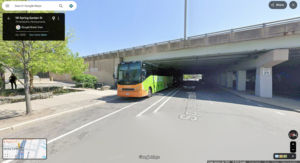
Also, Philadelphia is a city where it gets cold in the winters! Traveling by intercity bus like this should at least, in the interest of the rider, have a shelter. - Washington, DC, on the other hand, houses only one intercity bus station within city limits in a large facility connected to Amtrak’s Union Station. There is, technically, a “stop” located at Dupont Circle, but a cursory glance at upcoming buses indicates no buses actually use that location. All other stops in the DC metro are located in towns near the Beltway: Bethesda, Md., College Park, Md., and Tysons, Va., all have their own stops with less frequent service to the city center. Philadelphia has one: King of Prussia, home to its eponymous mall.
It should go without saying that city center stations need to keep terminals. Transferring between services will take you to these city center stations; if you’re traveling between, say, Sioux Falls, S.D., and Fort Wayne, Ind., in the dead of winter, Greyhound.com gives you itineraries that could potentially force transfers in places like Kansas City and Minneapolis in the middle of the night. When it gets cold.
It’s going to be a long week of video editing ahead. I don’t expect things to be pretty, but it should be coherent and presentable. Which, frankly, it might be. I’d give it 2/3 odds of being nice and polished.
Leave a Reply
You must be logged in to post a comment.