
What exactly is Digital Resurrection?
March 10, 2026
Goals for last week
- Finish learning to use Artlist, Photoshop, and Blender – I’m actually getting pretty good at these tools, and I’ll make sure to demonstrate me using these in action once I add the finishing touches on my methodology
- Read Multiple View Geometry in Computer Vision and Historic Preservation: Curatorial Management of the Built World – I was able to get a lot of extra reading done, which is why I decided to make this blog post a full literature review for my project.
Overall, I believe I met and surpassed my goals from last week. Obviously, not every week is going to be like this, but my project is going quite swimmingly if I do say so myself.
Literature Review
This is, for the most part, all the reading I will be doing for my project, unless something interesting catches my eye in the upcoming weeks.
You’ll also notice how I don’t completely go into detail for every single one of my sources. This is because a lot of the more theoretical sources only provide hypothetical methodologies that artificial intelligence improves on in every way possible. I know I’m sounding very vague and cocky, but I’ll go more into detail when I demonstrate my methodology in my next blog.
Lahaina
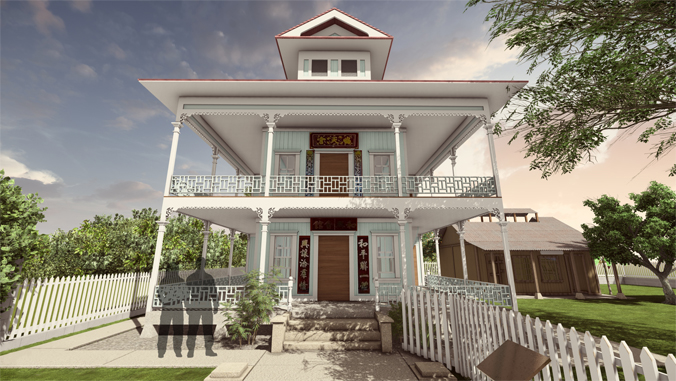
The article explains how architecture students at the University of Hawaii are using artificial intelligence to reconstruct the town of Lahaina, that was lost in a wildfire in 2023. This is, by far, the closest project I have seen to what I aim to do. However, their methodology differs from mine in two ways. First, they use completely different softwares from me. From what I’ve seen, their primary 3d modeling software is Lumion, while mine is Blender. This also leads into the second difference, which is that they are not generating their models from images. It’ll be interesting to see if my approach of forming my reconstructions with the use of image-to-image AI will create models more detailed than theirs, but their work is already so detailed that I’m starting to doubt my methodology a bit. It’s quite a hard bar to clear, as you can see from their model below.
Notre Dame
This article was similar to the Hawaii one, but the methodology is different. For context, this article is about efforts to digitally reconstruct the Notre Dame Cathedral in Paris following the 2019 fire that burned it down. Several teams worked to reconstruct it, but the most prevalent one seems to have used the software Solidworks. Again, I am using different softwares and adding an image-to-image component, which should enable me to make more accurate and detailed models of even older buildings.

Multiple View Geometry in Computer Vision and Historic Preservation: Curatorial Management of the Built World
The reason I put these two works together is that they are very closely related in the sense that they are both theoretical works about this field that were published years before artificial intelligence became so mainstream. Due to this, most of their content is relatively outdated, as many of the problems they posit can be solved through any combination of the three softwares I am using. For instance, Multiple View Geometry centers around a complex plan for turning 2d images into 3d models, while my methodology can eliminate several steps in said plan.
However, the ethical questions they bring up are interesting and very much worth discussing. As a result, I will now be dedicating a section in all my future blogs just rambling about philosophical questions related to historical preservation. I’ll spare you all for this blog, as it’s getting quite long.
Citations for Literature Review
“Students Use AI to Preserve Lahaina’s Historical Architecture.” University of Hawaiʻi System News, 22 Mar. 2024, www.hawaii.edu/news/2024/03/22/lahaina-historical-architecture/.
Tyron, Leon. From Ruins to Residences: How Ai Is Revolutionizing the Refurbishment of Old Buildings into Modern Homes | by Leon Tyron | Medium, medium.com/@leontyron/from-ruins-to-residences-how-ai-is-revolutionizing-the-refurbishment-of-old-buildings-into-modern-a46d0b3e32d3. Accessed 11 Jan. 2026.
Reconstruction of Historical Cities Using AI Technology (Augmented Reality), www.researchgate.net/publication/386354884_Reconstruction_of_Historical_Cities_Using_AI_Technology_Augmented_Reality. Accessed 15 Jan. 2026.
Hartley, Richard, and Andrew Zisserman. Multiple View Geometry in Computer Vision. Cambridge University Press, 2019.
Fitch, James Marston. Historic Preservation: Curatorial Management of the Built World. University Press of Virginia, 2007.
Horgan, Rob. “How Digital Technology Is Aiding Notre Dame Rebuild, Two Years since Tragic Blaze.” New Civil Engineer, 15 Apr. 2021, www.newcivilengineer.com/latest/how-digital-technology-is-aiding-notre-dame-rebuild-two-years-since-tragic-blaze-15-04-2021/.
Goals for next week
- Finalize methodology enough to make a prototype model
- Get access to Alviso’s Bayside Canning Company(the first building I aim to model)
Leave a Reply
You must be logged in to post a comment.