
• Skip to primary navigation
  • Skip to main content

BASIS Independent Schools

BASIS Independent SchoolsBASIS Independent Schools
  • About
    • Why BASIS Independent Schools?
    • Mission & Philosophy
    • Diversity & Citizenship
    • History
  • Academics
    • Curriculum
    • Early Learning Program
    • Primary Program
    • Middle School Program
    • High School Program
    • The Senior Year
    • Summer Programs
    • International Student Program
  • Achievements
    • International Performance
    • College Admissions
    • Advanced Placement
    • National Merit
  • Find Your School
Inquire

Academics

Meet the Winner of the 2025 Fellows Scholarship for Excellence in Senior Projects!

November 5, 2025 by mirandamartinez Leave a Comment

To kick off a new year of Senior Projects, we are sharing a conversation with the inspiring winner of the 2025 Fellows Scholarship, a $10,000 prize awarded annually to one project. Maxim Smelyansky, a Class of 2025 graduate of BASIS Independent Brooklyn, their 2025 Valedictorian, and current Stanford University student, impressed our committee with his project titled The Future of American High-Speed Rail: Analyzing and Discovering the Most Effective High-Speed Rail Development Methods on Promising Rail Corridors in the United States.

The Senior Project is an independent, student-led culmination of our high school experience. After three years of academic preparation, our seniors are ready to spend the last trimester of their high school careers applying the skills and knowledge they have gained to develop a project that is insightful, academically rigorous, and professional in nature. 

Our seniors start by designing a research question that is often centered on a subject they are passionate about or curious about. Then they embark on a journey to answer it, documenting and analyzing their findings as they go. They partner with both an internal and external advisor to support and guide their research. Students may choose to conduct their research in the form of internships or experimental research at university research labs, field work abroad, or research conducted remotely from home. From explorations into new-age technology to cutting-edge medical advancements to social justice, the Senior Project offers students the opportunity to channel their innate curiosity. This experience readies them for the type of self-direction and self-discipline expected in an undergraduate and graduate setting. 

In his Senior Project and accompanying blog, Maxim channeled his lifelong passion for transportation into a compelling case for high-speed rail in the United States. Supported by an externship with Ukrainian Railways, his work demonstrates both rigorous scholarship and a bold vision for a more connected, sustainable future. His blog not only makes the case for high-speed rail—it models the kind of intellectual curiosity, clarity, and purpose we aim to foster in all BASIS Curriculum Schools students. 

In this interview, conducted over the summer, Maxim shares insights into his research process, the real-world impact of his on-site placement, and the academic foundation that helped him bring his ambitious ideas to life. We hope you’ll join us in celebrating the inspiring work of one of our network’s newest alumni. 

Could you give our readers a short introduction to yourself, where you’re from, and what your plan is for after graduation? 
My name is Maxim Smelyansky. I am from the BASIS Independent Brooklyn Campus. I am one of the founding family members from 10 years ago. I was originally born in Eastern Europe, but in grade 2 I joined BASIS Independent Brooklyn, and then since then, I’ve grown with the school. And after graduating, I will be studying Civil Engineering at Stanford University in California. 

Congratulations on being this year’s Fellow Scholarship recipient. What did this award mean to you?  
I worked very hard on this project, working with Ukrainian Railways, conducting my own scholarly literature review.  I felt like winning this award was definitely a culmination of my BASIS Independent Schools experience because a lot of the work that I put in was applying the skills that I learned from before, or, for example, from my AP Capstone journey. 

Being the Fellows Scholarship recipient really validated my passion for transportation and my dedication to exploring opportunities for more sustainability and America’s future not being so car-dependent, but rather full of walkable cities.  

Could you introduce your project and its importance to our readers? 
My Senior Project was on the future of high-speed rail in America. Some examples include current projects such as the notorious California High-speed Rail, and semi-high-speed rail, such as Brightline in Florida and Brightline West in Las Vegas, currently in construction. There’s definitely a keen interest in building high-speed rail across America, but there are clear structural and management failures that are visible and could deter America from moving in the more sustainable direction, the direction that would give consumers the freedom to choose which mode of transport they want to use.  

So, my research focused on international high-speed rail development methods, usually in countries where the networks are already well developed on a large scale. My criteria, which I shared in my first senior blog post, were countries with over 1,000 kilometers of high-speed rail built and more than 500 kilometers currently in construction. I analyzed existing methods and determined which one would be the best for the application in the United States. I ultimately applied it through a mock Texas high-speed rail project. 

It’s an important topic because, most simply, it saves people money. Why in Europe can you buy flights for $10/$15? Because there are good rail connections that are very competitive. So even if you’re not taking the train, you’re still saving yourself money because airlines will have to adjust by having so many more options on the table. 

The second thing is that for a more sustainable future, high-speed rail is critically needed. If you look at carbon dioxide emissions on a per-kilometer basis, the thing that emits the most is not a cruise ship, it’s not a car, it is short term domestic flights—think 200 to maybe 500 miles. So your New York to DC flight, your Dallas to Houston, Houston, San Antonio, Austin, all those kinds of flights, those are the ones that emit the most per kilometer flown. And if you want to limit emissions, those are the routes you want to target because there is a simple, more sustainable solution to it. 

By caring about high-speed rail, you’re promoting a more sustainable future that also on top of all that, not only makes your flight cheaper—and some of the times makes your commute shorter—but it also creates jobs. It induces development. There’s a reason why most new developments are around where public transit is being built. While that value isn’t seen, the land value that rises around these stations revitalizes their neighborhoods too. 

It really is important to care about this because if done right, the amount of benefits from sociopolitical, from an economic, from an environmental point of view, are just simply immeasurable and they can really help bring America into the future. And I also didn’t even mention the crumbling infrastructure that we have right now, the freeways and everything. We need alternatives. We need to diversify our reliance on cars. High-speed rail is a great solution to this. 

When did you arrive at the idea for your Senior Project? Were there other ideas that you were considering alongside it, or were you pretty set on this idea from the beginning?  
I definitely knew I wanted to continue researching something in the field of transportation. I considered doing something along the lines of continuing my AP Research project, where I studied price discrimination on airline tickets and airline ticketing algorithms.  

But I really wanted to do something that allowed me to build upon my internship from last summer at Ukrainian Railways. Thanks to my work there last summer, I was able to get another externship and gain the experience and the knowledge I really needed to help this more ambitious project come to life.  

Could you shed some light on how you worked with this group? 
I have always been passionate about transportation. And really, after AP Seminar and AP Research, I had some tangible projects under my belt. I’m of Ukrainian origin, so I wanted to use my transportation knowledge to help the betterment of Ukraine and Ukrainian civilians. 

My dad actually works in Ukraine, and to visit us, since there are no commercial flights flying in and out of Ukraine, he has to take the train to the border from Kyiv to Warsaw, which is where the largest and closest international airport is.  

So, I reached out to Ukrainian Railways, wanting to help research some proposals on how to improve the rail commute between Kyiv and Warsaw. After reaching out and saying I was willing to work for free as an unpaid intern, I was tasked with researching and proposing a potential solution to improve this commute.  

The big issue is that Ukraine and former Soviet states have a track gauge or track width wider than their European counterparts. Because of that, the train simply couldn’t go into Poland because Poland had a narrower track width. 

And because of that, they had to change trains at a border town called Chelm. Now, the issue with that is for consumers who want to go directly to the airport and not to Warsaw. They would have to first transfer from the train they just took from Ukraine into this border town, change to another train going to the center of Warsaw, and then change to another train going to the airport. 

So after analyzing, the flights that could be available if you make a more direct link, I proposed a bus shuttle that picks up passengers from Chelm and goes directly to the airport. And this allows consumers to save precious hours, and allows them to catch most night flights. 

So instead of arriving at the airport at maybe 9:00/9:30, they arrived at 7:00/7:30, which allowed them to catch pretty much all the night flights. And that proposal would’ve allowed approximately 22,000 people annually to have a more convenient and daily access to the airport. 

That proposal was approved for implementation. While I obviously wasn’t able to help implement it, as this was already getting into the college application season, it definitely made a profound impression on me, showing me that my research actually had a potential tangible impact. 

Can you tell me a little bit about your on-site advisor whom you worked with at Ukrainian Railways?  
So, he was different from my mentor when I did the internship over the summer. This advisor is the Director of Strategy and Transformation at Ukrainian Railways. And, really, having him as a mentor was definitely very crucial to my success in this project because, simply put, he had a lot of experience, not just domestically, but internationally. 

He is looking into high-speed rail developments across the world, as he is envisioning a post-war future for Ukraine. 

But at the same time, how can we transform Ukraine in the future, and how can we improve Ukrainian railway services right now? Just having those two facets of experience from a more macro point of view and from a more micro point of view really allowed me to consider a lot of factors. 

And even when it comes to something like station locations, if you see in my paper, that just the consideration of those factors on a more micro scale definitely was because of the help I got from my advisor.  

He was able to point me in the right direction, especially at the start, looking at what were best practices were. And in a way, obviously, while I was comparing the results of the development methods. He was also able to point me to resources to see what the general best practices are. In that aspect, I was able to learn a lot, especially from the International Union of Railways handbook on high-speed rail development. 

What was the most challenging aspect, and how did you face that challenge? 
That would be when Russian hackers hacked the Ukrainian Railways Website. This was the week our school came back from Spring Break, and for about two weeks, I did not have contact or support from my on-site mentor because he had to focus on rebuilding the digital infrastructure for Ukrainian Railways to run on time and run smoothly. Doing the project by myself for those two weeks was definitely a bit of a struggle because I couldn’t ask my mentor to point me in the right direction to really figure out what the right sources were 

He was an invaluable resource from the beginning. When I first shared my scope, he suggested I review three sources, and those three sources were frankly the backbone of my future research because he knew exactly what I was looking for—he knew the field that well from his decades of industry experience.  

Losing contact with him, even temporarily—at the time I didn’t know how long it would be—that definitely was a little bit of a struggle, finding the sources I needed to continue my research. But I would say that my resiliency and my skills, again, from AP seminar and AP research of how to find scholarly sources, how do how to utilize EPSCO or Econ Biz, or Google Scholar, thanks to that, I was still able to find critical sources. 

One of them was actually the Transit Cost Project, which was a database that analyzed, I think, 10 or 12 countries. Not all their projects, but all the projects that they were able to find analyzed their high-speed rail development methods on a cost per kilometer basis, which was one of my rubric points. The amount of time they spent per mile of high-speed rail trackage, and also, the percent of the trackage that went through tunnels or bridges, which is more expensive than just on flat land.  

Just finding those sources without the guidance of my mentor was a bit of a struggle. Other students probably had much bigger challenges in their Senior Projects than mine, but I’m still proud I overcame that, and my project continued pretty smoothly to the end. 

Reading your blog each week, it was clear that your voice as a researcher and author was extremely distinct, and your format was very methodical. You also did a great job making this subject accessible and engaging. Did that come naturally?  
When it comes to this topic, it definitely came a little more naturally to me. Even if I wasn’t researching it, I’ve been watching videos on infrastructure construction projects probably since grade 2, maybe even grade 1. I used to play around with subway maps and envision expanding the New York City subway. 

But I definitely realized that just because it comes to me naturally, it doesn’t come naturally to everyone else. When I started doing my research, especially when I was explaining the method and rationale for selecting each of the categories and why I gave a country a certain rubric score, I realized that without sufficient context, without reading the previous week’s blog post, you couldn’t just jump in and understand what was going on. 

I really needed to figure out how I could convey my message in a way that people could understand; it was one of my main priorities for the blog. True mastery of a subject means that you can explain it in simple terms, and I try to push myself to be in a position where I can explain it in simpler terms and make people understand very quickly. 

It helped that the Senior Project allowed me to experiment with visuals and graphics. I found that the only way I was able to explain it very well was through visuals; I even put some in my paper for people to understand and make it as accessible as possible. 

One of the important lessons I learned in the blog was making a short abstract giving the reader the basic information, as well as the context, and a summary of the process: okay, this is what he did the week before, and this is how he builds upon it.  

Keeping a focused narrative not only kept the readers on track but kept me on track. For example, saying, “This is what I’m going to do next week,” – really setting out my goals for the coming week – kept me accountable and prevented me from falling behind. It also kept me somewhat in check because having an online externship rather than a mentor just keeping an eye on me, it can be a bit difficult to keep yourself motivated. Setting out those goals and putting them out in the public definitely helped me achieve them. 

As far as developing your voice as a writer and a researcher, were there any classes you took at BASIS Independent Brooklyn that you want to give a shout-out to? 
AP Seminar and AP Research are definitely some of the most useful classes I’ve taken in my high school career, and to be honest, I probably would recommend them to anyone more interested in STEM courses than the humanities courses. I would say that while AP English Language & Composition and AP English Literature & Composition were definitely good classes that helped me find my voice as a writer, the skills that you learn from AP Seminar and AP Research really develop your academic voice, which is crucial for more non-humanities courses and even some humanities in terms of analysis.  

AP Seminar helps so much in terms of just broadening your perspectives and evaluating multiple perspectives, which is so important because most of academia isn’t black and white; it’s a lot of gray. It also helped cut through political polarization at times, just by understanding people’s perspectives. 

AP Research really helps as well. It’s almost like doing the Senior Project before the Senior Project. You create your own research project, you learn how to develop a proper research question, you develop a method on how to conduct this research and how to even scope your project, you analyze your data, you write a paper, and you present on it. Even if it’s potentially not peer-reviewed journal material, it’s a really good introduction to conducting primary research.  

That entire track really made my process much easier in the whole senior year. In Capstones, I was able to focus on the knowledge that I was learning in each class rather than focusing on how to properly write an academic paper with formatting, citations, and everything.  

With the base knowledge you get in Seminar and Research, you’re saving yourself time when you’re writing college applications too. Looking ahead, applying these skills can help you in your college classes or even help you land that first position or that internship. 

You concluded your BASIS Independent Brooklyn career as both the Valedictorian and the winner of the Fellows Scholarship. That’s a big senior year. As far as the year ahead, do you have any specific academic goals or goals regarding campus involvement? 
My big goal for the year would be getting that next internship. With regard to campus involvement, I didn’t necessarily want to give myself concrete plans just yet because I feel like college is a time for learning and exploring. I want to come in the first quarter at Stanford with an open mind. 

One idea I definitely have in mind is joining the Transportation Research Center at the Transportation Research Institute at Stanford in some sort of role. But I feel like one of the things that has allowed me to be successful so far is that I had an open mind, and honestly, at times it was because I did things spontaneously. I want to let that flow happen in that first quarter. But I’m definitely going to hold myself accountable. And really, the two big things are getting an internship for next summer and establishing a consistent routine. 

Do you anticipate continuing your Senior Project in any form? 
In terms of just the field of transportation research in general, yes. That’s definitely something I do want to continue at Stanford. To be honest, transportation has been my bread and butter since the age of three. Maybe even two. I’m proud to say it’s my passion. 

What shape or form will it take at Stanford? I’m not exactly sure. Will I definitely try my best to look for those opportunities? Definitely. Either transportation research on campus or finding some potential internships. I would love to do something like transportation consultancy or something like that where I can learn best practices just by being surrounded by experts and professionals. 

And I feel like one of the small regrets I have for my Senior Project was that it wasn’t in person. Because I felt like gaining that hands-on experience would’ve definitely helped a lot. But that is something that I would really like to search for at Stanford. 

Do you have any advice for students who are looking ahead to their Senior Project?  
I think the biggest piece of advice would be to do something you’re actually passionate about. Don’t do something that you find is probably the path of least resistance. 

At times during my project, I was questioning myself a lot. If I hadn’t chosen a project I was so passionate about, I probably would’ve given in to the temptations of senioritis.  

The second point of advice I would say in general is obviously I lucked out in terms of my placement or externship, but start thinking ahead regarding on-site placements. Without connections, it will require a lot of outreach—a lot of cold calls and cold emails. That takes a lot of time, so start early. Those are the two things that I would really suggest for the Senior Project.  

Thank you so much for taking the time to sit down with me to share a little bit more about your senior project. Congratulations again on your many accomplishments and best of luck in the year ahead! 
Thank you for giving me the platform. Thank you so much for allowing me to speak proudly of my work and my accomplishments.

Maxim with BASIS Independent Brooklyn Head of School, Mr. Josh Harmon

Filed Under: Academics, Alumni, Awards & Recognition

Why BASIS Independent Manhattan is the Essential Bridge to High School Success

November 5, 2025 by christineklayman Leave a Comment

The transition to middle school is one of the most exciting shifts in a student’s academic life. For our grade 5 Wildcats in New York City, the “Bridge Years” (grades 4–5) have already marked a powerful trajectory toward independence and abstract thinking. By focusing on skills like self-advocacy, growing responsibility, and enhancing a fundamental love of learning, your student is uniquely prepared.

Staying at BASIS Independent Manhattan for grades 6–8 ensures that this momentum continues. Our private middle school in NYC is engineered to be a college preparatory pathway, teaching students to use knowledge as fuel for deeper understanding, unlimited exploration, and a strong basis for high school.

male student holiding up a latin project

The Grade 6 Academic Advantage

Our grade 6 curriculum intentionally introduces a level of rigor and organization that builds the intellectual foundation for our High School Program, which is designed for AP success.

Your grade 6 student’s schedule shifts to a fully departmentalized model guided by our Subject Expert Teachers:

  • Advanced STEM Curriculum: Students participate in a full course covering biology, chemistry, and physics three days per week. This integrated science sequence gives them a significant head start.
  • Differentiated Math Daily: Students are placed into either Pre-Algebra or the accelerated Algebra and Geometry I track, ensuring they are challenged at their precise level.
  • Core Humanities: Students receive daily instruction in English, Latin IB, and World History and Geography I.
  • Well-Rounded Student Experience: The week includes three days of electives (art, band, or drama), plus Physical Education and Sports at our partner facility Chelsea Piers.
students conducting a hands on activity in grade 6
female student in a lab coat mixing a solution in chemistry
grade 6 students looking through a microscope
upper school students act out math with their teacher in the classroom

Mastering Executive Functioning and High-Stakes Assessments

Exposure to a challenging curriculum is strategically coupled with intentional lessons that develop critical executive functioning skills. Grade 6 is where students adopt study habits and organization systems that lead to success in high school, college, and beyond.

To prepare students for college-level final exams, our middle school utilizes Pre-Comprehensive Exams (Pre-Comps), which are formative assessments, and Comprehensive Exams (Comps), which are summative. Students learn how to manage and synthesize a large body of knowledge in a supportive environment.

This growth succeeds through our robust student support system, including:

  • Peer Tutoring: One-on-one study help from experienced high school students who have mastered the material.
  • Homeroom and Advisory: Structured time for community building and guidance.
  • Student Hours: Opportunities to meet directly with Subject Expert Teachers for personalized academic support.

Our Middle School is intentionally designed as a safe place to explore, take risks, make mistakes, and find passions, all while gaining exposure to the content and skills that will set them up for future success.

two female students in front of their organized lockers

What Our Parents Say

Word of mouth, online reviews, and parent testimonials are an important part of the search for the best middle schools in NYC. One Wildcat family, who are in their seventh school year with us, shares why they chose BASIS Independent Manhattan middle school for their current grade 9 student, as they prepare for their younger daughter to make the transition to middle school in 2026-27.

“We are so happy we stayed for middle school. Our ninth-grade daughter, Emma, is thriving in high school because of the strong foundation built throughout her school experience at BASIS Independent Manhattan.
While the academics are advanced, I see how students, including my daughter, are now truly ahead of the game in life skills—she’s come a long way and has acquired fantastic organizational systems and time management skills. She takes ownership for her failures as much as her successes, which is huge.
All of this happens in a supportive environment provided by the teachers and staff, but even more so among her classmates. I love seeing how much they root for one another and work to build each other up.”
— Leila G., Parent of Emma (Grade 9) and Lina (Grade 5)

Another middle school parent Alex B., explains why our students are “monumentally more prepared” for high school rigor, AP coursework, and critical thinking challenges—because they’ve been building those skills since middle school. Watch the video:


Learn More

See how the BASIS Independent Manhattan Middle School Program prepares students for a competitive high school and college path.

Visit Our School
four students playing chess and socializing on the roof

Filed Under: Academics, Culture of Support, Featured, High School, Middle School, Student Learning, Student Support

A Day in the Life: Grade 7

November 4, 2025 by mirandamartinez Leave a Comment

Meet Aarohi!

Aarohi A. is a Grade 7 student at BASIS Independent Silicon Valley who approaches each day with curiosity, creativity, and a love of learning. She enjoys exploring new ideas, connecting with friends, and challenging herself academically. We had the chance to shadow Aarohi and see what a typical school day looks like, from her first class to the last.

All BASIS Independent Schools utilize the BASIS Curriculum, an internationally benchmarked program designed to challenge students while equipping them with the skills, knowledge, and support they need to excel academically, think critically, and succeed in high school, college, and beyond. Continuously refined by curriculum experts, it ensures students like Aarohi are supported in every subject and fully prepared for the academic challenges ahead.

Period 1 | 8:25 AM – 9:10 AM | French I A

Aarohi starts her day in French class, developing listening, speaking, reading, and writing skills while building cultural awareness. Students engage in conversations and practice grammar and vocabulary to communicate effectively in real-world situations. Aarohi enjoys the energy of morning classes and starting her day with something creative and interactive.

Grade 6 students take Latin as their World Language, and beginning in Grade 7, they have the opportunity to choose between French, Latin, Mandarin, and Spanish.

Period 2 | 9:15 AM – 10:10 AM | World History & Geography II + Homeroom

History is Aarohi’s favorite subject, and it’s easy to see why. During World History & Geography II, she explores the histories of Africa, Asia, Europe, the Americas, and Oceania from 1450 to today. “I’ve enjoyed the National History Day project we just kicked off this week,” she shared. “We’ll be creating presentations based on this year’s theme, and I’m hopeful about the possibility of advancing to the competition.” The last 10 minutes of the period are dedicated to homeroom, where students catch up on announcements and connect with classmates.

Period 3 | 10:15 AM – 11:00 AM | Algebra & Geometry II

In Algebra & Geometry II, Aarohi tackles equations and problem-solving exercises that build her mathematical reasoning. She enjoys collaborating with peers and exploring creative ways to solve challenging problems.

*Grade 7 students take either Algebra and Geometry I, II, or Pre-Calculus as their math course.

Period 4 | 11:05 AM – 11:50 AM | Lunch

Aarohi’s favorite part of the day is lunch. “It’s the perfect time to relax and connect with friends from different classes before the afternoon sessions begin,” she said. Her lunch breaks are never dull — she and her friends often play Truth or Dare or, on more adventurous days, “simulate the Hunger Games in a style similar to Dungeons and Dragons!”

Period 5 | 11:55 AM – 12:40 PM | English 7

In English class, Aarohi strengthens her reading, writing, and critical thinking skills. She explores poetry, novels, speeches, and other texts while analyzing literary devices and practicing advanced vocabulary. Outside of class, Aarohi enjoys writing poems and short stories — and one of her biggest goals is to publish her own book or an anthology someday.

Period 6 | 12:45 PM – 1:30 PM | Elective MS: Computer Science II

In Computer Science, Aarohi develops her computational thinking through text-based programming projects. She learns about algorithms, web technologies, and game development while designing her own unique projects that encourage creativity and problem-solving. She’s also part of the school’s Robotics and Algorithm Problem Solving and Data Structures clubs, where she enjoys applying what she learns in class to real-world challenges.

*Grade 7 elective options can include Band/Orchestra, Computer Science, Creative Writing, Introduction to Engineering, Piano, Stagecraft, and Visual Arts

Period 7 | 1:35 PM – 2:20 PM | Physics 7

In Physics, Aarohi explores motion, forces, energy, momentum, and waves. She applies math to real-world scenarios, conducts experiments, and learns how physical laws govern the world around her.

Period 8 | 2:25 PM – 3:10 PM | Biology 7

Aarohi ends her academic day in Biology, studying the diversity of life from cells to ecosystems. She investigates natural selection, classification of organisms, and interactions between living things and their environments. During class, a group of Aarohi and her classmates were working on a biology simulation game, which made learning the concepts interactive and fun.

Office Hours | 3:15 PM – 4:00 PM

Teachers hold Office Hours throughout the week, providing flexible one-on-one or small-group support. During this time, students can ask questions, review challenging material, or dive deeper into subjects that interest them. This extra support helps students strengthen their understanding, build confidence, and stay on track with their learning.


In Middle School, students take three separate science classes: Biology, Chemistry, and Physics. On the day we shadowed Aarohi, she had Biology and Physics, while Chemistry is scheduled on other days of the week. Health and PE & Sports are also held on select days throughout the week. Taking science as three distinct courses allows students to focus on each discipline in depth, make connections across concepts, and build a strong foundation for high school science.

Beyond her academic life, Aarohi enjoys playing tennis and piano and takes pride in her leadership roles on campus. “This year, I’m proud of two particular accomplishments: speaking as a Student Ambassador at the Middle School Curriculum Night and being selected for this Student Spotlight,” she said. When asked what she loves most about being a BASIS Independent Silicon Valley student, she shared, “The amazing teachers and the supportive environment created by the staff.”

Looking ahead, Aarohi hopes to continue nurturing her creativity through writing and says her best advice for younger students is: “Study hard and do what you know you’re going to like and excel at!”

BASIS Independent Dublin is a Grades 6 – 12 private school, providing students with an internationally benchmarked liberal arts and sciences curriculum, with advanced STEM offerings. Considering joining the BASIS Independent Dublin community? To join our interest list for the next school year and receive admissions updates and more, please click here.

Filed Under: Academics, Student Life, Uncategorized

Parent Perspectives Shared at Our Fall Open House

November 3, 2025 by jogoldfarb Leave a Comment

At BASIS Independent Brooklyn’s recent Open House, several parents spoke on a panel about what drew them to our school and what stands out most based on their years in our community. We wanted to capture the conversation to help others understand what makes our school stand apart. Many thanks to all our parents for sharing their experiences!

Paul C. (Dad to Jasper in Gr. 10)

We were talking to one of my wife’s aunts, who lives in Arizona, and she told us that they’re building a BASIS [Independent] School in Brooklyn, and she told us that we needed to do whatever we could to get our kid into it. She’s an educator in Arizona, so she was very familiar with the BASIS Curriculum. That’s why we came to the school and took the tour, and it was so inspirational. Literally, my wife was crying because it just felt like this is what we’re looking for.

This school has a reputation for being a really challenging school. However, the truth is, in our experience – and it’s been about 10 years now – that BASIS [Independent Brooklyn] is going to make your kid a better student, no matter what their capabilities are. That’s what’s most important.

The other thing that I loved in this whole process and journey, are the relationships that my son has developed with the teachers along the way. They talk about classes; they talk about movies and more. He’s leaned into a lot of different and varying interests here. I think that is possible when you are at a school that has a smaller student body. The school and the teachers You’re able to have a more meaningful relationship with the students and nurture their interests.

Seema S. (Mom to Sonia in Gr. 6):

My daughter, Sonia, started here in third grade, so this is her fourth year at Basis. Our family is very happy with Basis.  When we started looking at schools, we were looking at different public and private schools. My husband was very keen on BASIS Independent Brooklyn. He’s an engineer by background. So, he was looking for a rigorous STEM education. I was a little bit skeptical because I wanted a more well-rounded, and I thought BASIS [Independent Brooklyn] might be too STEM-heavy.

 We’ve been really impressed with the breadth of the curriculum.   For example, Basis offers classes in creative writing, philosophy, drama, music, and choir. The administration has been building out its sports program as well. In fourth grade, the kids put on a school play – Alice in Wonderland, and it was amazing. It was so impressive. The students even designed the props, and the acting was great. My daughter loves her creative writing class. So, I think it’s a very well-rounded education.

Ralf S. (Dad to Frankie in Gr. 5 and Alba in Gr. 7):

I’m the very lucky father of two daughters here at BASIS Independent Brooklyn. Frankie is a fifth grader, and it’s her eighth year at the school. Alba is a seventh grader, and it’s her tenth year at BASIS Independent Brooklyn. We came to the school for many of the same reasons as the other parents mentioned. In 2014, there was a newspaper article about a new school in Brooklyn with a world-class learning culture and high-level education that combines that with the joy of learning. It sounded great on paper because that’s a virtuous circle: The more they learn, the more they enjoy learning, the more they learn. It’s just this positive upwards spiral, and that’s definitely been proven to be so over the past 10 years.

Let me just pick a couple of specific reasons why we love the school.

One, my daughters learn a lot overall, but they also learn how to learn. And that’s almost more important to me than any specific subject matter. For example, they learn about time management and organizational skills. It is so important that they learn how to organize themselves, how to communicate, and how to deal with “struggle”. These kids have the skills to learn.

Second, we love that the school normalizes failure. I actually think BASIS [Independent Brooklyn] is a super nurturing school. If you look up the word nurturing in the dictionary, it says that it means “to help somebody develop and succeed.” And that’s exactly what the school and the teachers do.

As mentioned, one example is to normalize failure. For example, in science, let’s say you have a project to build a bridge, you build your project while working with your team. Then let’s say the bridge doesn’t hold the weight that you wanted it to hold. Okay, that’s fine. You deal with it. You talk to your classmates. You talk to teachers, you go to student hours, and you just try again. It’s okay to fail. And then you pick yourself up and try again.

In my opinion, one of the most important things to succeed in life is developing resilience and grit and never giving up. And BASIS [Independent Brooklyn] kids have an abundance of that because they’ve just learned this throughout their classes. I think it’s much better to have these experiences and to learn skills dealing with failure now rather than when you’re going into college.

Rajashree C. (Mom to Leandra in Gr. 5):

My daughter has been at BASIS [Independent Brooklyn] from Kindergarten. Now she is in fifth grade, so we are entering middle school. We have a lot of respect for how they manage the transition from primary to middle school. This year, we’re really navigating what it means to not have what they call a Learning Expert Teacher. Students navigate classes of their own, move from one class to another. A couple of weeks ago I came in for the Meet the Teacher Night, and sometimes I’m surprised by all my daughter learning. I went home, and I asked her, “Do you feel like this is okay?” And she responds very confidently, “Yeah, it’s fine.” And this is how it’s been. It’s been an evolution.

Whatever level your students are at, based on my experience, BASIS [Independent Brooklyn] will help your students grow and be more responsible for their own journey and their own sort of pathways. That’s what’s been most interesting to me – how Leandra has grown.

=================

Thank you to our parents for sharing their experiences with prospective families, and thank you for the honor and privilege of educating your children!

BASIS Independent Brooklyn is a PreK–Grade 12 private school, providing students with an internationally benchmarked liberal arts and sciences curriculum, with advanced STEM offerings. Considering joining the Bears community? To join our interest list for the next school year and receive admissions updates and more, please click here.

Filed Under: Academics, Admissions Events, Community Values, Culture of Support, Featured, Fine Arts, Humanities, STEM, Student Learning, Uncategorized

Rigorous Curriculum, Personalized Support: How We Help Every Student Thrive

October 31, 2025 by sarahpeterson Leave a Comment

When prospective families learn about our spiraling curriculum—where students typically work one year ahead of traditional schools and high schoolers manage 3-5 AP courses simultaneously—we often hear the same question: “Will my child be able to handle this?”

It’s a valid question, especially for families considering transferring from public school programs. But here’s what makes our approach different: academic rigor doesn’t mean leaving students to sink or swim. Our commitment to challenge goes hand in hand with an equally strong commitment to educating the whole student and providing individualized support.

Meeting Students Where They Are

Every student’s academic journey is unique. Some arrive ready to sprint ahead, while others need time to build confidence in new areas. That’s why we’ve designed comprehensive support systems that ensure each student receives exactly what they need to progress and thrive.

Throughout the school year, we use internal testing data to gain a clear picture of where each student stands. This information doesn’t just sit in a file—it drives action. Our educators use these insights to identify students who would benefit from our Enrichment and Intervention programs, creating a responsive learning environment that adapts to each child’s needs.

Enrichment: Challenging Students to Reach Higher

For students who are ready for additional challenges, our Enrichment Program provides opportunities to dive deeper and think bigger. At the Lower School, these students work with their teachers and our Specialist Expert Teacher on advanced individual or group projects that go beyond the standard curriculum.

These aren’t just “extra” assignments—they’re carefully designed experiences that integrate higher-order thinking skills like analysis, creation, and evaluation. Students apply their knowledge in new and innovative ways through hands-on activities that make learning come alive.

Take, for example, a project currently underway with third graders. Our Specialist Expert Teacher, Ms. Bhora, is working with students who have mastered multiplication by arrays. Rather than simply moving on to the next concept, these students are designing farms with differently sized animal pens—a real-world application that brings multiple mathematical concepts together.

“The students and I are having a wonderful time creating a Farm Map and Budget while applying multi-digit multiplication using estimation, partial product method, standard algorithm, and fractions,” Ms. Bhora explains. “So far, the students have designed a farm map featuring six different farm animals. They calculated how much area each animal will need, the fraction of the farm’s total area per animal, and added the fractions to double-check their work. They have now started working on the budgeting portion. I gave them the annual cost of raising an animal. They need to calculate the total cost per animal and estimate whether a given amount will be enough to run the farm each year. The kids and I are having a lot of fun doing this enrichment project.”

This is enrichment in action—taking mastered skills and applying them in engaging, complex scenarios that prepare students for real-world problem-solving.

Intervention: Providing Support When Students Need It

Just as some students need additional challenges, others benefit from extra support in certain subjects or content areas. Our Intervention Program ensures that no student falls through the cracks.

When a student is identified for intervention support, they don’t work with just one teacher—they work with a whole team. This includes their Learning Expert Teacher, Subject Expert Teacher, Specialist Expert Teacher, Dean of Students, and Director of Student Affairs. Together, this team creates an individualized plan tailored to address the student’s specific needs.

These customized plans might include support with organization and project management skills, in-class assistance to ensure understanding of new concepts, or one-on-one and small group sessions with our Specialist Expert Teacher at the Lower School or Director of Student Affairs at the Upper School.

What’s crucial is that this isn’t a “set it and forget it” approach. The team continuously tracks the student’s progress, adjusting the plan as needed to ensure it’s having the desired outcome and the student is moving forward.

Student Office Hours: Support on Demand

Beyond our structured programs, teachers at both our Lower and Upper School campuses offer Student Office Hours throughout the week. This open-door approach gives students the flexibility to seek help when they need it.

During these sessions, students can work with teachers one-on-one or in small groups. Some use this time to ask clarifying questions, while others work through challenging assignments with guidance. Still others seek additional challenges to deepen their understanding of subjects they’re passionate about.

This accessibility sends a powerful message to students: asking for help is encouraged, not stigmatized. Seeking challenges is celebrated. Your teachers are your partners in learning.

The Bottom Line

Yes, our curriculum is rigorous. Yes, we challenge students to reach higher than they might in traditional settings. We recognize that challenge without support isn’t education—it’s just stress.

Our approach ensures that every student—whether they need an extra push forward or a helping hand along the way—receives the personalized attention they need to succeed. Academic excellence isn’t about pushing every student through the same program at the same pace. It’s about helping each student discover what they’re capable of achieving when they have the right support system behind them.

That’s the difference between rigor and rigidity, and it’s what allows our students to not just survive our challenging curriculum, but to truly thrive within it.

Ready to see how personalized support and academic rigor work together? Schedule a campus tour to experience our learning environment firsthand and discuss how we can help your child thrive.

BASIS Independent Fremont is a TK – Grade 12 private school, providing students with an internationally benchmarked liberal arts and sciences curriculum, with advanced STEM offerings. Considering joining the BASIS Independent Fremont community? To join our interest list for the next school year and receive admissions updates and more, please click here.

Filed Under: Academics, Featured, Student Learning, Uncategorized

A Day in the Life of a Grade 4 LET – Ms. Strider!

October 23, 2025 by emilyhughes Leave a Comment

My name is Ms. Strider and I am the Grade 4 LET (Learning Expert Teacher) at BASIS Independent Bellevue. I stay with my class of students throughout the day, supporting both their academic development and personal growth. While Grade 4 students follow a full schedule similar to upper grades, my role is to help them build responsibility and independence as they prepare for Grade 5. I work closely with our Subject Expert Teachers (SETs) to collaboratively teach each subject, ensuring lessons are engaging and connected across disciplines. Because I see my students in every class, I gain a deep understanding of their learning needs and strengths. This allows me to form meaningful relationships with families and provide thoughtful, and accurate updates on student progress throughout the year.

My day with Grade 4 begins at 7:55 AM when I pick my students up from the multi-purpose room and we head to our lockers to get ready for our day. Students get to say hello to their friends each morning, catch each other up on their fencing practice or dance rehearsal, and get the last of their wiggles out before it is time for class.

Period 1: Science with Ms. Delp!

The first five minutes of each class look fairly similar throughout the day. Students are filling out their CJs (communication journals) and following any directions on the board as a warm up. In Science, students’ daily warm up is to copy down the notes from the board into their science folders so they have all the necessary information ready to go when it is time for a discussion or to start collecting data. Ms. Delp and I work together to provide Grade 4 students with materials, guidelines, and data points for a variety of different scientific activities. In the first month of school, we have measured our wingspans and compared our lengths to that of birds, tested if double stuffed Oreos are actually doubled stuffed, and explored surface tension by adding singular water droplets to pennies. Once we have our notes, completed our experiments, and graphed our data, it is time to clean up, pack up, and line up for our next class.


Period 2: Specials—Music, Art, Drama or Engineering!
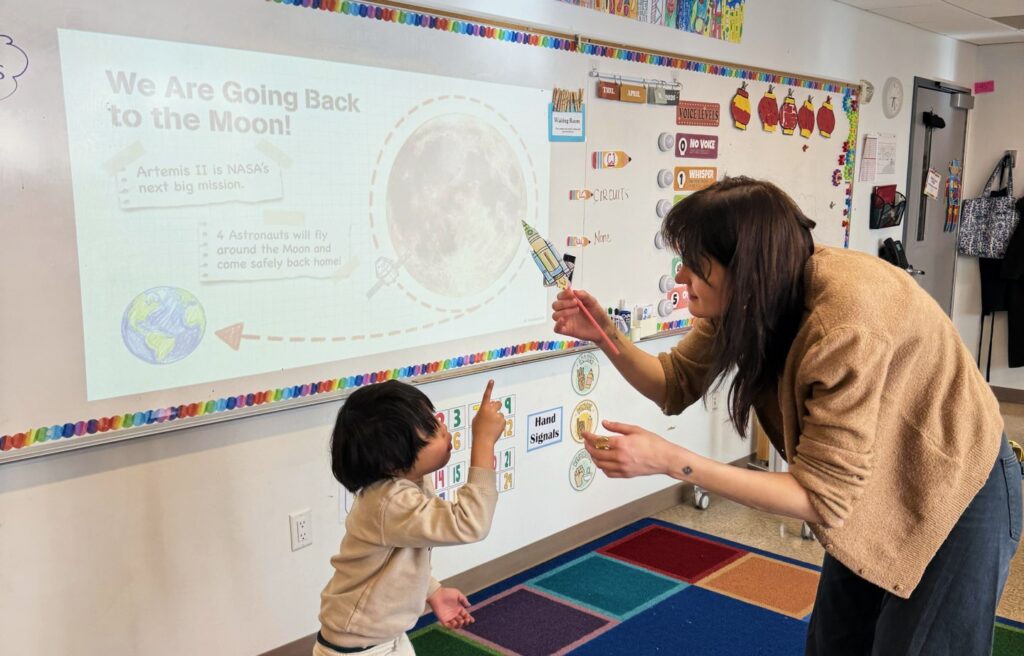
Primary students have a variety of specials throughout the week. This morning’s special is Engineering with Ms. DiBattista! Our Specials classes look different than the classic LET/SET model. During these classes, I sometimes work with small groups of students in various levels of reading groups conduct interventions or enrichment. Today, I pulled a few of my students to conduct a reading intervention activity, while the rest of my class did an engineering lesson with Ms. DiBattista. Students’ reading levels are decided by our process of reading assessments that happen once per trimester. With that data, students are placed into small groups, of 3–5 students, and work directly with me on various reading strategies such as identifying the main idea, providing text evidence, or determining character motivation. Building these skills will help students in English class, advance their literacy skills, and most importantly, allow them to be able to read and understand texts independently.
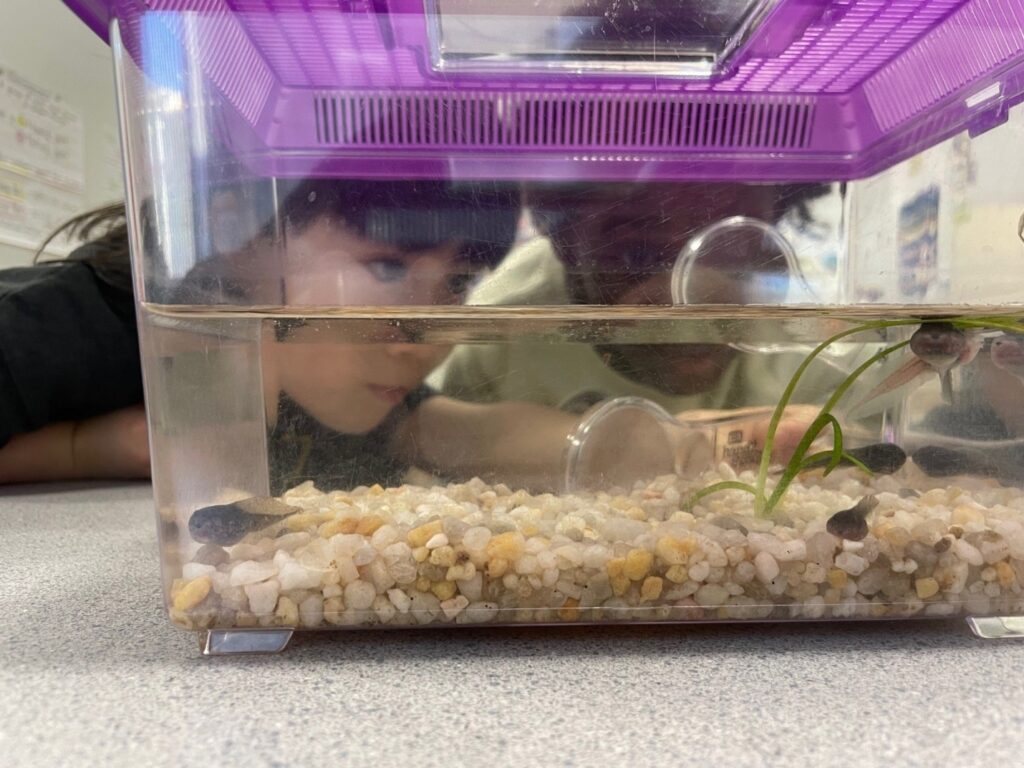

Period 3: English with Ms. Tseng!

Just like in Science class, students begin class by filling out their CJ’s, noting any homework or upcoming assessments, and working independently on their warm ups. Ms. Tseng and I usually collect this work and begin getting students ready for their Novel Study. Currently, we are reading The Phantom Tollbooth! We take turns reading pages in the book between Ms. Tseng, myself, and the students. Learning to annotate texts is a skill we are building and growing in Grade 4. The Phantom Tollbooth is great practice for these skills, as it has several settings and characters. Ms. Tseng may pause the reading to point out a vocabulary word that we need to write down. I may also pause when we meet a new character to take notes about their description and add a sticky note annotation. English class flies by when everyone is so invested in the story! Time to clean up, pack up, and line up for lunch and recess.


Period 5: Math with Ms. Tessler!

These consistent classroom routines make a huge difference in the lives of the students and the teachers. No matter what subject, students know exactly how each class is going to start and exactly what each teacher is expecting their behaviors should be. Grade 4 enters math class, fills out their CJs, and begins their math warm up. Math warm ups are usually a set of problems covering material that we learned the day before. I will go over the warm up with the class, model the work on the board, and answer any questions. Ms. Tessler will get the class set up and ready for notes in their math notebooks. As students are taking notes or working on their independent math assignment, this is a great time for me to look for students who are exhibiting qualities of P.A.C.E (perseverance, active, community, and empathy). Students who show one or more of these qualities at any time during the day receive a PACE Pass. Students turn in their earned passes to the front office to enter the grade level weekly raffle for a chance to win a small prize every Friday. Once all of our daily math tasks have been completed, it is time to clean up, pack up, and line up!


Period 6: Specials or Mandarin!

Three days of the week, Grade 4 has Mandarin class. There are two different Mandarin classes that students are sorted into from the beginning of the year based on ability-level. I do not attend Mandarin class, so I spend this time meeting with SETs, planning reading groups, or having an extra cup of coffee and a snack.

However, this afternoon is Drama with Mr. Mullens! Once all of the students have entered the drama space, filled out their CJs, and listened to Mr. Mullens’ daily expectations, I begin pulling another round of small reading groups. Groups can meet once, twice, or three times a week depending on students’ needs for reading and decoding texts. In Drama class, students are working in three different casts to write their own scripts for the upcoming spring performance. Even though some students are pulled away during the script writing, the entire cast works collaboratively and is able to quickly and effectively fill in any students upon their return to the classroom.


AE (Academic Enrichment) Time!

All students Grade 4 and above have a 20-minute AE period each afternoon. There are a variety of ways to spend a Grade 4 AE period: study hall, brain breaks, or most often, SEL (Social Emotional Learning), lessons and activities. For our SEL lessons we utilize a program called CharacterStrong at BASIS Independent Bellevue. Each month is centered around a character trait theme—October’s is Responsibility. Throughout the month, our class engages in mini-lessons, discussions, videos, and games designed to help students learn about and practice being responsible in their daily lives. Because academic expectations are high on this campus–even in the primary grades–it’s important to remind students that they are more than their grades, and that being a kid is about learning and growing in all areas of life.


Period 7: History with Ms. Rieger!

Our last core class of the day, but procedures and expectations remain the same. Students enter the classroom quietly, fill out their CJs with today’s topic, homework, and upcoming tests. Warm ups in History require students to have their binders and answer the questions on the board neatly on a piece of notebook paper. When the five–minute timer goes off, I read each question with the students and go over the answers. Often in this course there is some background information to read before students can dive deep into the new content, analyze cause and effects, and collect evidence. At the beginning of class I will read the passages with the students and have some student helpers annotate for vocabulary and important details. Then Ms. Rieger will share her slides, photographs, or stories about the time period we are focusing on and begin to ask critical thinking questions to the class. After notes, worksheets, or discussions, it is time to clean up, pack up, and line up once again.


Period 8: PE with Coach Shelp!

“Welcome to your favorite class!” is the way Coach Shelp begins PE. This class is different from Art, Music, and Drama because I always attend PE with my class. PE is a great way to get moving and learn about sportsmanship. Students begin each PE class by jogging some laps around the gym. Once we are warmed up, it is time to play—dodgeball, soccer, pickleball and more! We congratulate our teammates and exchange kind words with our opponents. Time flies in PE and then it is time to grab all of our belongings from our lockers and go home!

After all of my students have been picked up from dismissal, I meet with my co-teaching SETs to collaborate on lessons for the following week. After school you will find me at home in the coziest pajamas crocheting or snuggling with my cat. Another great day in Grade 4!


Filed Under: Academics, Community Values, Faculty & Staff, History, Humanities, Lower School, Mandarin, Math, Primary Program, Recess, School Community, Science, Student Learning, Student Life

A Day in the Life: Grade 6

October 16, 2025 by mirandamartinez Leave a Comment

What does a typical day look like for a grade 6 student at BASIS Independent Schools? We followed Uma, a student at BASIS Independent Fremont, through her day to find out—and to hear how she navigated the transition from her previous private school to BASIS Independent Schools’ rigorous academic environment.

Meet Uma

Uma joined BASIS Independent Fremont in grade 5 after moving from another private school in the area. Like many students who join in middle school, she had questions about what the transition would be like—and whether she’d find her place in a new academic community.

Today, Uma is thriving. Outside the classroom, she balances swimming (breaststroke is her specialty), soccer, piano, and will soon add fencing to her roster. She loves spending time outdoors and has built strong friendships across campus.

But the beginning of her journey looked different. “At first, I did not want to come to BASIS Independent Fremont (BIF). I didn’t want to leave my old school,” Uma remembers honestly. The first day felt overwhelming—until a classmate extended a hand. “This girl came up to me and said, ‘Hey, I’m Sunny. Do you want to sit with me at lunch tomorrow?’ I was just kind of keeping my head down the whole day, but then all of a sudden someone in my class just came up to me.”

That moment changed everything. “Actually, quickly, I really liked it. I met different people, some were from my old school, and I was able to make new friends.”

The academic adjustment took focus and effort. “Classes were obviously harder than in my old school. I struggled a little bit, but I got up to speed after about a month. My teachers were good, and they helped me, and there were Office Hours. Office Hours really help.” With the right support systems in place, Uma found her footing—and then some.

Her advice to families considering BASIS Independent Schools? “It seems hard at first to change schools, but you know, BIF has a lot of really nice people. The teachers are kind, they’re supportive, and I’ve really enjoyed my time here.”

So what does a day in grade 6 actually look like? Let’s walk through Uma’s schedule—from Latin translation to physics experiments—and see how the combination of challenging coursework and strong support systems helps students like Uma succeed.


Period 1 (8:25–9:10 AM): Latin IB with Mr. Baldwin

Uma’s day begins with Latin, where students build vocabulary, grammar, and translation skills while exploring life in the Roman Empire. Through Latin texts and historical sources, they investigate how different people—citizens, immigrants, enslaved individuals, and women—lived and contributed to Roman society.

Today, students worked in their “Legions”—collaborative small groups—to answer comprehension questions before sharing insights with the class.

Academic Enrichment (9:15–9:25 AM)

This brief period gives students time to prepare for their day—finishing assignments, studying for tests, connecting with friends, or simply taking a mental break. Academic Enrichment at BASIS Independent Fremont is held outdoors in their Quad and is monitored by a combination of teachers and administrators, specifically their Student Affairs Team, ensuring students have a safe and supportive environment to start their morning.

Period 2 (9:30–10:15 AM): PE & Sports 6 with Mr. Mosley

Physical education for grade 6 emphasizes communication, perseverance, and learning to respond constructively to both success and setbacks. Students explore the FITT principle and develop healthy habits that extend far beyond middle school. FITT stands for Frequency (how often), Intensity (how hard), Time (how long), and Type (what kind).

This week introduced flag football, with students learning gameplay fundamentals and building teamwork skills on the field.

Period 3 (10:20–11:05 AM): Pre-Algebra with Ms. Yaru

Pre-Algebra bridges arithmetic and higher-level mathematics, preparing students for Algebra I and Geometry. The curriculum covers essential concepts, including fractions, decimals, proportions, algebraic expressions, scientific notation, and real-world problem solving.

Today, students worked through algebraic equations—and Uma has discovered something unexpected. “My favorite class is Math. I never thought I’d say that, but Ms. Yaru makes it nice and easy. I like the way she teaches.”

*Grade 6 students take either Pre-Algebra or Algebra I and Geometry as their math course.

Period 4 (11:10–11:55 AM): Lunch

BASIS Independent Schools looks for local hot lunch providers that can offer a variety of meal options for special dietary needs, including vegetarian and nut-free.

During lunch, Uma plays four-square with friends. The competitive game sometimes brings intense moments, but she’s developed perspective. “I think I’ve just gotten a little bit more mature since coming to BIF. I’ve learned how to deal with situations and just go on with it.”

Period 5 (12:00–12:45 PM): Middle School Art with Teacher Danae

Students in grade 6 select a fine arts elective. Uma’s is Art. In this elective, students develop 2-D and 3-D art-making skills through traditional and contemporary techniques. The course emphasizes individual expression, historical perspective, and art as communication, with projects inspired by both contemporary and historical artists.

Students are completing their Album Cover Portraits, creating transformative works based on reference photos of subjects meaningful to them. Uma’s portrait features her older sister.

Period 6 (12:50–1:35 PM): English 6 with Mr. Gailliard

English 6 develops lifelong communication skills through five core components: conventions, reading, writing, scholarship, and reasoning. Students strengthen their command of grammar and punctuation while building critical thinking abilities and foundational research skills that support learning across all disciplines.

Today’s focus was on identifying helping verbs—fundamental building blocks of effective writing.

Period 7 (1:40–2:25 PM): Physics 6 with Ms. Yaru

Physics introduces students to the language that describes the physical world around them. Through core topics including motion, forces, energy, and electricity, students learn to apply mathematics to physical relationships. Hands-on demonstrations and laboratory sessions help students investigate everyday physics—from how bicycles work to what happens inside a battery.

Today, students learned to calculate speed using the gradient of a distance-time graph, connecting mathematical concepts to physical motion.

Period 8 (2:30–3:15 PM): World History & Geography I with Ms. Sagal

This course traces global human history from the Paleolithic Era through the Renaissance, examining major events and civilizations across Africa, Europe, Asia, Oceania, and the Americas. Students develop historical thinking skills—comparing civilizations, analyzing causes and effects, and constructing arguments from primary and secondary sources.

Today’s lesson explored the social and political characteristics of the Norte Chico civilization, one of the earliest complex societies in the Americas.

Office Hours (3:20–4:00 PM)

Teachers hold Office Hours throughout the week, for both students and parents, offering flexible one-on-one and small group support. Students use this time to ask clarifying questions, work through challenging material, or explore subjects more deeply. One day each week, grade 6 students enjoy unstructured outdoor time during this period.

While today is an outdoor day, Uma typically spends Office Hours with Ms. Yaru, working on math. “I did not want to do Office Hours at first, but this year, I’ve gone to all the math office hours, and it’s really helped me. I was not good at math before, but now I think I’m doing pretty well.”


After school, Uma heads to swim practice to work on her breaststroke technique, soccer training, or piano lessons. With fencing starting soon, she’s adding another dimension to her already active schedule—proof that rigorous academics and rich extracurricular experiences go hand in hand at BASIS Independent Schools.

BASIS Independent Dublin is a Grades 6 – 12 private school, providing students with an internationally benchmarked liberal arts and sciences curriculum, with advanced STEM offerings. Considering joining the BASIS Independent Dublin community? To join our interest list for the next school year and receive admissions updates and more, please click here.

Filed Under: Academics, Student Life

A Day in the Life: Uma V., Grade 6

October 16, 2025 by sarahpeterson Leave a Comment

What does a typical day look like for a grade 6 student at BASIS Independent Fremont (BIF)? We followed Uma through her day to find out—and to hear how she navigated the transition from her previous private school to BIF’s rigorous academic environment.

Meet Uma

Uma joined BASIS Independent Fremont in grade 5 after moving from another private school in the area. Like many students who join in middle school, she had questions about what the transition would be like—and whether she’d find her place in a new academic community.

Today, Uma is thriving. Outside the classroom, she balances swimming (breaststroke is her specialty), soccer, piano, and will soon add fencing to her roster. She loves spending time outdoors and has built strong friendships across campus.

But the beginning of her journey looked different. “At first, I did not want to come to BIF. I didn’t want to leave my old school,” Uma remembers honestly. The first day felt overwhelming—until a classmate extended a hand. “This girl came up to me and said, ‘Hey, I’m Sunny. Do you want to sit with me at lunch tomorrow?’ I was just kind of keeping my head down the whole day, but then all of a sudden someone in my class just came up to me.”

That moment changed everything. “Actually, quickly, I really liked it. I met different people, some were from my old school, and I was able to make new friends.”

The academic adjustment took focus and effort. “Classes were obviously harder than in my old school. I struggled a little bit, but I got up to speed after about a month. My teachers were good, and they helped me, and there were Office Hours. Office Hours really help.” With the right support systems in place, Uma found her footing—and then some.

Her advice to families considering BIF? “It seems hard at first to change schools, but you know, BIF has a lot of really nice people. The teachers are kind, they’re supportive, and I’ve really enjoyed my time here.”

So what does a day in grade 6 actually look like? Let’s walk through Uma’s schedule—from Latin translation to physics experiments—and see how the combination of challenging coursework and strong support systems helps students like Uma succeed.


Period 1 (8:25–9:10 AM): Latin IB with Mr. Baldwin

Uma’s day begins with Latin, where students build vocabulary, grammar, and translation skills while exploring life in the Roman Empire. Through Latin texts and historical sources, they investigate how different people—citizens, immigrants, enslaved individuals, and women—lived and contributed to Roman society.

Today, students worked in their “Legions”—collaborative small groups—to answer comprehension questions before sharing insights with the class.

Academic Enrichment (9:15–9:25 AM)

This brief period gives students time to prepare for their day—finishing assignments, studying for tests, connecting with friends, or simply taking a mental break. Academic Enrichment is held outdoors in our Quad and is monitored by a combination of teachers and administrators, specifically our Student Affairs team, ensuring students have a safe and supportive environment to start their morning.

Period 2 (9:30–10:15 AM): PE & Sports 6 with Mr. Mosley

Physical education for grade 6 emphasizes communication, perseverance, and learning to respond constructively to both success and setbacks. Students explore the FITT principle and develop healthy habits that extend far beyond middle school. FITT stands for Frequency (how often), Intensity (how hard), Time (how long), and Type (what kind).

This week introduced flag football, with students learning gameplay fundamentals and building teamwork skills on the field.

Period 3 (10:20–11:05 AM): Pre-Algebra with Ms. Yaru

Pre-Algebra bridges arithmetic and higher-level mathematics, preparing students for Algebra I and Geometry. The curriculum covers essential concepts, including fractions, decimals, proportions, algebraic expressions, scientific notation, and real-world problem solving.

Today, students worked through algebraic equations—and Uma has discovered something unexpected. “My favorite class is Math. I never thought I’d say that, but Ms. Yaru makes it nice and easy. I like the way she teaches.”

*Grade 6 students take either Pre-Algebra or Algebra I and Geometry as their math course.

Period 4 (11:10–11:55 AM): Lunch

BIF offers a hot lunch service that caters from several local restaurants, providing multiple menu options from each. The restaurants rotate throughout the year, giving students variety in their daily choices.

During lunch, Uma plays four-square with friends. The competitive game sometimes brings intense moments, but she’s developed perspective. “I think I’ve just gotten a little bit more mature since coming to BIF. I’ve learned how to deal with situations and just go on with it.”

Period 5 (12:00–12:45 PM): Middle School Art with Teacher Danae

Students in grade 6 select a fine arts elective. Uma’s is Art. In this elective, students develop 2-D and 3-D art-making skills through traditional and contemporary techniques. The course emphasizes individual expression, historical perspective, and art as communication, with projects inspired by both contemporary and historical artists.

Students are completing their Album Cover Portraits, creating transformative works based on reference photos of subjects meaningful to them. Uma’s portrait features her older sister.

Period 6 (12:50–1:35 PM): English 6 with Mr. Gailliard

English 6 develops lifelong communication skills through five core components: conventions, reading, writing, scholarship, and reasoning. Students strengthen their command of grammar and punctuation while building critical thinking abilities and foundational research skills that support learning across all disciplines.

Today’s focus was on identifying helping verbs—fundamental building blocks of effective writing.

Period 7 (1:40–2:25 PM): Physics 6 with Ms. Yaru

Physics introduces students to the language that describes the physical world around them. Through core topics including motion, forces, energy, and electricity, students learn to apply mathematics to physical relationships. Hands-on demonstrations and laboratory sessions help students investigate everyday physics—from how bicycles work to what happens inside a battery.

Today, students learned to calculate speed using the gradient of a distance-time graph, connecting mathematical concepts to physical motion.

Period 8 (2:30–3:15 PM): World History & Geography I with Ms. Sagal

This course traces global human history from the Paleolithic Era through the Renaissance, examining major events and civilizations across Africa, Europe, Asia, Oceania, and the Americas. Students develop historical thinking skills—comparing civilizations, analyzing causes and effects, and constructing arguments from primary and secondary sources.

Today’s lesson explored the social and political characteristics of the Norte Chico civilization, one of the earliest complex societies in the Americas.

Office Hours (3:20–4:00 PM)

Teachers hold Office Hours throughout the week, for both students and parents, offering flexible one-on-one and small group support. Students use this time to ask clarifying questions, work through challenging material, or explore subjects more deeply. One day each week, grade 6 students enjoy unstructured outdoor time during this period.

While today is an outdoor day, Uma typically spends Office Hours with Ms. Yaru, working on math. “I did not want to do Office Hours at first, but this year, I’ve gone to all the math office hours, and it’s really helped me. I was not good at math before, but now I think I’m doing pretty well.”


After school, Uma heads to swim practice to work on her breaststroke technique, soccer training, or piano lessons. With fencing starting soon, she’s adding another dimension to her already active schedule—proof that rigorous academics and rich extracurricular experiences go hand in hand at BIF.

Learn more about our Middle School Program here.

BASIS Independent Fremont is a TK – Grade 12 private school, providing students with an internationally benchmarked liberal arts and sciences curriculum, with advanced STEM offerings. Considering joining the BASIS Independent Fremont community? To join our interest list for the next school year and receive admissions updates and more, please click here.

Filed Under: Academics, Middle School, Student Learning, Student Life, Student Perspectives, Student Spotlight, Uncategorized

Subject Expert Spotlight: How Dr. C Redefines Biology at Our NYC Private School

October 7, 2025 by christineklayman Leave a Comment

At BASIS Independent Manhattan, our passionate Subject Expert Teachers (SET) are the secret ingredient to delivering our advanced curriculum in an engaging way, helping students take intellectual risks and make real-world connections outside of the classroom.

This month, we spotlight Dr. Chubaryov (Dr. C), our Biology SET at the Upper School in Chelsea, who teaches AP and Honors Biology in addition to AP Environmental Science to our high school students. After reading about her approach in the classroom and what makes her one of the best teachers in Manhattan, come and see for yourself at one of our Fall Open Houses.

Dr. Chubaryov

The Spark: From Opera to Observation

In August, Dr. C balanced a full life that brought huge changes at the start of this school year: she graduated from her PhD program at NYU and got married. Yet, her focus remains on the students. Dr. C’s own passion for biology was ignited in high school by an amazing teacher who made the subject exciting—even “cool.” A fond memory that sticks with her is how her biology teacher would play opera music while instructing the class on how to do dissections. This mix of creativity and deep study informs her teaching today.

Two female students performing a dissection in biology class

Thinking Like a Scientist: Beyond Memorization

Once in high school at BASIS Independent Manhattan, students have already completed three years of physics, biology, and chemistry. With this preparation and budding passion for biology, Dr. C can immediately help grow her students’ intellectual curiosity. She also challenges them to take risks that go beyond just learning biology, helping them feel confident to “do biology.”

Dr. C is one of the best subject expert teachers in manhattan, demonstrating a hands-on learning lab for her students

From NYU PhD to Chelsea Classroom

To enable her students to be active participants, Dr. C emphasizes that they are scientists in training. She often brings her doctoral research into the classroom, sharing personal anecdotes about her work in the NYU lab studying Hirschsprung Disease. These stories help her students connect abstract concepts – like cellular signaling or genetics – and their real-world applications. Dr. C notes that this is when she really sees her students thinking like scientists: reasoning through how biological systems interact and discovering both the beauty and relevance of biology in everyday life.

three female students present a biology poster on cell organelles

A Nurturing Academic Environment

When asked about their teacher, students immediately get wide-eyed and say she is great because of her duality. Dr. C’s teaching style is direct, but it is constantly peppered with personal anecdotes about her PhD studies that bring the subject to life. Students also appreciate how she holds them accountable, but does so by consistently performing “checks for understanding” to ensure every student feels supported. This exemplifies the nurturing academic environment at BASIS Independent Manhattan, where students feel inspired to safely take intellectual risks and achieve their highest potential.

student presenting to her peers in the classroom

The Takeaway

BASIS Independent Manhattan’s unique model, featuring passionate Subject Expert Teachers who deliver an advanced curriculum in a nurturing environment, is why we are recognized among the best NYC private schools. It’s designed to empower students to think critically and achieve great success.

Experience the BASIS Independent Manhattan difference!

Join us at one of our upcoming Fall Open Houses to meet Dr. C and the rest of our incredible teachers.
Upper School
Sunday, October 26
Grades 6–12, Chelsea Campus
10:00 AM–12:00 PM

Lower School
Saturday, October 25
PreK–5, UWS Campus
10:00 AM–12:00 PM

Save Your Spot Today

Filed Under: Academics, Admissions Events, Faculty & Staff, High School, Science, STEM, Student Learning

Our Entire Class of 2025 and Approximately 70% of High School Students Awarded AP Scholar Distinction

October 3, 2025 by jogoldfarb Leave a Comment

At BASIS Independent Brooklyn, we prioritize celebrating our students’ accomplishments. Today, we can proudly share that all members of our Class of 2025 and nearly 70% of our high school students qualified as Advanced Placement (AP) Scholars during their tenure at our school. Students move from AP Scholar to AP Scholar with Honor and then AP Scholar with Distinction. With the 2025 scores, BASIS Independent Brooklyn students earned the highest-ever average AP test score of 3.94 as well as the highest-ever passing rate of 94%.

“We reached a milestone this year with every one of our seniors receiving an honor of AP Scholar or higher this year at BASIS Independent Brooklyn,” said Josh Harmon, Head of School for BASIS Independent Brooklyn’s Upper School. “When looking at all students in grades 9-12, our students earned the highest average score yet of 3.94 across all the exams and a pass rate of 94%. This is possible due to a number of factors: the strong drive of our students, an outstanding curriculum that spirals through the years, the expertise of our teachers, and the overall support offered by our faculty and Student Affairs team.”

AP Scholar awards recognize students who have demonstrated both a depth and breadth of knowledge and whose work has shown college-level mastery across multiple disciplines. The College Board awards the following distinctions for AP exams, and we have students who have achieved all levels.

AP Scholar: students who received a score of 3 or higher on 3 or more AP exams.

AP Scholar with Honors: students who received a score of 3 or higher on 4 or more exams, and have an average score of at least 3.25 across all exams taken.

AP Scholar with Distinction: students who received a score of 3 or higher on at least 5 exams, and an average score of 3.5 across all exams taken.

Nationwide, only about 10% of students earn the distinction of AP Scholar or higher by the time they graduate (based on historic data provided by the College Board). We are thrilled to share some of the top accomplishments here:

80 students in our high school were named AP Scholar (or higher distinctions), representing approximately 67% of our high school, after the exams were taken in May 2025.

Approximately 63% of our seniors received the AP Scholar with Distinction, the highest award offered by the College Board.

Congratulations to all our students who have earned an AP Scholar Award for their performance on the exams during their High School tenure. See the full list of student recipients updated to include the 2025 results below:

AP Scholar: Students who received a score of 3 or higher on 3 or more AP exams.

Victor Bergman-B. ’25

Dana B. ’26

Matthias B. ’25

Leo B. ’25

Leonardo C. ’27

Joaquim H. ’26

Gabriel H. ’26

Rachel K. ’25

Ethan L. ’27

Summer L. ’26

William M. ’28

Hendrix. N. ’25

Jason P. ’25

Saajan P. ’26

Ishan P. ’28

Julia R. ’28

Gabe S. ’26

Willa S. ’27

Sasha T. ’25

Vivian W. ’27

Victor Y. ’27

Erica Z. ’26

AP Scholar with Honors: Students who received a score of 3 or higher on 4 or more AP exams and have an average score of at least 3.25 across all exams taken. Nationwide, only about 6% of students will graduate high school with this degree of recognition or higher. Nearly all of these honorees have done so well before graduation.

Bodhi D. ’27

Laith J. ’25

Audrey L. ’27

Viola L. ’25

Noah N. ’27

Nolan S. ’27

Isabella Y. ’27

AP Scholar with Distinction: Students who have a score of 3 or higher on at least 5 exams, and an average score of 3.5 across all exams taken. These students have already completed at least a semester’s worth of college credit while still in high school. Only about 4% of graduating seniors nationwide receive this award, and less than 1/10th of 1% of students receive it after sophomore year.

Overall, in our high school, more than 50 students received this honor:

Wyatt A. ’26

Orsen A. ’27

Iris Autier-B. ’27

Maya B. ’27

Philip B. ’26

Henry B. ’27

Jack C. ’25

Nathaniel C. ’26

Mia C. ’26

Nicolas D. ’25

Colin D. ’25

Axel F. ’25

Petra G. ’27

Alexa G. ’26

Abraham G. ’27

Douglas H. ’27

Archie H. ’26

Maxwell H. ’25

Mateo K. ’25

Sofia K. ’27

Katherine K. ’26

Lianna L. ’26

Aidan L. ’25

Harrison L. ’27

Thomas M. ’25

Sabrina M. ’26

Varick M. ’27

Maddox M. ’25

Sefir O. ’26

Talin P. ’26

Crosby P. ’27

Gustavo P. ’25

Kanika R. ’26

Noah R. ’26

James R. ’25

Skye S. ’25

Zahra S. ’26

Hudson S. ’27

Nadia S. ’25

Xinyi S. ’26

Bowen S. ’27

Gregory S. ’26

Maxim S. ’25

William S. ’27

Hugo S. ’27

Jasmine S. ’26

Indi S. ’27

Olivia S. ’27

Ryan T. ’25

Beckham V. ’26

River W. ’26

Photo (above): Our Class of 2026 posing with Head of School Josh Harmon and College Counselor Matt Brauch.

Please join us in congratulating our Bears!

BASIS Independent Brooklyn is a PreK–Grade 12 private school, providing students with an internationally benchmarked liberal arts and sciences curriculum, with advanced STEM offerings. Considering joining the Bears community? To join our interest list for the next school year and receive admissions updates and more, please click here.

Filed Under: Academics, AP Scholars, Awards & Recognition, Featured, High School, Student Achievement, Student Learning

  • Page 1
  • Page 2
  • Page 3
  • Interim pages omitted …
  • Page 6
  • Go to Next Page »

© BASIS Independent Schools

  • Contact Us
  • Media Recognition
  • Careers
  • Privacy Policy
  • CA Privacy
  • Terms of Use

Headquartered in Campbell, California, Spring Education Group is majority-owned by investment funds administered by Primavera Holdings Limited, an investment firm owned by Chinese persons and principally based in Hong Kong with operations in the United States, China and Singapore.

Sitemap