
Hera L-Y, a senior at BIM, conducted a series of water-quality analyses on samples collected from several local areas during her free time. After testing samples from Falls Church, Loudoun County, Washington, D.C., Montgomery County (MD), and Alexandria, VA, she discovered a significant discrepancy between Alexandria’s results and those of the other regions. We recently interviewed her about her process and findings.

Hera, I know you’ve been doing your own research on Polyfluoroalkyl substances (PFAS) in our water, and it was recently written about in the Alexandria Times. How did you get started looking into forever chemicals?
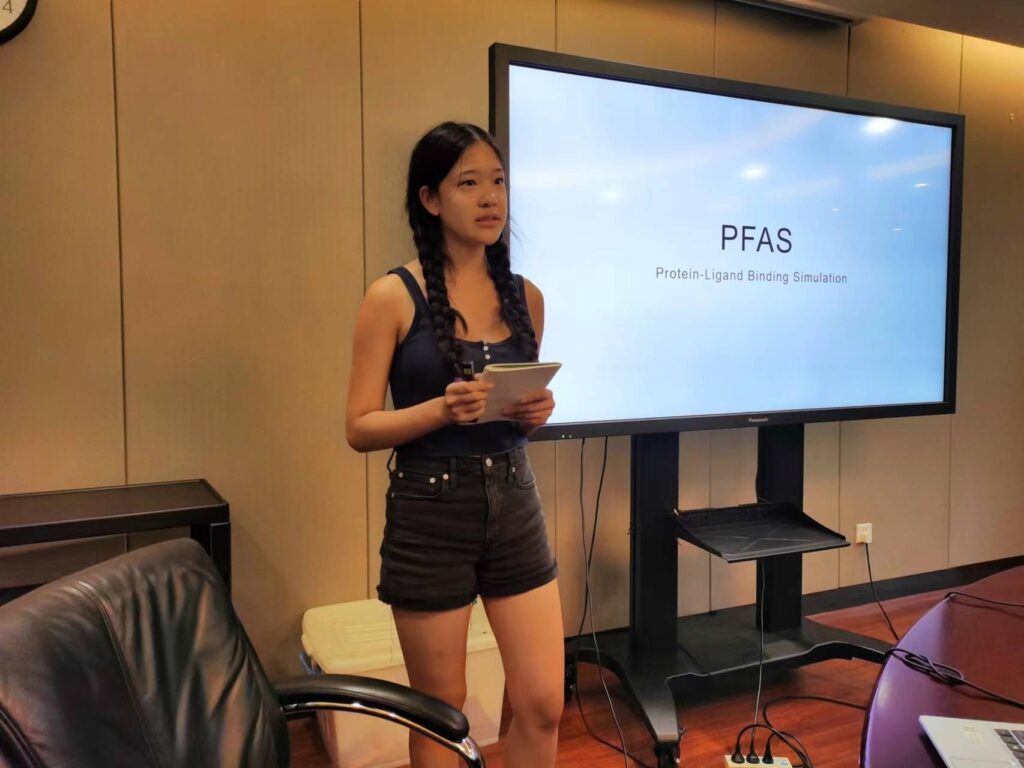
In the summer after my sophomore year, I did an internship in a chemistry lab in China, and the professor who was mentoring me introduced me to PFAS and gave me a project to work on with the help of some graduate students. I learned a bunch of different simulation software and then simulated the interactions between PFAS and proteins. We used Perfluorooctanoic acid (PFOA), which is really common. We studied its interaction with bovine serum albumin, which is a protein in cows very similar to human serum albumin but a bit less complicated.
We found that the binding energy was really strong, which told us that PFOA was really likely to bind to the protein. And then we calculated how much the protein changed after interaction with PFOA and found it hadn’t changed much at all. We realized that because the interaction was so stable, the body wasn’t recognizing it as a foreign particle. But binding to the protein could still knock it out of service.
It harms protein function without triggering any sort of immune response? That doesn’t sound good.
Not good.
So your lab work got you interested in PFAS. How did you get from there to testing local water?
After that summer, I knew that this was something that I wanted to continue looking into. I built my own website about PFAS, trying to, like, educate people as much as possible about products that contain them. And then in March or April of 2024, I started this project. What sparked the whole thing was that I found these filters online that let you test your own tap water’s PFAS level. So I bought two and tested my tap water, and then also tested boiled water, because my family drinks a lot of tea.
Then I wondered if the concentration in my home would be different from my friends’ homes. So I tested in a bunch of different towns: Arlington, Alexandria, Loudoun, and Falls Church. The average was around 9-10 PPT, but there were two outliers. Loudoun was really low, around 3.5 PPT. And I actually expected that to happen because they advertised that they are implementing things to filter out PFAS. So I knew Loudoun was going to be lower than the rest, but then I found that my first result for Alexandria was 22 PPT, more than twice the average. At first, I thought it might have been an experimental error, so I tested again at a different location in Alexandria. That one came back 17 PPT, so less, but still way more than average.

So what was going on with Alexandria’s water?
What I did was look into the water sources for all the counties. So I tested the Potomac River and the Occoquan Reservoir, because those are the two main sources of water in Northern Virginia. Both were in double digits. The Potomac was around 15 PPT, and the Occoquan was 21 PPT, both of which are lower than the first Alexandria reading, which was a little confusing. But concentrations do vary with rainfall.
I reached out to a few newspapers because I’ve never seen this covered before, and I got connected with the journalist who wrote the article. We did some research and found an article from 2023 that talked about how Alexandria had an actionable level of PFAS. The mayor at the time was talking about how they were going to do something to stop it, but their levels are actually higher now. So clearly, they didn’t really do anything.
What’s next with this project?
It’s kind of on pause right now for college applications, but I definitely want to continue it in college. Because we know PFAS are bad for us, but we don’t know the extent of how bad. There’s a strong correlation between the concentration of PFAS in someone’s body and liver cancer. I do know that the liver is the main thing that detoxes your body. Because PFAS are so non-degradable, they kind of build up in your liver over time. I’m curious about the biochemistry there.
Sounds fascinating. I look forward to hearing more about it in the future. Thanks, Hera!
BASIS Independent McLean is an Age 2–Grade 12 private school, providing students with an internationally benchmarked liberal arts and sciences curriculum, with advanced STEM offerings. Considering joining the Red-Tailed Hawks community? To join our interest list for the next school year and receive admissions updates and more, please click here.