• Skip to primary navigation
  • Skip to main content

BASIS Independent Schools

BASIS Independent SchoolsBASIS Independent Schools
  • About
    • Why BASIS Independent Schools?
    • Diversity & Citizenship
    • History
  • Academics
    • Curriculum
    • Early Learning Program
    • Primary Program
    • Middle School Program
    • High School Program
    • The Senior Year
    • Summer Programs
    • International Student Program
  • Achievements
    • International Performance
    • College Admissions
    • Advanced Placement
    • National Merit
  • Find Your School
Inquire

Science

Making Science Come to Life: Every Spring, Our Cubs Watch Life Change Before Their Eyes

June 5, 2026 by jogoldfarb Leave a Comment

There’s a moment that happens every spring in our Lower School classrooms when a hush falls over a group of young Cubs as they peer into a glass container and watch, with wide eyes, as something that was once a tiny egg or a wriggling larva becomes something entirely different. It’s the kind of moment no worksheet or video can replicate.

That’s exactly why, for several weeks each spring, our Lower School dedicates itself to one of science’s most wondrous stories: the life cycle.

“In an urban environment where kids don’t get as much exposure on a day-to-day basis to nature, anything we can do to bring the natural world to life for students is really important,” commented Head of the Lower School Ms. Miller-Sims. “When you can put a living creature in front of them and observe the life cycle from the beginning, you just see it light up in their eyes in a completely different way than learning about it on a screen, or learning about it in a textbook, or talking about it through a discussion in class. Those moments are just so pivotal, because it is what the children will remember and constantly go back to, even as they age, remembering these foundational experiences.”

Engaging, Experiential Learning

From PreK through Grade 2, our students don’t just read about how living things grow and change; they witness it. Each year, our campus becomes a living science lab as we welcome a carefully chosen cast of creatures: caterpillars that spin themselves into chrysalises, tadpoles paddling in tanks, ladybug larvae inching along leaves, and eggs nestled in a warm incubator, waiting to hatch.

The goal isn’t just to teach biology. It’s to give children a visceral, unforgettable understanding of transformation, and allow them to see that living things change, grow, and become something new, right in front of their eyes.

“When students see something happening in real time, they really learn the best that way,” stated Grade 2 Math and Science Subject Expert Teacher Ms. Witherspoon. “When we have our eggs in our incubator, they can see how they are growing inside. Yes, we have a chart where they can see inside the egg. It’s different when you see it day by day. Once the chicks hatch, they can see how fast they may grow, or that not all chicks are yellow, learning about different colors and different breeds. The joy on their faces when they learn something and see it in person is just really unforgettable.”

Students observing the growth of tadpoles in Kindergarten

Why Hands-On Learning Matters

Young children learn best when they can touch, observe, and wonder. Watching a tadpole sprout tiny legs over the course of a week is a lesson in patience, curiosity, and scientific observation all at once. Checking on a tray of eggs each morning teaches children to look closely for details, to notice small changes, and to ask questions. When a chrysalis finally opens, the room fills with a kind of collective awe that’s impossible to manufacture and impossible to forget.

“The whole school gets involved by the time our chicks are hatching,” said Ms. Witherspoon. “I get parents, all the time, sharing that they are learning just as much as their children are learning. It’s great just to see from our littlest ones in the PreK classrooms to our oldest ones in Grade 2 how they are all just curious at the end of the day.”

These experiences also build a foundation for scientific thinking that will serve our Cubs for years to come. They begin to understand that nature operates on its own timeline, that change is a process, and that the world is full of living things undergoing their own remarkable journeys.

The Lineup This Spring

Each creature we bring to campus represents a different kind of life cycle story:

Caterpillars to chrysalises to butterflies: Students observe the transformation from larva to winged insect, learning about metamorphosis up close.

Tadpoles: The classic frog life cycle unfolds in a classroom tank, day by day.

Ladybug larvae: These spotted favorites go through a dramatic transformation that surprises even the adults in the room.

Chick eggs: Perhaps the most anticipated of all, children gather around the incubator and wait (and wait and wait) for the first signs of hatching. “Chick watch” is the term we use, and this year, Ms. Witherspoon helped welcome the great-grand chicks of the first chicks hatched in her classroom three years ago!

A Tradition Worth Protecting

In an age of screens and simulations, there’s something quietly radical about putting a living creature in a child’s classroom and saying: watch what happens. Our Lower School’s life cycle unit is one of those rare school experiences that students carry with them long after the school year ends- the spring they saw a chick hatch, the morning they noticed the tadpole had legs.

We’re proud to offer our Cubs this window into the natural world, and we are committed to nurturing their curiosity in such engaging ways for years to come.

Students in PreK marvel at butterfly larve

Filed Under: Academics, Early Learning Program, Featured, Primary Program, Science, STEM, Student Learning

The Evolution of Lab Sciences: From Exploration in Primary Years to Advanced Laboratory Experiences in High School

May 22, 2026 by emilyhughes Leave a Comment

At BASIS Independent Bellevue, science comes to life through hands-on experiments, collaborative projects, and engaging investigations that encourage students to think critically and creatively. Across every division, from Primary School to High School, students are actively exploring the world around them in a variety of capacities.

Primary School: Building Curiosity Through Exploration

In Primary School, students are introduced to the wonders of science and engineering through engaging, project-based learning experiences. Throughout the primary years students deepen their knowledge of essential science concepts while teachers inspire a sense of wonder and excitement about the natural world, encouraging them to see themselves as young scientists ready to explore and discover.

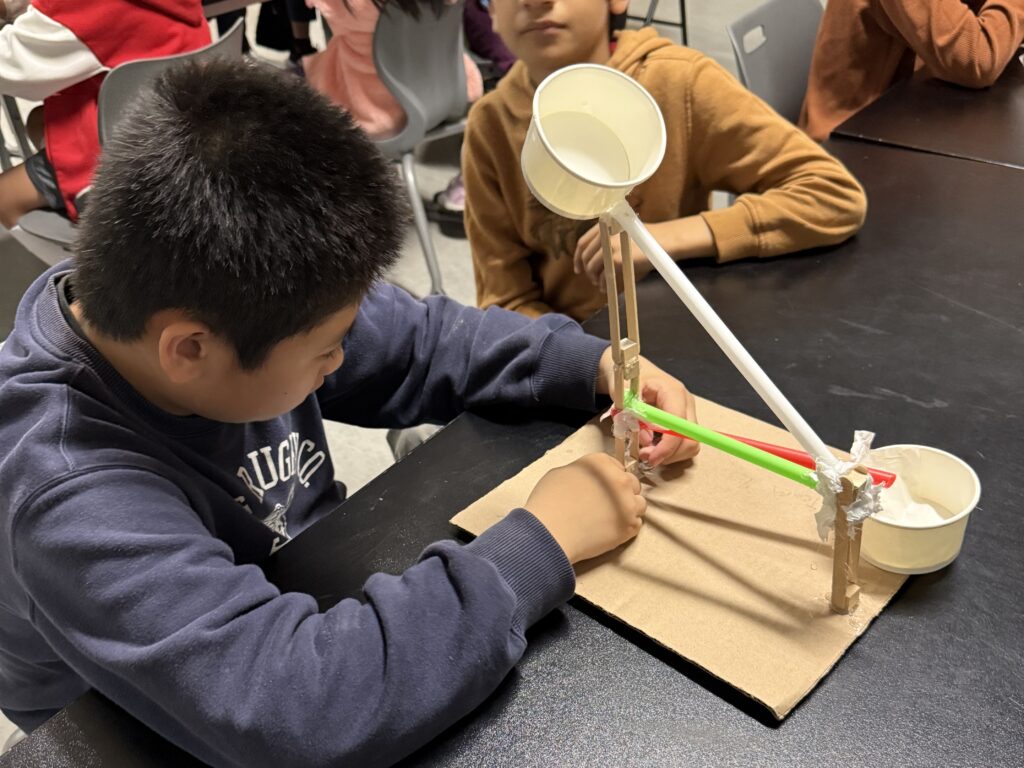
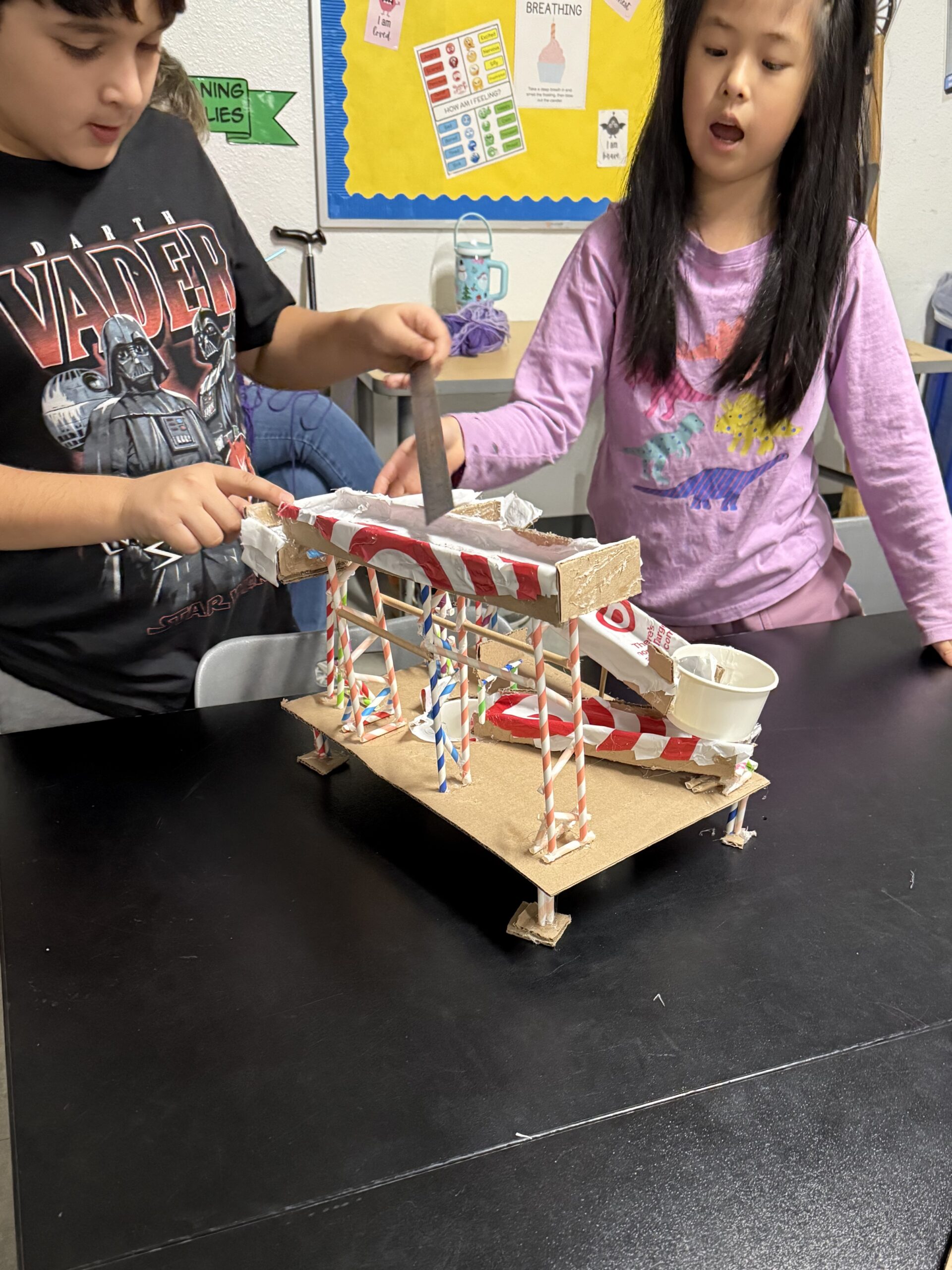
In engineering classes, students explored various aspects of STEAM through units on civil and aerospace engineering. During the civil engineering unit, students worked collaboratively to design free-standing paper skyscrapers and environmentally informed cities centered around green spaces. In aerospace engineering, students designed rockets inspired by the Artemis II launch. During presentations, the BASIS Aeronautics Space Administration (B.A.S.A.) voted on the most innovative rocket design, with one winning all-girls team, impressing classmates by designing a rocket capable of cooking s’mores for astronauts during takeoff.

Class presentations
Most Innovative Rocket Design Winners!
Paper skyscraper city
Grade 3 students admiring their city.
A proud rocket engineer!

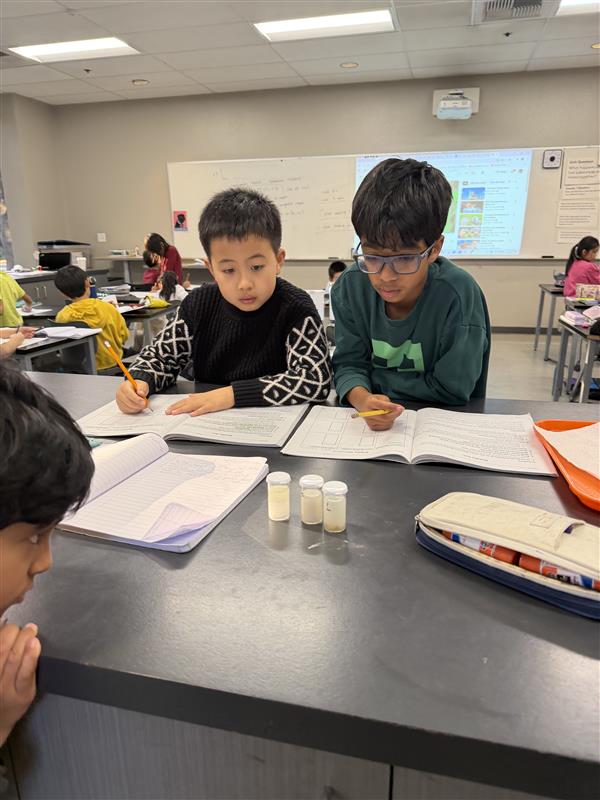
Students also participated in several exciting scientific investigations throughout the year. During a month-long moon phase project, students observed and documented the moon each night in moon journals before reenacting the positions of the Earth, moon, and sun to better understand lunar phases. Students also explored light energy through learning centers focused on how light travels and reflects off surfaces. Another favorite activity came during the measurement unit, where students practiced measuring liquids and following detailed lab instructions. If completed correctly, the experiment resulted in a colorful rainbow, making science both educational and exciting.

Exploring light energy
Reenacting lunar phases
Rainbow measuring lab

Middle School: Applying Science Through Hands-on Learning

Middle School students take scientific exploration to the next level through challenging labs, engineering projects, and interactive investigations. From grade 6–grade 8 students take three separate, concurrent science classes, biology, chemistry, and physics.

In physics classes, students participated in the “Egg War,” where they applied concepts such as Newton’s Laws, momentum, impulse, and kinematics to design vehicles capable of protecting an egg during a head-on collision. Students also explored electricity by building a variety of circuits using batteries, wires, and light bulbs, gaining firsthand experience with electrical systems and experimentation.

Final round of “The Egg War”
Experimenting with circuits
“The Egg War” in action

Engineering electives have also provided students with opportunities to collaborate and innovate. In grade 6 Introduction to Engineering, students worked together to build and code robots capable of competing in friendly robot battles. Through this project, students strengthened their skills in coding, construction, teamwork, and problem-solving.

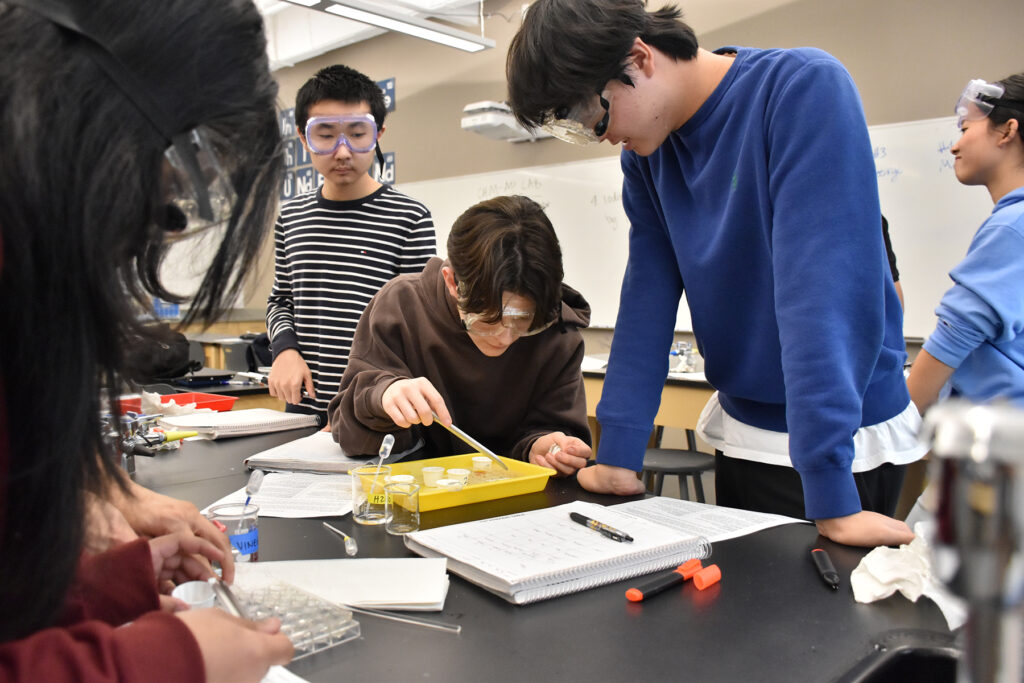
Middle School chemistry students recently completed a stoichiometry lab involving a single replacement reaction between Copper (II) Sulfate and Aluminum. Students calculated theoretical yields, conducted the reaction, and analyzed their percent yield based on the copper produced. Biology students have also immersed themselves in the study of anatomy and life sciences through a variety of dissections, including cow hearts, cow eyes, frogs, and owl pellets. In addition, students explored the microscopic world by using microscopes to observe tissues, organisms, and cellular structures.

Cow heart dissection
Observations with a microscope
Frog dissection
Stoichiometry lab
Copper yield

High School: Connecting Theory to Real-World Science

In high school science courses, students deepen their understanding of scientific concepts through advanced laboratory experiences and independent inquiry. In AP Physics 2, students conducted a capacitance lab in which they built parallel-plate capacitors using aluminum foil and textbooks. By testing how effectively paper functioned as a dielectric material, students were able to apply classroom equations to real-world experimentation and engineering design. In AP Physics 1, students got to build model trebuchets, a medieval siege engine powered by a counterweight. They explored the forces and torques acting on the system and how their design choices affected the range and accuracy of their models.

Building the trebuchet
Testing the trebuchet

Honors and AP Chemistry students have also engaged in a wide variety of labs throughout the year, including titrations, acids and bases investigations, and experimental procedure design. Students are often challenged to create their own methods for achieving a scientific goal using only a provided set of materials, encouraging creativity and critical thinking in the lab. But what is the fun in chemistry without some fire? One particularly memorable experiment involved testing metals in flames to demonstrate properties of matter. By combining alcohol with different salts, students produced brilliantly colored flames that brought chemistry concepts vividly to life!


From designing rockets and building robots to conducting advanced chemistry and physics experiments, students across all grade levels are discovering that science is more than just a subject. It is an opportunity to explore, create, and innovate. Through these engaging lab experiences, our students continue to develop the problem-solving skills that will assist them in their future endeavors.


Filed Under: Academics, High School, Lower School, Middle School, Science, STEM, Student Learning, Uncategorized

Dr. Araci Honored with Regional Teaching Excellence Award from the American Chemical Society

January 29, 2026 by sarahpeterson Leave a Comment

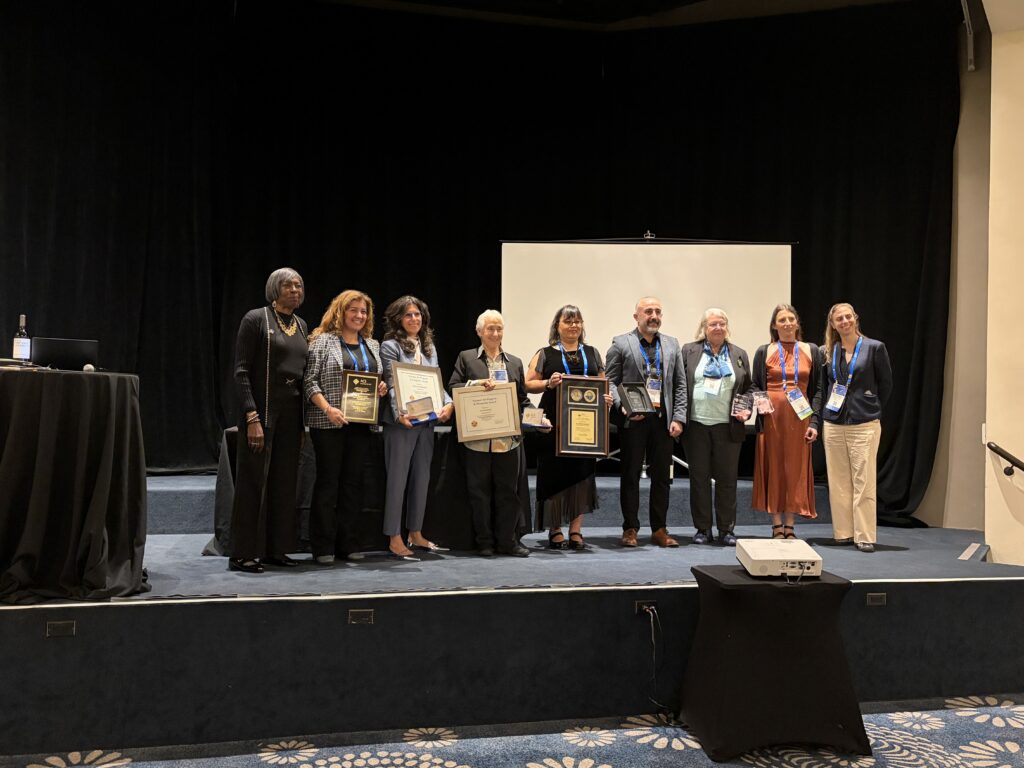
Excellence in education deserves to be celebrated—and we couldn’t be prouder to share that Dr. Araci, the Chemistry Subject Expert Teacher at Fremont Independent Upper School, has been recognized by the American Chemical Society with the 2025 Regional Award for Excellence in High School Teaching in the Western Region.

Dr. Araci received this prestigious honor at the ACS Western Regional Meeting Awards Ceremony in San Jose in October, standing out among exceptional educators across a 15-section region spanning California, Arizona, Hawaii, and Nevada.
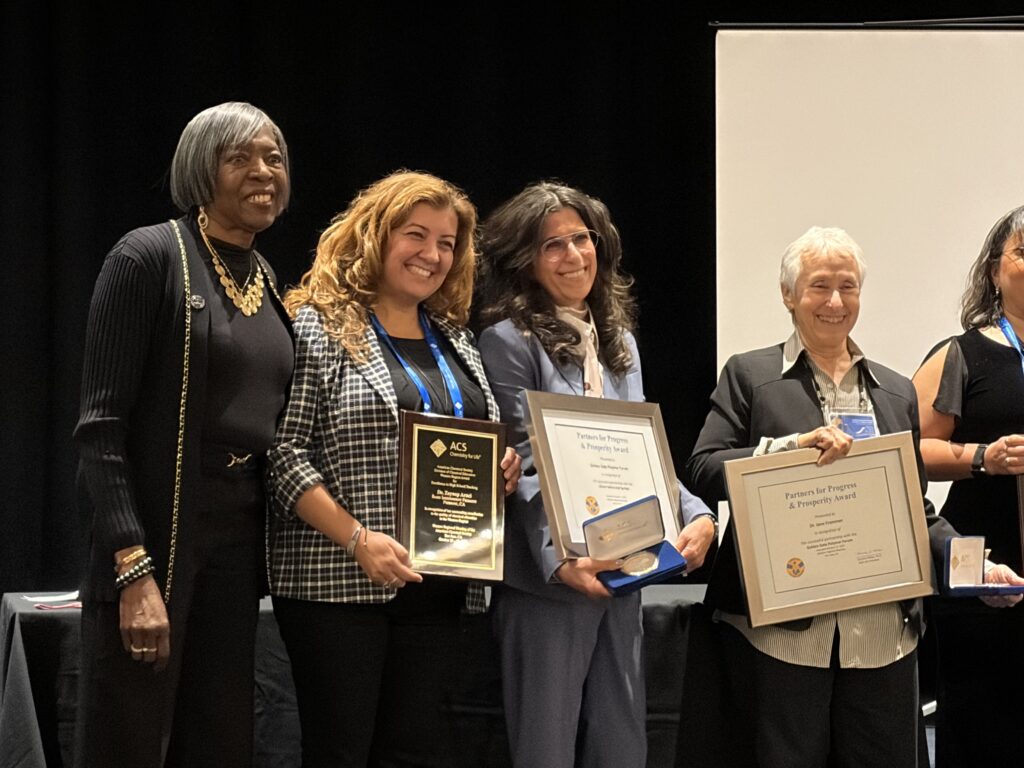
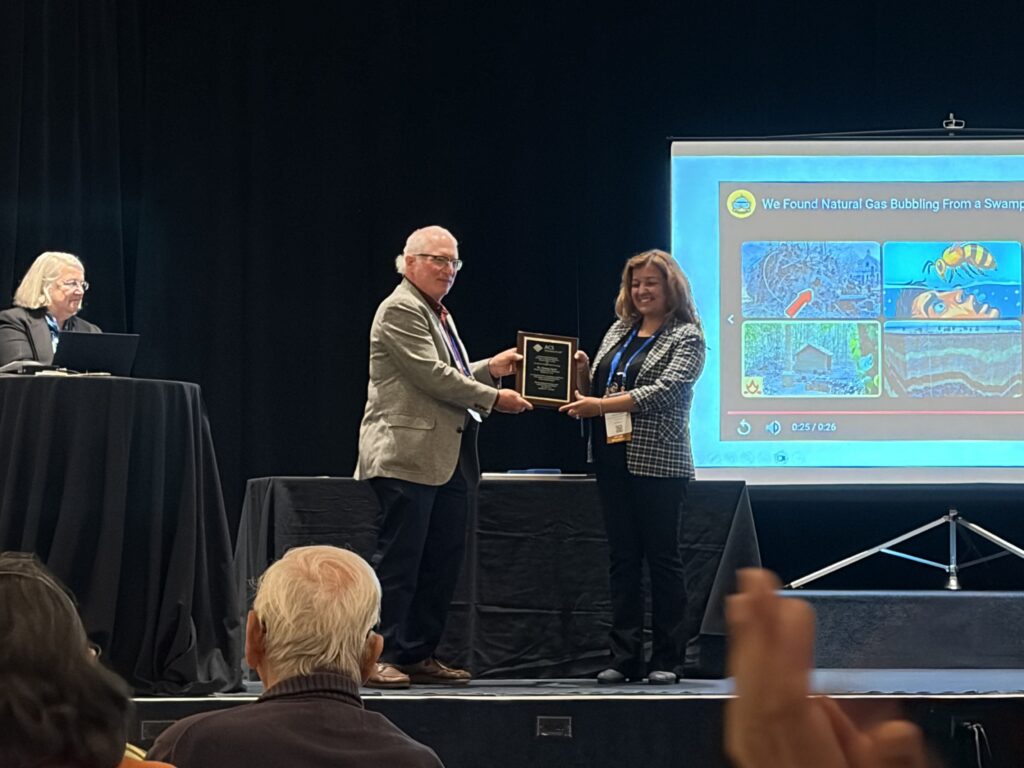
“We are incredibly proud of Dr. Araci’s recognition,” said Ms. Abodouma, Head of School. “This award is so well-deserved. Dr. Araci elevates the learning experience on our campus every single day, inspiring our students to see chemistry not just as a subject to study, but an exciting exploration and another lens through which they can understand and transform the world around them.”

The Excellence in High School Teaching Award celebrates educators who demonstrate exceptional quality of instruction, inspire and challenge students, and contribute to the broader chemistry education community. Dr. Araci embodies these qualities in remarkable ways.

In her Honors Chemistry, AP Chemistry, and Drug Discovery and Development Capstone courses, Dr. Araci creates a transformative college-level learning environment where students evolve into independent thinkers and researchers. Through hands-on laboratory work and collaborative discussions, she empowers students to seek answers, ask deeper questions, and discover the joy of scientific inquiry.

Her impact extends far beyond the classroom. Dr. Araci leads workshops on academic integrity and classroom engagement and advises student-led initiatives and competitions, including the Chemistry Club, the You Be the Solution Challenge, the ACS Berkeley Chemistry Tournament, and the US National Chemistry Olympiads. She also created one of our school’s most beloved traditions: the annual Honors Chemistry Debate held each Valentine’s Day. This unique event brings together students and the entire school community to explore thought-provoking questions like “What makes the world go around: Money or Love?”
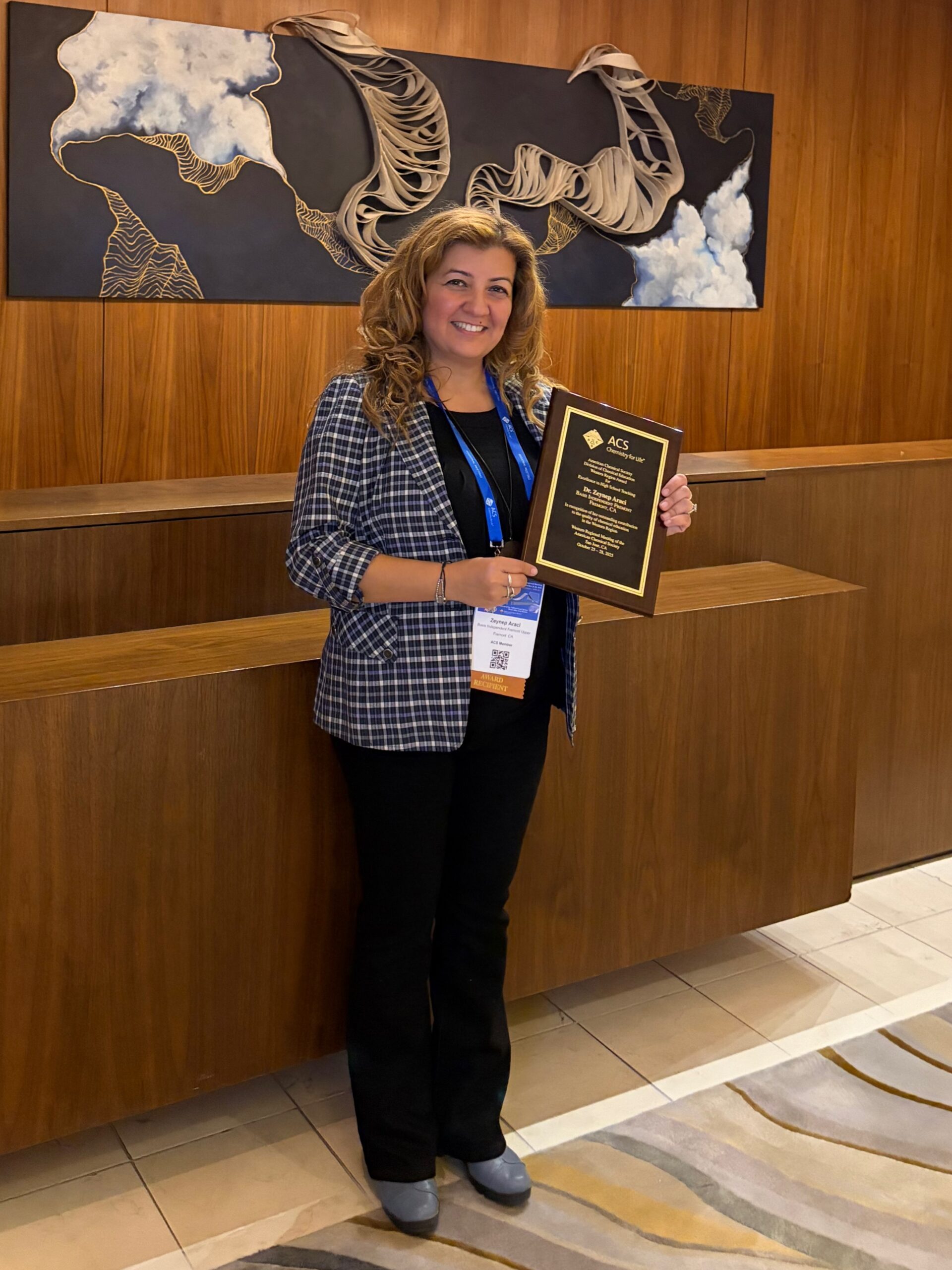
“It was wonderful to be recognized, and I am honored to be awarded by ACS,” Dr. Araci shared after the ceremony, where she connected with educators, college professors, and industry professionals from across the Western United States—relationships that promise to open new doors for collaboration and opportunity for our students.

This recognition is a testament to Dr. Araci’s unwavering dedication to making chemistry engaging, accessible, and transformative. She doesn’t just teach chemistry; she ignites curiosity, builds confidence, and shapes the next generation of scientists and critical thinkers.

Congratulations, Dr. Araci. This honor reflects what we’ve known all along—you’re making an extraordinary difference.

Explore our innovative programs and see how BASIS Independent Fremont is redefining STEM education.

BASIS Independent Fremont is a TK – Grade 12 private school, providing students with an internationally benchmarked liberal arts and sciences curriculum, with advanced STEM offerings. Considering joining the BASIS Independent Fremont community? To join our interest list for the next school year and receive admissions updates and more, please click here.

Filed Under: Administration & Staff, Awards & Recognition, Faculty & Staff, Featured, Science, Uncategorized

Real Questions, Real Investigations: How BASIS Independent Fremont Students Develop Scientific Thinking Skills

January 22, 2026 by sarahpeterson Leave a Comment

Real scientists don’t start with textbooks. They start with questions about the world around them. At BASIS Independent Fremont (BIF), our Lower School students learn the same way: by investigating real phenomena, testing their ideas, and using evidence to support their conclusions. From engineering solutions to ancient problems to exploring why oil and vinegar refuse to mix, BIF students practice thinking like the scientists and engineers they may one day become.

Learning Through Real-World Investigation

At BIF, science education is phenomena-based, meaning students begin with observable events and real-world questions rather than memorization. Our approach develops three essential skills: active investigation (students doing, not just watching), scientific communication (reading, writing, and discussing like scientists do), and evidence-based reasoning (supporting conclusions with data).

This matters because these skills extend far beyond the science classroom. Whatever our students choose to become in life, they need to ask thoughtful questions, analyze information, and solve complex problems. Science at BIF is preparation for thinking critically about the world.

What Scientific Thinking Looks Like at BASIS Independent Fremont

Students Observe and Question

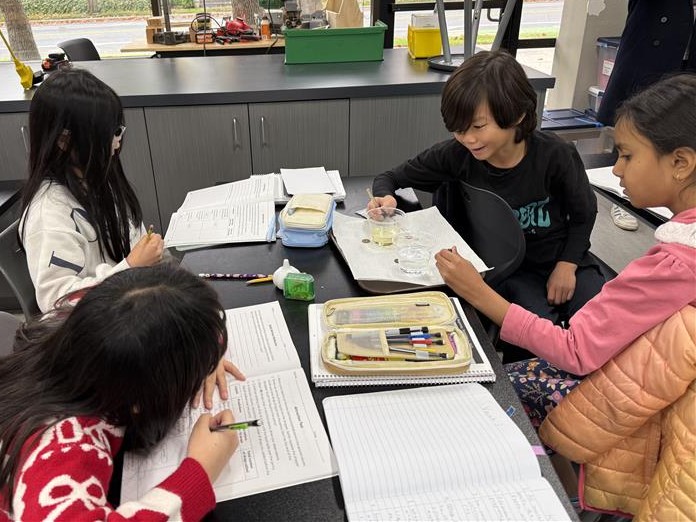
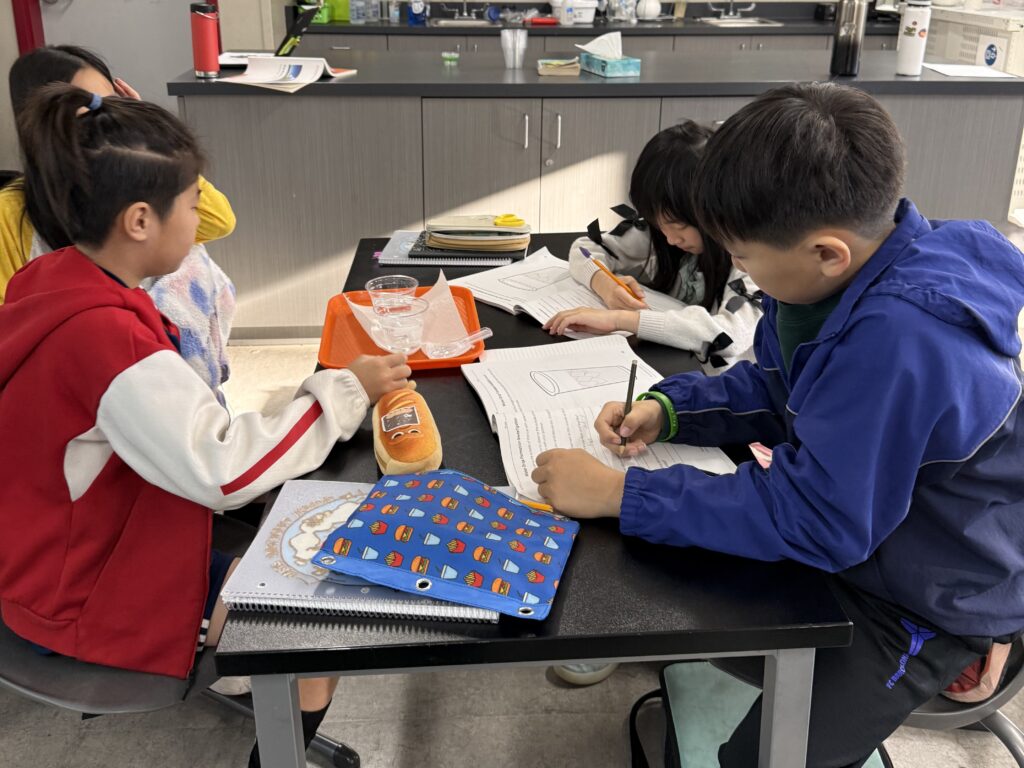
In Dr. Luo’s grade 4 science class, students recently tackled a deceptively simple question: why do oil and vinegar sometimes mix instead of separating into layers? “We started at the observable scale by having students mix oil and vinegar and notice that they don’t mix and instead form layers,” Dr. Luo explains. From that initial observation, students generated their own questions about what was happening at a molecular level—questions that would drive their entire investigation.

Similarly, in Mr. Kasper’s engineering class, the students face a historical challenge: How did ancient Rome transport fresh water to support its growing population? “Students are guided to ask essential questions such as: Why is this a problem? Who is being affected? What are the possible causes of the water shortage?” Mr. Kasper notes. “Students are encouraged to ask additional questions of their own, deepening their understanding of the challenge.”

Students Investigate and Test

Scientific thinking requires more than curiosity—it demands action. Dr. Luo’s students moved from observation to experimentation, testing various substances to see what would help oil and vinegar combine. “Students experimented with adding lecithin, flour, and cornstarch to oil and vinegar. They discovered that lecithin helps oil and vinegar mix by acting as an emulsifier.”

In engineering, Mr. Kasper’s students design and build prototypes of aqueducts, working within budgets and material constraints just as real engineers do. “During construction, they test their structures for strength and for their ability to successfully transport water,” he explains. “Testing is an ongoing process, and students carefully record not only how their prototypes perform, but also the results of each test and the improvements they believe will fix any issues.”

Students Read, Write, and Communicate Like Scientists

Scientific literacy is just as important as hands-on experimentation. Dr. Luo’s students didn’t just conduct experiments—they read scientific texts to deepen their understanding. “Students built their own online models and read texts like Handbook of Food Science and Solving Dissolving to learn about molecular structure and how molecules attract themselves and other molecules,” she shares.

Throughout their investigations, students document their findings in science journals, write lab reports, and present their conclusions to classmates. This mirrors how real scientists communicate their discoveries to the broader scientific community.

Students Use Evidence to Support Their Ideas

Perhaps most importantly, BIF students learn that good ideas must be backed by evidence. When Dr. Luo’s students concluded that lecithin acts as an emulsifier, they could point to specific experimental results and molecular models that supported their claim. They learned about emulsifiers’ special structure—one that can attach to both oil and vinegar molecules—through both reading and hands-on observation.

Mr. Kasper’s engineering students practice the same evidence-based thinking. “Each idea is discussed and evaluated based on the identified constraints and goals, such as efficiency, cost, available materials, and the ability to successfully transport water,” he explains. “Through this process, students learn that engineering is not about choosing the first idea, but about carefully comparing options to determine the best possible solution.”

Building Skills That Last

The sophistication of scientific thinking grows as students do. By grades 4 and 5, students are working with complex concepts like molecular structure and engineering design processes, but the foundation begins much earlier—with kindergarteners observing how materials change and grade 1 students exploring the natural world.

These investigations teach students to approach problems with confidence. They learn that failure is part of the process, that questions are more valuable than quick answers, and that evidence matters more than opinions. As Mr. Kasper notes, “This reflection reinforces the idea that engineering is iterative and that failure is an important part of learning and improvement.”

By the time BIF students reach Upper School, they’ve spent years practicing how to think, not just what to think. They carry forward skills they’ll use for life: asking thoughtful questions, designing investigations, using evidence to support ideas, and communicating findings clearly.

Science as a Way of Thinking

At BASIS Independent Fremont, science isn’t a subject students study. It’s a way of thinking to practice every day. From our youngest Bumblebees to our grade 5 students preparing for middle school, students learn to approach problems like scientists and engineers: with curiosity, creativity, and evidence.

Want to see scientific thinking in action? Schedule a campus tour to visit our Lower School classrooms and discover how BIF students are learning to investigate, question, and solve the problems that matter.

BASIS Independent Fremont is a TK – Grade 12 private school, providing students with an internationally benchmarked liberal arts and sciences curriculum, with advanced STEM offerings. Considering joining the BASIS Independent Fremont community? To join our interest list for the next school year and receive admissions updates and more, please click here.

Filed Under: Academics, Featured, Lower School, Science, STEM, Uncategorized

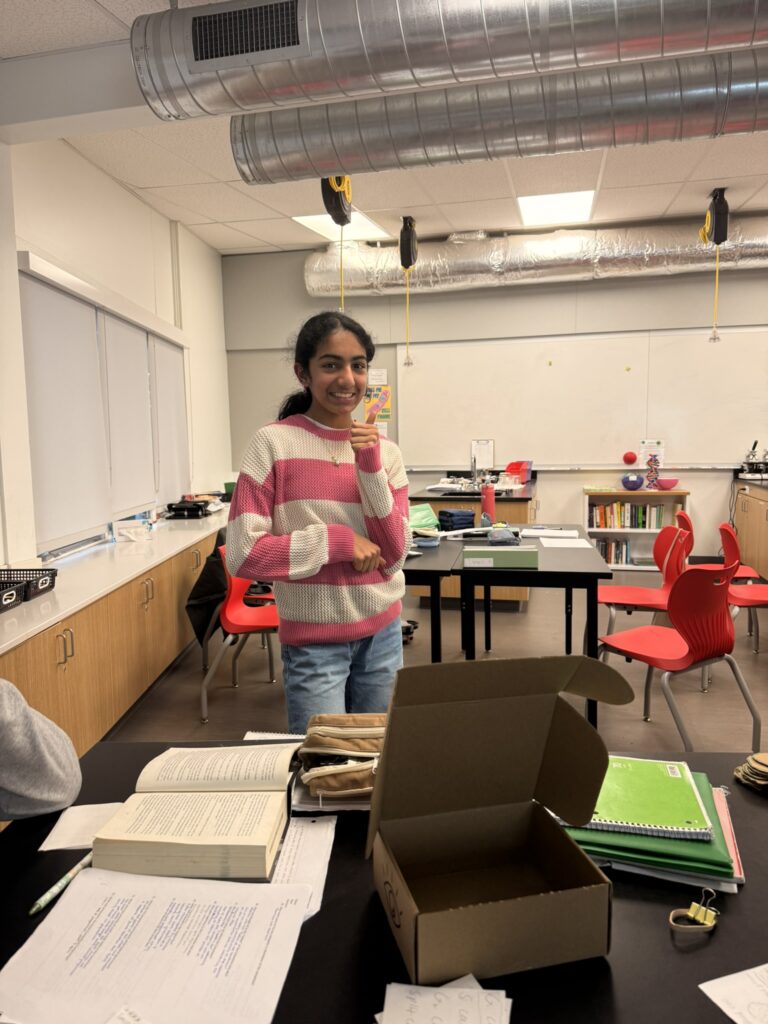
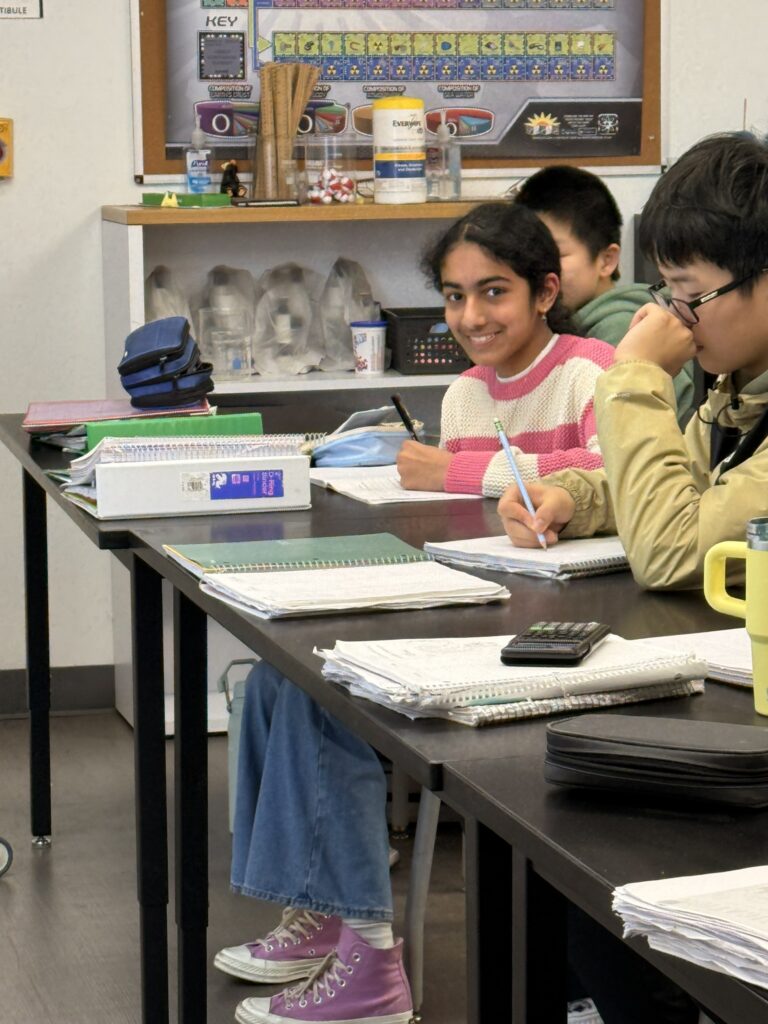
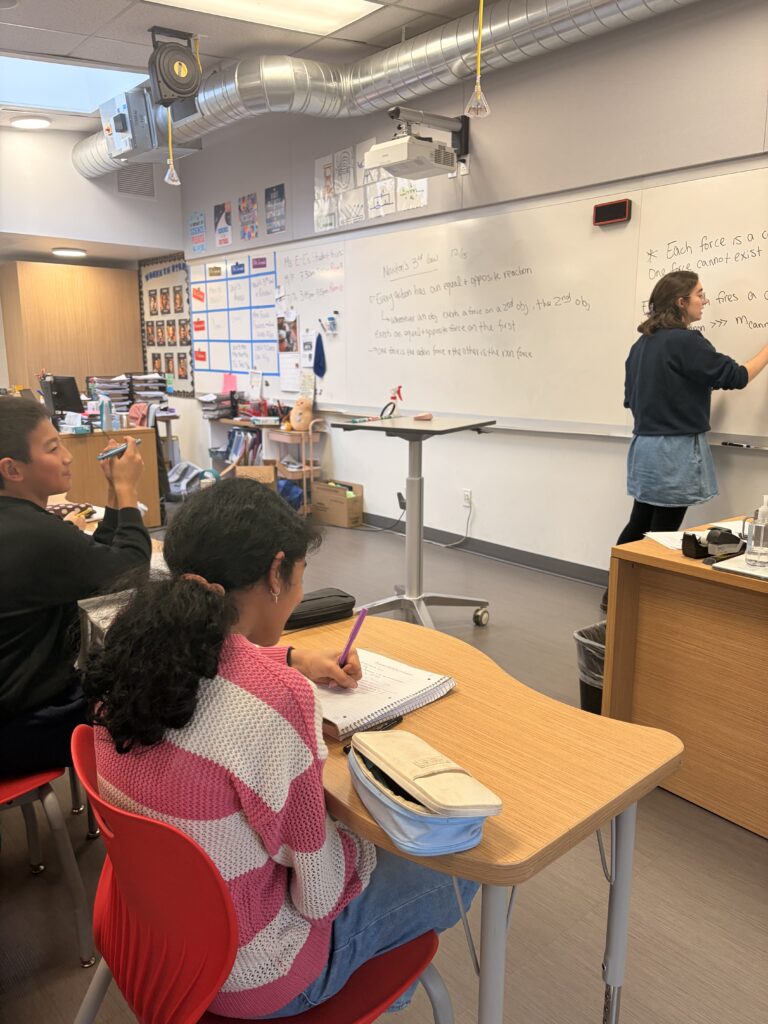
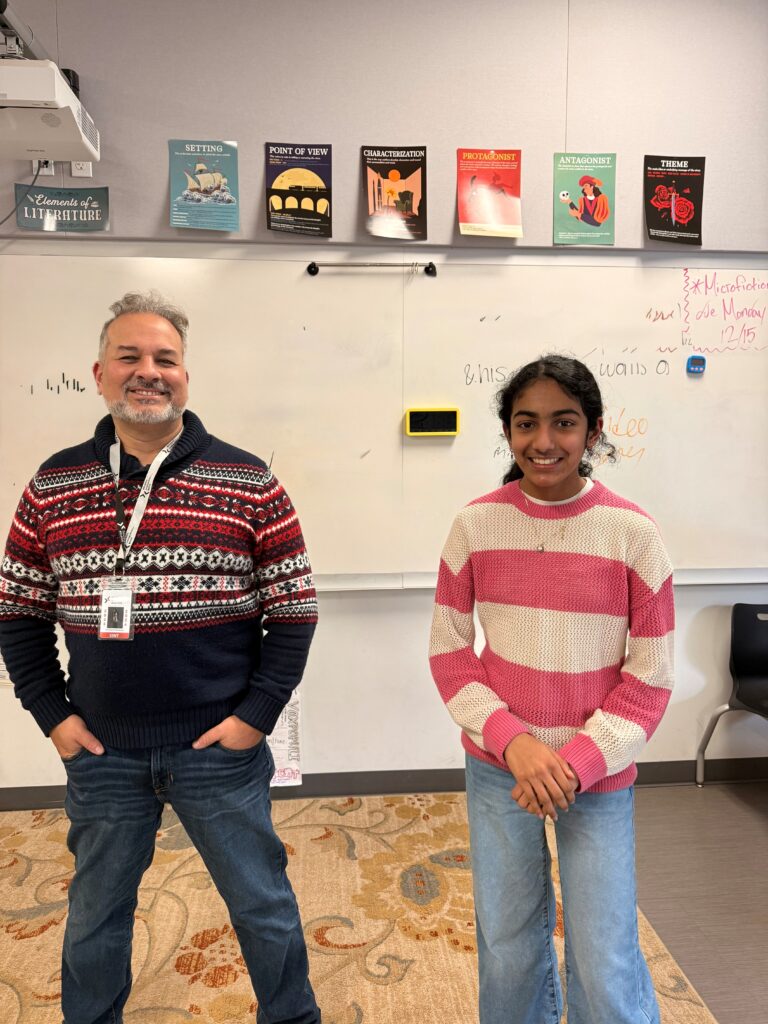
Step Inside Grade 8 at BASIS Independent Bellevue with Megna P.!

December 17, 2025 by emilyhughes Leave a Comment

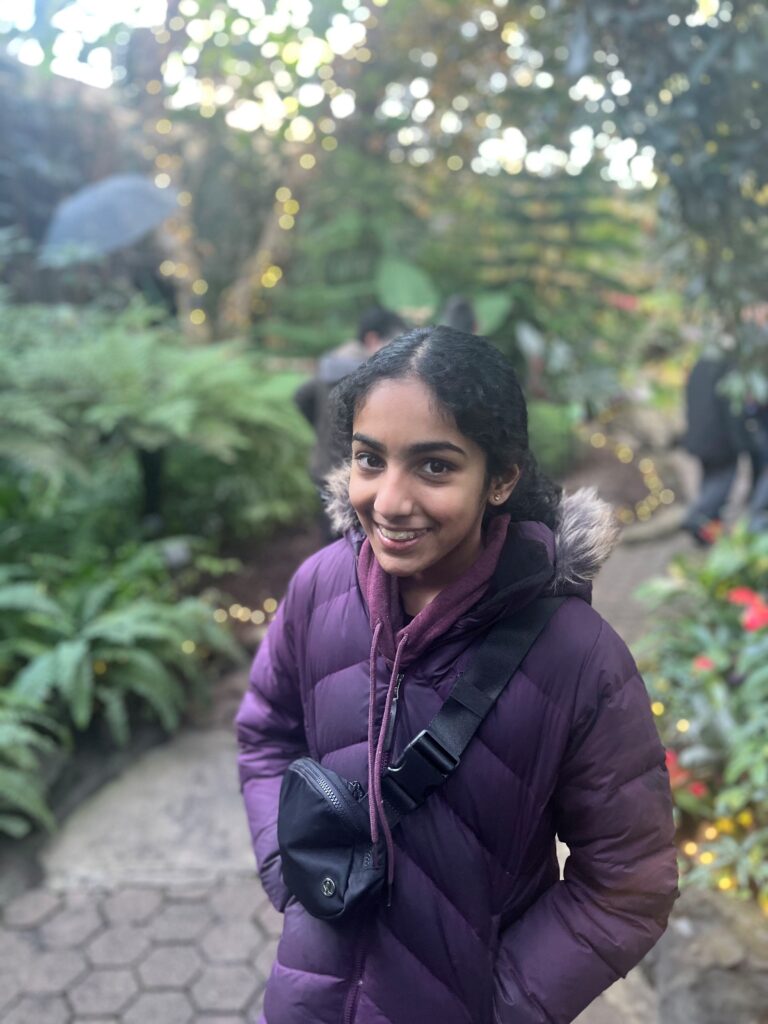
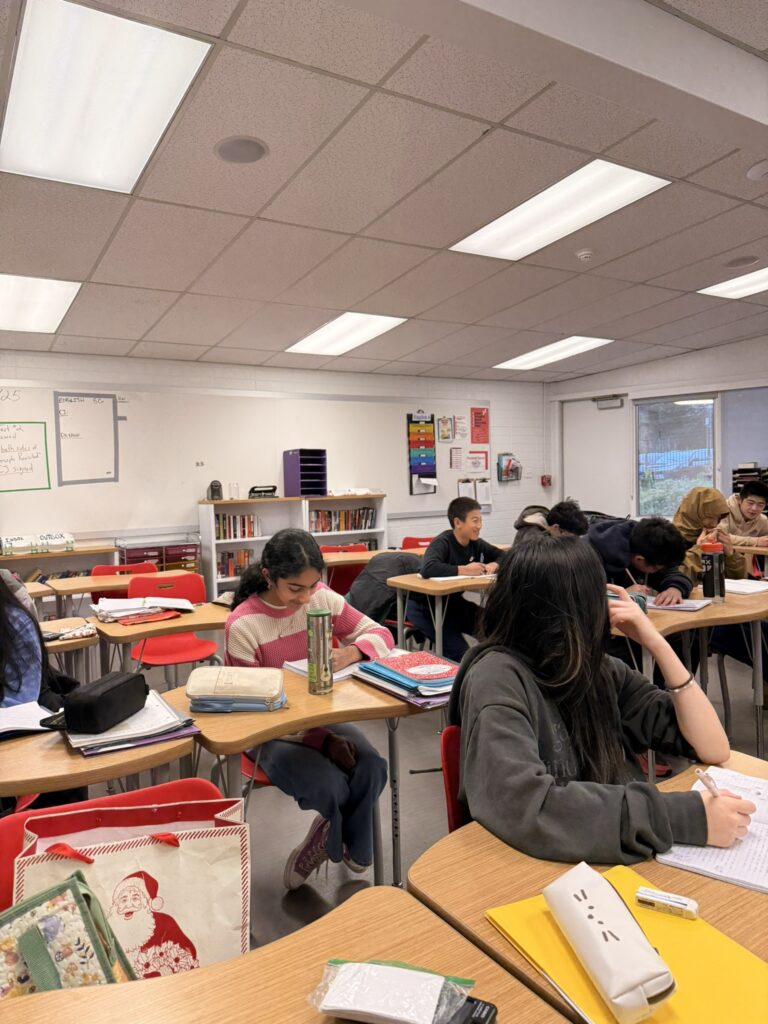
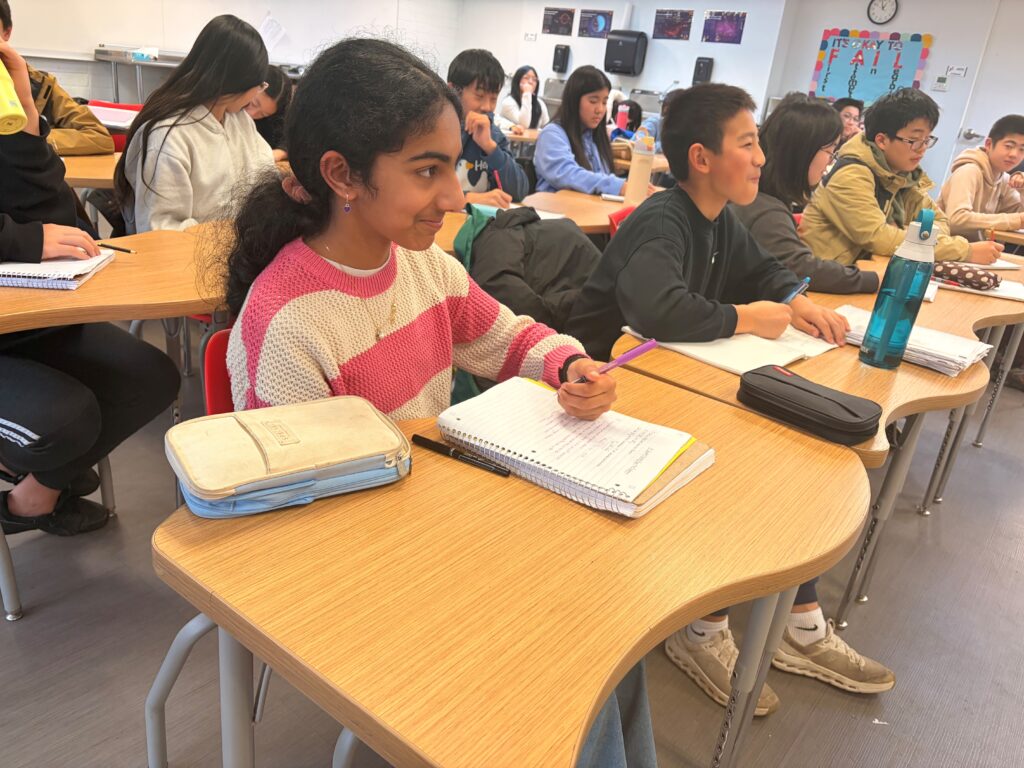
Meet Megna P., a beloved grade 8 student at BASIS Independent Bellevue! Megna is a brand new student to our campus, having just joined BLV in fall 2025 and we couldn’t be more excited to have her as a part of our Mountaineer Community!

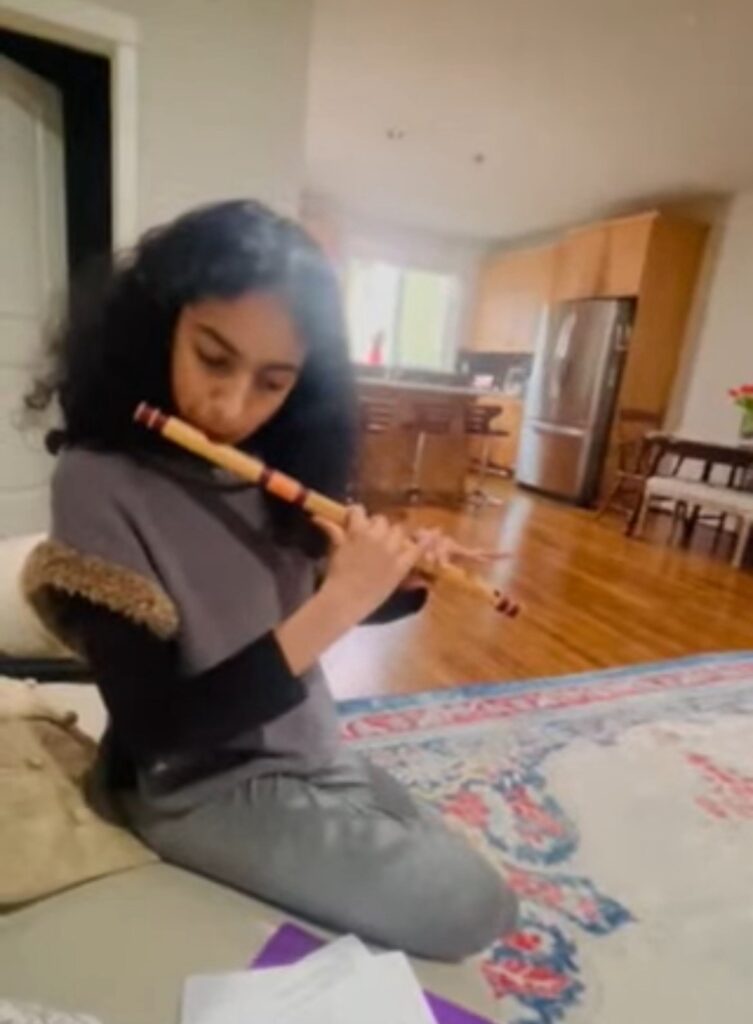
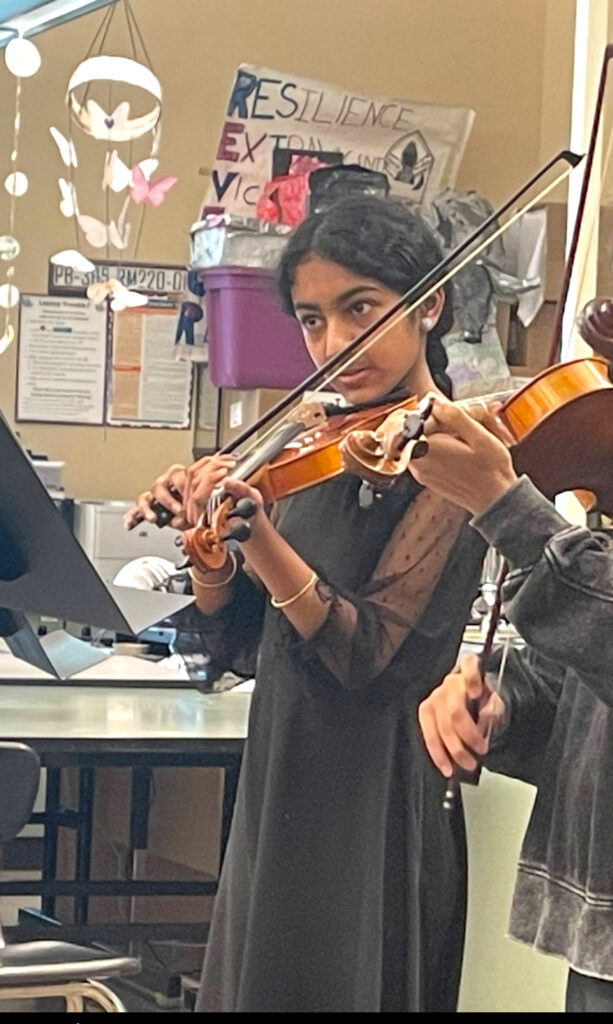
Although it is just her first year at BASIS Independent Bellevue, Megna was eager to get involved on campus and is already a part of National Junior Honor Society and our Student Ambassador program. Outside of school Megna loves music. She enjoys playing the flute, violin, and singing! Megna was kind enough to let us follow her around for a day, so we could highlight all of the wonderful aspects of being a grade 8 student at BASIS Independent Bellevue.


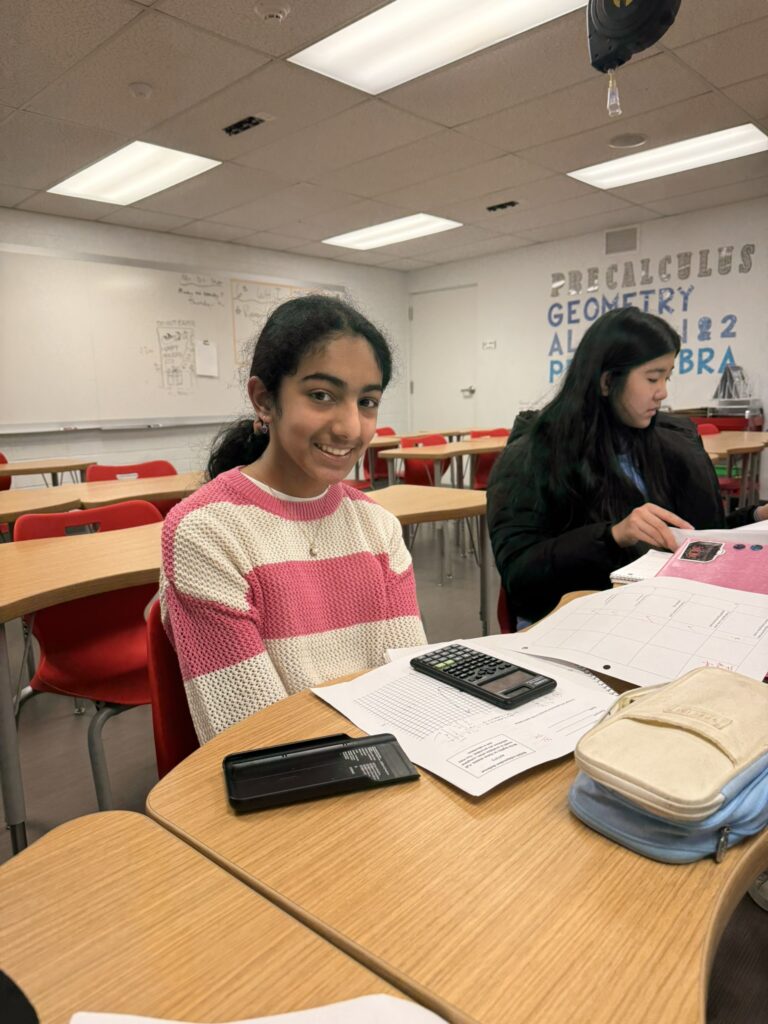
Period 1: Algebra and Geometry II

Megna begins each day in Algebra and Geometry II with Ms. Illiescu. When students join BASIS Independent Bellevue in grade 5–9 they are all invited to take an optional math placement exam, which allows us to asses their skills and appropriately determine their math level. Algebra and Geometry II build upon the concepts introduced in Algebra and Geometry I, such as solving equations and inequalities with absolute value quadratic and logarithmic equations, and working with complex numbers and trigonometric functions of right triangles. Students will also be introduced to proofs in geometry with similar and congruent figures, circles and their parts, lines, and planes. With this knowledge, next year Megna will be ready to take on a Pre-Calc course in grade 9!

Period 2: Biology

At BASIS Independent Bellevue, students take Physics, Chemistry, and Biology as separate classes for all three years of middle school. This prepares the students to be ready to take honors and AP level science classes when they enter high school!

On this day, Megna is headed to Biology for period 2. Biology is her favorite subject. She loves how Dr. Dornhoffer encouragers her to ask questions and creates engaging labs that amplifying her knowledge and interest in the subject even further. In this course students study and apply the scientific method, describe the chemistry of life, analyze cell structure and function, and explain the drivers of cellular transport. Students also describe the processes of living organisms like photosynthesis and cellular respiration. To demonstrate her learning of the cell cycle, Megna got to design and create a board game based on the cell cycle.


Period 3: Chemistry

After Biology Megna is headed off to Chemistry with Ms. Abele. This course includes more advanced principles of atomic structure, elements, compounds, molar quantities, and the periodic table. Students are also introduced to high level concepts such as gas laws, stoichiometry, and types of reactions. Megna’s favorite lab so far this year has been the density lab. In the density lab, Megna measured the mass and volume of an aluminum foil shape and calculated the density based on the ratio of mass to volume. The class then compiled their data to test if they were accurate and precise with their measurements and calculations.


Period 4: U.S. History

Megna is then headed to U.S. History with Mr. Tyler! Megna enjoys having Mr. Tyler as a teacher for his keen ability to bring history to life through stories and his well timed jokes. This course is specifically focused on the history of the United States from the Pre-Columbian Era through the turn of the 20th century. In grade 6-8 our history department prepares students to be ready to take AP level history courses beginning in grade 9. Megna shared that this year she enjoyed creating a trifold for their Founding Father’s Project. Megna chose to research and create the trifold about Robert R. Livingston.

After a busy morning Megna is off to a well-deserved lunch and recess break. All students at BLV get a recess break after their lunch. This is a chance for students to connect with their friends outside of class and enjoy a break from their studies.

Period 5: Physics

Megna’s next period of the day is Physics with Ms. Englert-Erickson. In this course students will learn topics such as kinematics, forces, energy, gravitation, momentum, electrostatics, electricity, and light waves throughout the course of the year. Using the concepts learned, students will develop the ability to pose a scientific argument and present scientific evidence to support a claim.

Period 6: AE (Academic Enrichment)

Following Physics, Megna has her Academic Enrichment or AE course with Mr. Ballantyne. AE is a daily twenty-minute period that students have for studying and homework completion. Additionally, every Monday during AE time is Mountaineer Monday, a dedicated time for students to engage in social-emotional learning with their AE teacher, using our wellness curriculum CharacterStrong.


Period 7: English

Megna then heads to Period 7, English, with Ms. Forrest. In this course, students broaden their exposure to a variety of literary genres, including fiction, nonfiction, poetry, and drama, while learning to produce thoughtful, well-argued analyses. This year, students read the novel Frankenstein, and Megna especially enjoyed creating a castle-shaped trifold project that highlighted the novel’s gothic themes.

Period 8: Creative Writing

Megna then ends each day in her Creative Writing course with Ms. Fischer. In grade 8, students get to choose one elective course that they would like to take for the year. This year our grade 8 students could choose Creative Writing, Art Studio 2D, or Band. Megna chose Creative Writing as her elective because she has always had a passion for writing her own stories. This year she is most proud of her creation myth about how the sun and moon came to be.


Mandarin

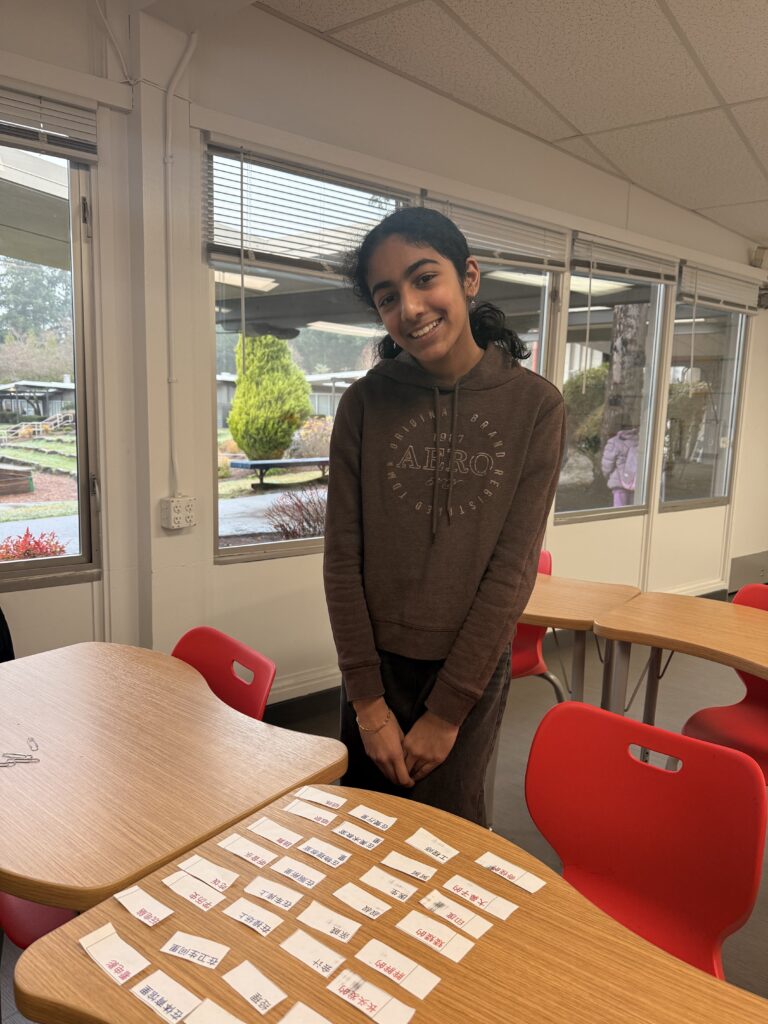
Another important part of Megna’s school day is her Mandarin class that she has three times a week. Starting in grade 7 students get to choose a world language they would like to study. Currently at BLV we offer Mandarin, Latin, Spanish or French for student to choose from. Megna has been taking Mandarin with a teacher outside of school for a few years before she chose it as her world language this year.

When asked why she chose to study Mandarin as her world language, Megna shared, “I felt that as a non-native Mandarin speaker, taking Mandarin would allow me to explore a new language. Mandarin has two components to it, characters and Pinyin, which makes it challenging, especially for non-native speakers. It has been rewarding to see my progress.” Reflecting on her first year of Mandarin at BLV, Megna added, “Ms. Zhang, my Mandarin teacher, has also been very supportive and encouraging since my first day here, and the small class size provides each student with a lot of individual attention. A special memory that comes to mind is that all my classmates in my Mandarin class came up with a Chinese name for me, which made me connect with my peers.”

As students join BLV in different grade levels our World Language teachers are experts in differentiation and supporting students at their various levels in the language they are learning.


After school Megna is headed home to practice her flute or violin. Megna is a fabulous representative of what it means to be a BASIS Independent Bellevue Mountaineer. Megna exemplifies our community values of PACE which stand for, perseverance, active, community and empathy. Megna has shown her perseverance in all of her classes by working hard to excel in the rigorous curriculum at BLV. You can always count on Megna for a warm smile and hello when you see her around campus. We are so grateful to Megna and her family for allowing her to partner with us on creating this blog!


Filed Under: Academics, Admissions, Community Values, Electives, Fine Arts, History, Humanities, Mandarin, Math, Middle School, School Community, Science, Student Learning, Student Life, Student Perspectives, Student Spotlight, Uncategorized

Holiday Season Has Arrived at BASIS Independent McLean!

December 16, 2025 by aixuanwang Leave a Comment

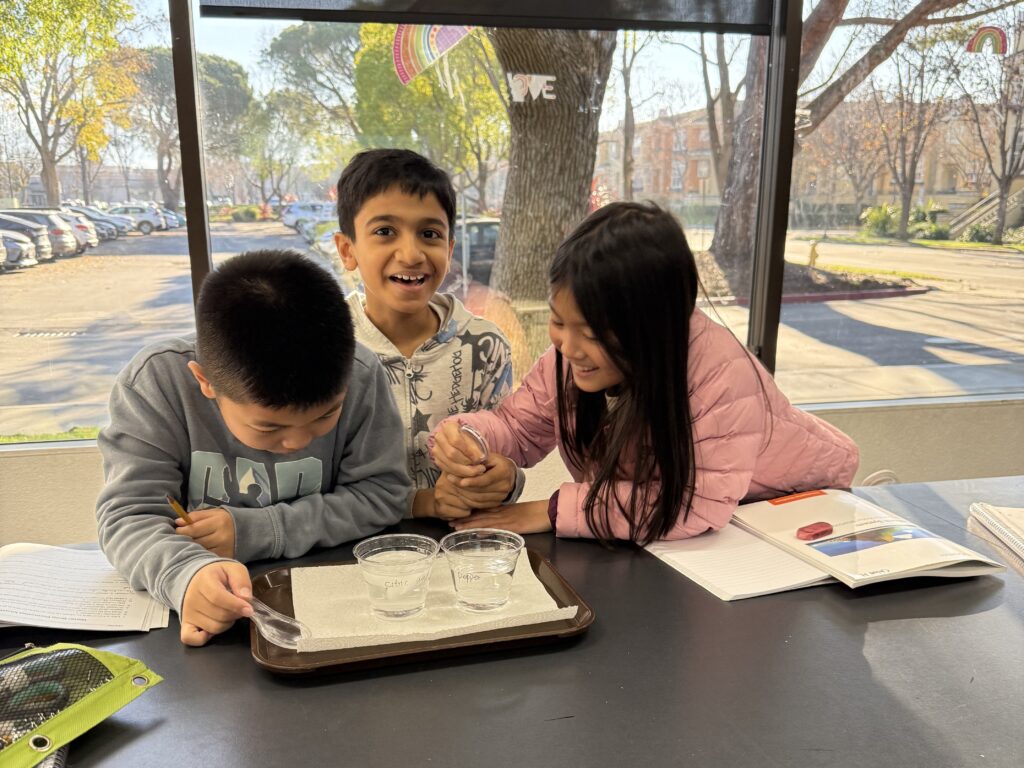
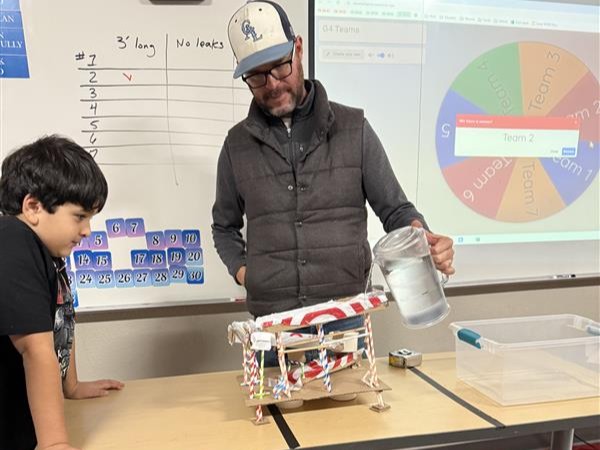
Ghost and goblins (and KPop Demon Hunters characters) walked our halls as students dressed up for Halloween. Then, before Thanksgiving, many of our students got into the festive spirit inside the classroom. In Dr. Hartman’s chemistry classes, students learned the chemistry behind turkey timers (the spring is held down by a layer of metal or wax, which melts at a specific temperature) and perfect mashed potatoes (over-cooking or over-mixing ruptures cells and releases starch, leading to potatoes that are too sticky). They then constructed Thanksgiving-themed molecules, such as tryptophan, out of common Thanksgiving ingredients like cranberries and marshmallows.

AP Chemistry students testing the chemical reaction of vinegar with a mystery kitchen powder to figure out “who ate Grandma’s Thanksgiving pie.”

In Mr. Haines’s Historical Leadership class, Grade 8 and 12 students worked together in a historical re-enactment game set on the eve of the first Thanksgiving. They played as either Wampanoag or English, who met in separate rooms with limited communication, and had to decide whether to cooperate, isolate, or fight. The game produced a rather sad outcome—the Wampanoag came bringing gifts of friendship, and the English turned them away—but it also provided insight into the lives of early settlers and just how close that first Thanksgiving was to never happening.

Historical conversations continued into the final week before Winter Break!

We are now gearing up for a week of celebration before Winter Break, including dressing up for Spirit Week, music and drama performances from our middle and high school students, and the NHS Coffeehouse (i.e., talent show). And, to top it all off, we will end with our annual Winter Fest celebration. It’s going to be a great end to 2025!


BASIS Independent McLean is an Age 2–Grade 12 private school, providing students with an internationally benchmarked liberal arts and sciences curriculum, with advanced STEM offerings. Considering joining the Red-Tailed Hawks community? To join our interest list for the next school year and receive admissions updates and more, please click here.
Filed Under: Academics, Science, Student Life

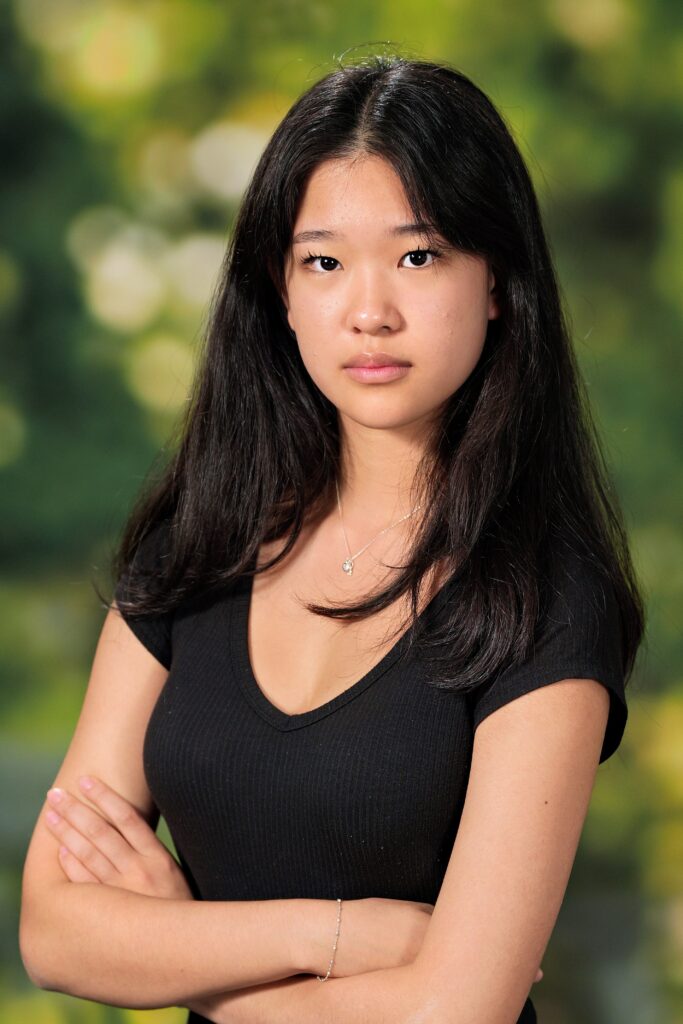
Student Spotlight: Hera L-Y—Researching Forever Chemicals in Our Water

December 6, 2025 by aixuanwang Leave a Comment

Hera L-Y, a senior at BIM, conducted a series of water-quality analyses on samples collected from several local areas during her free time. After testing samples from Falls Church, Loudoun County, Washington, D.C., Montgomery County (MD), and Alexandria, VA, she discovered a significant discrepancy between Alexandria’s results and those of the other regions. Dr. Hight recently interviewed her about her process and findings.


Hera, I know you’ve been doing your own research on Polyfluoroalkyl substances (PFAS) in our water, and it was recently written about in the Alexandria Times. How did you get started looking into forever chemicals?

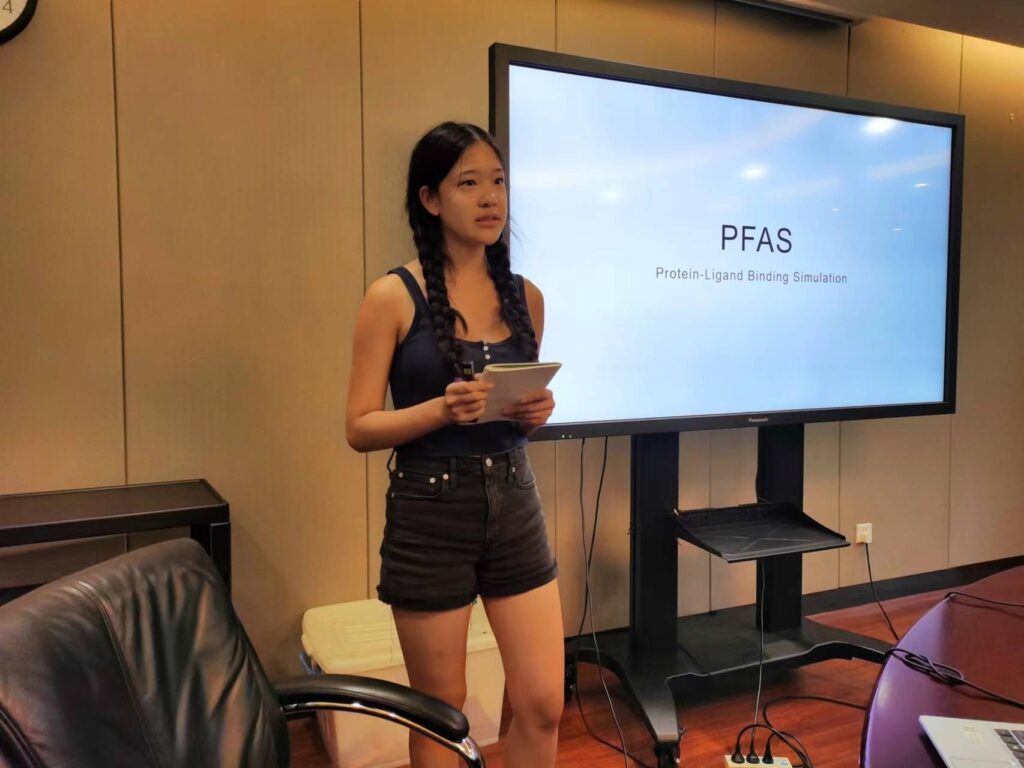
In the summer after my sophomore year, I did an internship in a chemistry lab in China, and the professor who was mentoring me introduced me to PFAS and gave me a project to work on with the help of some graduate students. I learned a bunch of different simulation software and then simulated the interactions between PFAS and proteins. We used Perfluorooctanoic acid (PFOA), which is really common. We studied its interaction with bovine serum albumin, which is a protein in cows very similar to human serum albumin but a bit less complicated.

We found that the binding energy was really strong, which told us that PFOA was really likely to bind to the protein. And then we calculated how much the protein changed after interaction with PFOA and found it hadn’t changed much at all. We realized that because the interaction was so stable, the body wasn’t recognizing it as a foreign particle. But binding to the protein could still knock it out of service.

Hera presenting on PFAS during her internship.

It harms protein function without triggering any sort of immune response? That doesn’t sound good.

Not good.

So your lab work got you interested in PFAS. How did you get from there to testing local water?

After that summer, I knew that this was something that I wanted to continue looking into. I built my own website about PFAS, trying to, like, educate people as much as possible about products that contain them. And then in March or April of 2024, I started this project. What sparked the whole thing was that I found these filters online that let you test your own tap water’s PFAS level. So I bought two and tested my tap water, and then also tested boiled water, because my family drinks a lot of tea.

Then I wondered if the concentration in my home would be different from my friends’ homes. So I tested in a bunch of different towns: Arlington, Alexandria, Loudoun, and Falls Church. The average was around 9-10 PPT, but there were two outliers. Loudoun was really low, around 3.5 PPT. And I actually expected that to happen because they advertised that they are implementing things to filter out PFAS. So I knew Loudoun was going to be lower than the rest, but then I found that my first result for Alexandria was 22 PPT, more than twice the average. At first, I thought it might have been an experimental error, so I tested again at a different location in Alexandria. That one came back 17 PPT, so less, but still way more than average.

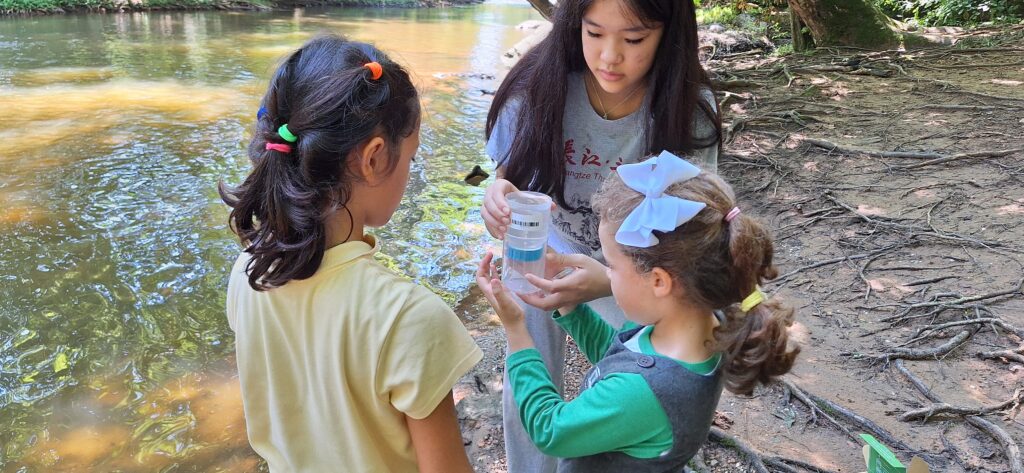
Hera collecting water samples with young campers during the Environmental Science summer camp she led.

So what was going on with Alexandria’s water?

What I did was look into the water sources for all the counties. So I tested the Potomac River and the Occoquan Reservoir, because those are the two main sources of water in Northern Virginia. Both were in double digits. The Potomac was around 15 PPT, and the Occoquan was 21 PPT, both of which are lower than the first Alexandria reading, which was a little confusing. But concentrations do vary with rainfall.

I reached out to a few newspapers because I’ve never seen this covered before, and I got connected with the journalist who wrote the article. We did some research and found an article from 2023 that talked about how Alexandria had an actionable level of PFAS. The mayor at the time was talking about how they were going to do something to stop it, but their levels are actually higher now. So clearly, they didn’t really do anything.

What’s next with this project?

It’s kind of on pause right now for college applications, but I definitely want to continue it in college. Because we know PFAS are bad for us, but we don’t know the extent of how bad. There’s a strong correlation between the concentration of PFAS in someone’s body and liver cancer. I do know that the liver is the main thing that detoxes your body. Because PFAS are so non-degradable, they kind of build up in your liver over time. I’m curious about the biochemistry there.

Sounds fascinating. I look forward to hearing more about it in the future. Thanks, Hera!

You can also read about Hera’s findings in the Alexandria Times.

BASIS Independent McLean is an Age 2–Grade 12 private school, providing students with an internationally benchmarked liberal arts and sciences curriculum, with advanced STEM offerings. Considering joining the Red-Tailed Hawks community? To join our interest list for the next school year and receive admissions updates and more, please click here.

Filed Under: Featured, Science, STEM, Student Achievement, Student Spotlight

Meet Our New Subject Expert Teacher, Dr. Kyle Covert

November 21, 2025 by nathanielyinger Leave a Comment

We are thrilled to introduce Dr. Kyle Covert as a founding Subject Expert Teacher (SET) at BASIS Independent Dublin.  Dr. Covert, who will serve as a Subject Expert Teacher in science, will be transferring to BASIS Independent Dublin from BASIS Independent Silicon Valley, where he has taught since 2024.  

For Dr. Covert, the opportunity to join the BASIS Independent Dublin founding faculty is exciting because it is a chance “to come back to the community that I love – I previously lived in Dublin for five years – while being able to stay with the school that I believe truly challenges our brightest minds.”  

Dr. Covert received both a dual Bachelor of Science degree in Biology and Chemistry and a PhD in Bioanalytical and Physical Chemistry from the University of the Pacific.  During his senior year of undergraduate work, Dr. Covert was recognized as the “ACS Undergraduate of the Year in Analytical Chemistry”.  

Prior to becoming a full-time teacher, Dr. Covert gained extensive industry experience, which has greatly influenced his teaching style; he seeks to share his field experience with his students to provide them with a taste of what a scientist’s life is like. His work experience includes seven years of research at the Lawrence Livermore National Lab and the Swiss Light Source, as well as five years at Agilent Technologies as an LC/MS Applications Scientist and Lead Trainer on Single Quadrupole instruments and software.  

Included in Dr. Covert’s research experience is assistance in drafting two successful NSF grant proposals.  He has contributed to several publications and presentations. 

Are there any highlights you’d like to share about your teaching philosophy or approach? 

My main goal as a teacher is to have my students teach someone else what they learned. If a student can share an interesting fact about science at the dinner table, then I’ve done my job. I try to incorporate other sciences in any subject I teach so students make connections on how this all works together.

What are some of the best or most rewarding parts of being a Subject Expert Teacher and working with BASIS Independent Schools students?  

To my last point, I ran an experiment with my Honors Chemistry students that involved making bread dough from scratch. Students learned how fermentation works in Chemistry, normally a Biology topic, but we go in depth about the chemical reactions occurring. They then took the dough home and baked it over Thanksgiving break. My favorite part was receiving comments from parents that they would’ve never thought they would see their child cooking, let alone bread they made on their own. 

Are there any thoughts that you’d like to share with families who are joining – or who are thinking of joining – the BASIS Independent Dublin community?

If you are already in the BASIS Curriculum Schools family then I welcome you to an amazing new campus and I cannot wait to teach your student SCIENCE! If you are considering BASIS Independent Dublin, I highly encourage you to explore this opportunity. As a brand-new and rapidly growing community, our school will offer an exceptional academic environment. Our Subject Expert Teachers greatly prepare students for the rigors of college and provide a foundation that will help them succeed in life. 

When he’s not in the classroom, Dr. Covert can be frequently found browsing articles and researching random topics just for the sake of learning something new; from the history of submarine warfare to how light particles interact with metal. His favorite thing to do outside the classroom is play videogames with his wife and daughter, and practice new recipes in the kitchen. 

BASIS Independent Dublin is a Grades 6 – 12 private school, providing students with an internationally benchmarked liberal arts and sciences curriculum, with advanced STEM offerings. Considering joining the BASIS Independent Dublin community? To join our interest list for the next school year and receive admissions updates and more, please click here.
Filed Under: Academics, Faculty & Staff, High School, Middle School, Science

A Day in the Life of a Grade 4 LET – Ms. Strider!

October 23, 2025 by emilyhughes Leave a Comment

My name is Ms. Strider and I am the Grade 4 LET (Learning Expert Teacher) at BASIS Independent Bellevue. I stay with my class of students throughout the day, supporting both their academic development and personal growth. While Grade 4 students follow a full schedule similar to upper grades, my role is to help them build responsibility and independence as they prepare for Grade 5. I work closely with our Subject Expert Teachers (SETs) to collaboratively teach each subject, ensuring lessons are engaging and connected across disciplines. Because I see my students in every class, I gain a deep understanding of their learning needs and strengths. This allows me to form meaningful relationships with families and provide thoughtful, and accurate updates on student progress throughout the year.

My day with Grade 4 begins at 7:55 AM when I pick my students up from the multi-purpose room and we head to our lockers to get ready for our day. Students get to say hello to their friends each morning, catch each other up on their fencing practice or dance rehearsal, and get the last of their wiggles out before it is time for class.

Period 1: Science with Ms. Delp!

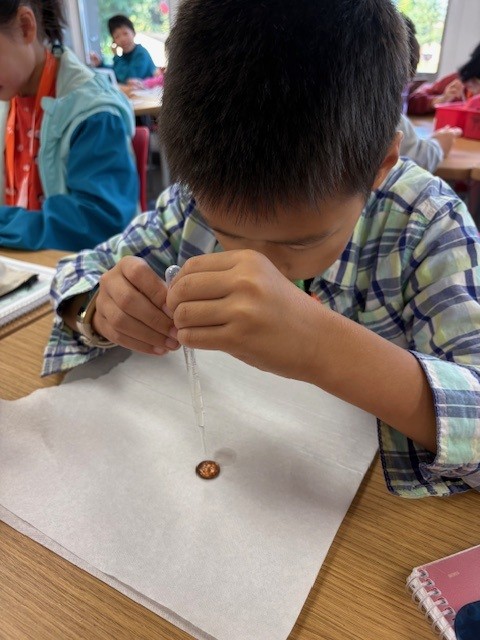
The first five minutes of each class look fairly similar throughout the day. Students are filling out their CJs (communication journals) and following any directions on the board as a warm up. In Science, students’ daily warm up is to copy down the notes from the board into their science folders so they have all the necessary information ready to go when it is time for a discussion or to start collecting data. Ms. Delp and I work together to provide Grade 4 students with materials, guidelines, and data points for a variety of different scientific activities. In the first month of school, we have measured our wingspans and compared our lengths to that of birds, tested if double stuffed Oreos are actually doubled stuffed, and explored surface tension by adding singular water droplets to pennies. Once we have our notes, completed our experiments, and graphed our data, it is time to clean up, pack up, and line up for our next class.


Period 2: Specials—Music, Art, Drama or Engineering!

Primary students have a variety of specials throughout the week. This morning’s special is Engineering with Ms. DiBattista! Our Specials classes look different than the classic LET/SET model. During these classes, I sometimes work with small groups of students in various levels of reading groups conduct interventions or enrichment. Today, I pulled a few of my students to conduct a reading intervention activity, while the rest of my class did an engineering lesson with Ms. DiBattista. Students’ reading levels are decided by our process of reading assessments that happen once per trimester. With that data, students are placed into small groups, of 3–5 students, and work directly with me on various reading strategies such as identifying the main idea, providing text evidence, or determining character motivation. Building these skills will help students in English class, advance their literacy skills, and most importantly, allow them to be able to read and understand texts independently.


Period 3: English with Ms. Tseng!

Just like in Science class, students begin class by filling out their CJ’s, noting any homework or upcoming assessments, and working independently on their warm ups. Ms. Tseng and I usually collect this work and begin getting students ready for their Novel Study. Currently, we are reading The Phantom Tollbooth! We take turns reading pages in the book between Ms. Tseng, myself, and the students. Learning to annotate texts is a skill we are building and growing in Grade 4. The Phantom Tollbooth is great practice for these skills, as it has several settings and characters. Ms. Tseng may pause the reading to point out a vocabulary word that we need to write down. I may also pause when we meet a new character to take notes about their description and add a sticky note annotation. English class flies by when everyone is so invested in the story! Time to clean up, pack up, and line up for lunch and recess.


Period 5: Math with Ms. Tessler!

These consistent classroom routines make a huge difference in the lives of the students and the teachers. No matter what subject, students know exactly how each class is going to start and exactly what each teacher is expecting their behaviors should be. Grade 4 enters math class, fills out their CJs, and begins their math warm up. Math warm ups are usually a set of problems covering material that we learned the day before. I will go over the warm up with the class, model the work on the board, and answer any questions. Ms. Tessler will get the class set up and ready for notes in their math notebooks. As students are taking notes or working on their independent math assignment, this is a great time for me to look for students who are exhibiting qualities of P.A.C.E (perseverance, active, community, and empathy). Students who show one or more of these qualities at any time during the day receive a PACE Pass. Students turn in their earned passes to the front office to enter the grade level weekly raffle for a chance to win a small prize every Friday. Once all of our daily math tasks have been completed, it is time to clean up, pack up, and line up!
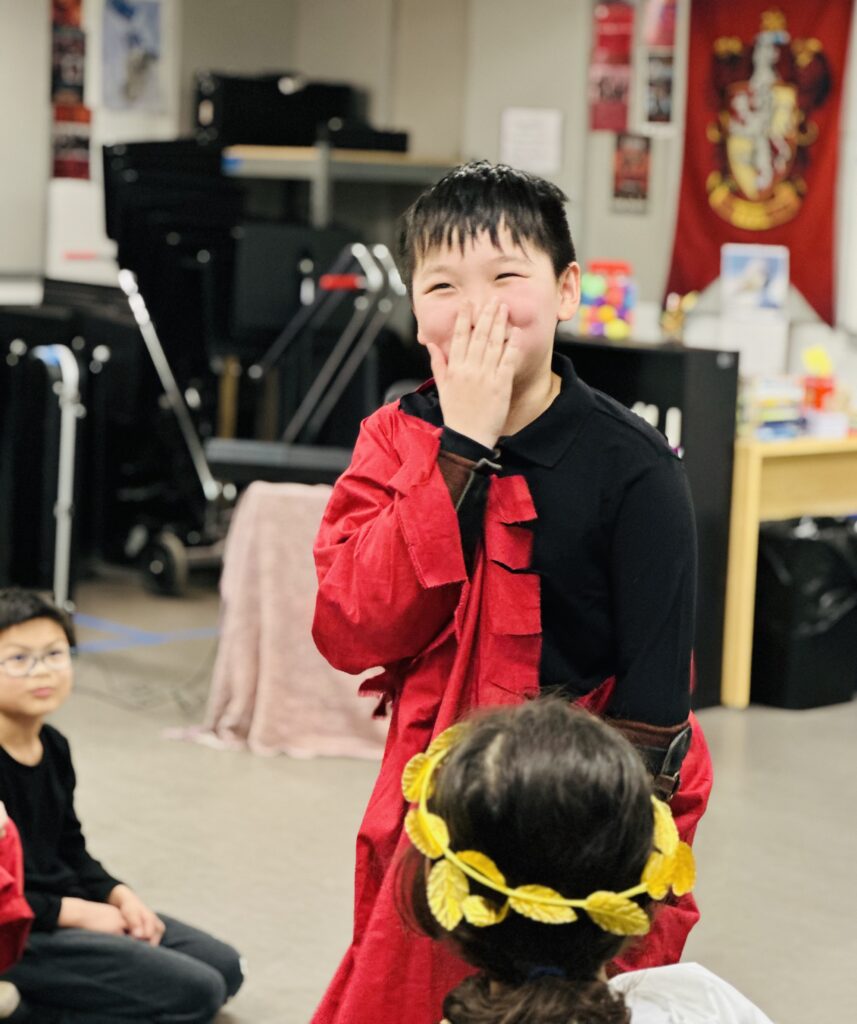

Period 6: Specials or Mandarin!

Three days of the week, Grade 4 has Mandarin class. There are two different Mandarin classes that students are sorted into from the beginning of the year based on ability-level. I do not attend Mandarin class, so I spend this time meeting with SETs, planning reading groups, or having an extra cup of coffee and a snack.

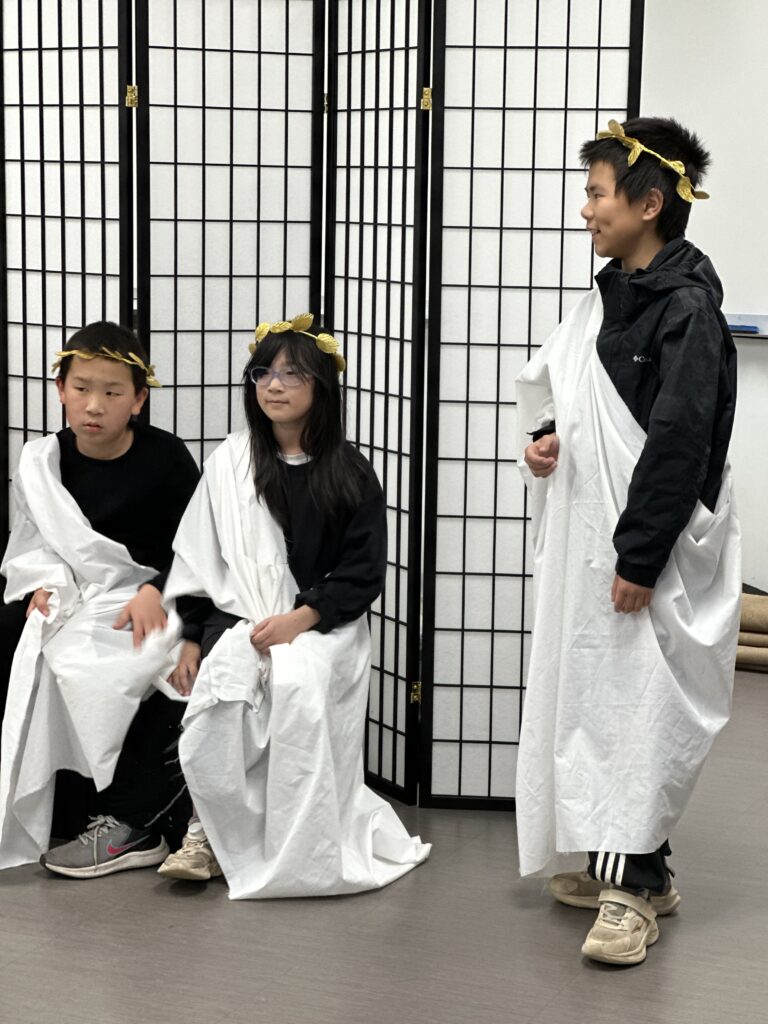
However, this afternoon is Drama with Mr. Mullens! Once all of the students have entered the drama space, filled out their CJs, and listened to Mr. Mullens’ daily expectations, I begin pulling another round of small reading groups. Groups can meet once, twice, or three times a week depending on students’ needs for reading and decoding texts. In Drama class, students are working in three different casts to write their own scripts for the upcoming spring performance. Even though some students are pulled away during the script writing, the entire cast works collaboratively and is able to quickly and effectively fill in any students upon their return to the classroom.

AE (Academic Enrichment) Time!

All students Grade 4 and above have a 20-minute AE period each afternoon. There are a variety of ways to spend a Grade 4 AE period: study hall, brain breaks, or most often, SEL (Social Emotional Learning), lessons and activities. For our SEL lessons we utilize a program called CharacterStrong at BASIS Independent Bellevue. Each month is centered around a character trait theme—October’s is Responsibility. Throughout the month, our class engages in mini-lessons, discussions, videos, and games designed to help students learn about and practice being responsible in their daily lives. Because academic expectations are high on this campus–even in the primary grades–it’s important to remind students that they are more than their grades, and that being a kid is about learning and growing in all areas of life.


Period 7: History with Ms. Rieger!

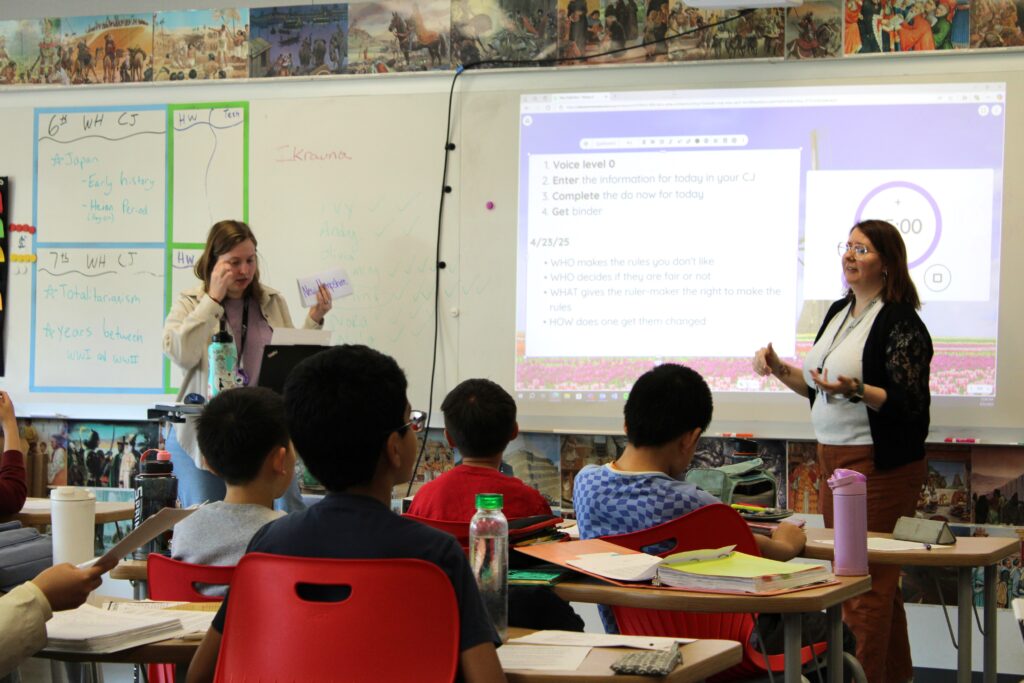
Our last core class of the day, but procedures and expectations remain the same. Students enter the classroom quietly, fill out their CJs with today’s topic, homework, and upcoming tests. Warm ups in History require students to have their binders and answer the questions on the board neatly on a piece of notebook paper. When the five–minute timer goes off, I read each question with the students and go over the answers. Often in this course there is some background information to read before students can dive deep into the new content, analyze cause and effects, and collect evidence. At the beginning of class I will read the passages with the students and have some student helpers annotate for vocabulary and important details. Then Ms. Rieger will share her slides, photographs, or stories about the time period we are focusing on and begin to ask critical thinking questions to the class. After notes, worksheets, or discussions, it is time to clean up, pack up, and line up once again.


Period 8: PE with Coach Shelp!

“Welcome to your favorite class!” is the way Coach Shelp begins PE. This class is different from Art, Music, and Drama because I always attend PE with my class. PE is a great way to get moving and learn about sportsmanship. Students begin each PE class by jogging some laps around the gym. Once we are warmed up, it is time to play—dodgeball, soccer, pickleball and more! We congratulate our teammates and exchange kind words with our opponents. Time flies in PE and then it is time to grab all of our belongings from our lockers and go home!

After all of my students have been picked up from dismissal, I meet with my co-teaching SETs to collaborate on lessons for the following week. After school you will find me at home in the coziest pajamas crocheting or snuggling with my cat. Another great day in Grade 4!


Filed Under: Academics, Community Values, Faculty & Staff, History, Humanities, Lower School, Mandarin, Math, Primary Program, Recess, School Community, Science, Student Learning, Student Life

Subject Expert Spotlight: How Dr. C Redefines Biology at Our NYC Private School

October 7, 2025 by christineklayman Leave a Comment

At BASIS Independent Manhattan, our passionate Subject Expert Teachers (SET) are the secret ingredient to delivering our advanced curriculum in an engaging way, helping students take intellectual risks and make real-world connections outside of the classroom.

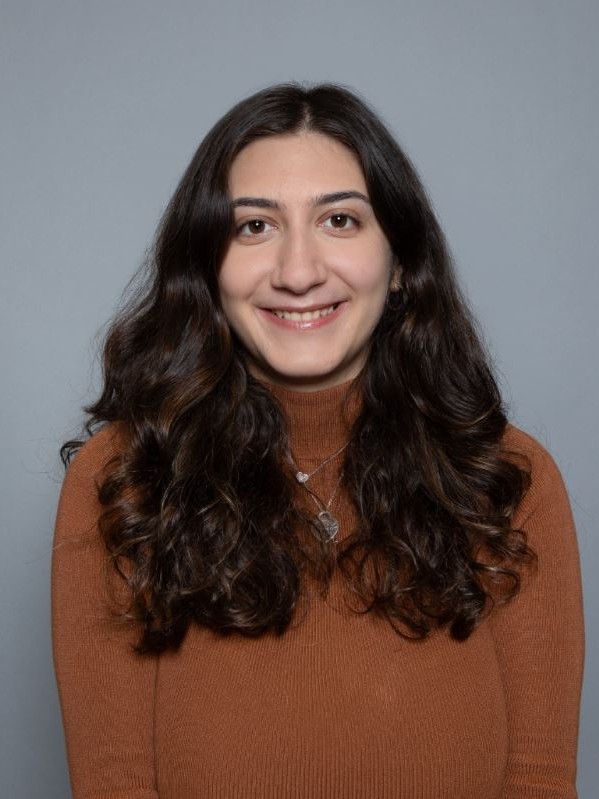
This month, we spotlight Dr. Chubaryov (Dr. C), our Biology SET at the Upper School in Chelsea, who teaches AP and Honors Biology in addition to AP Environmental Science to our high school students. After reading about her approach in the classroom and what makes her one of the best teachers in Manhattan, come and see for yourself at one of our Fall Open Houses.

Dr. Chubaryov

The Spark: From Opera to Observation

In August, Dr. C balanced a full life that brought huge changes at the start of this school year: she graduated from her PhD program at NYU and got married. Yet, her focus remains on the students. Dr. C’s own passion for biology was ignited in high school by an amazing teacher who made the subject exciting—even “cool.” A fond memory that sticks with her is how her biology teacher would play opera music while instructing the class on how to do dissections. This mix of creativity and deep study informs her teaching today.

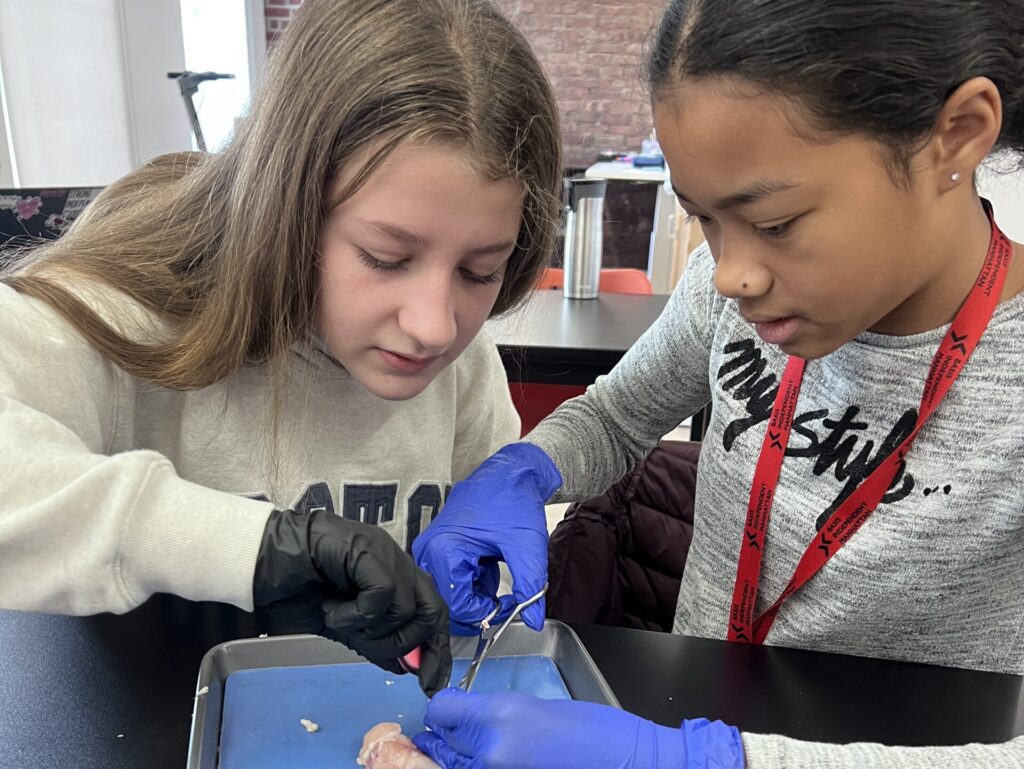
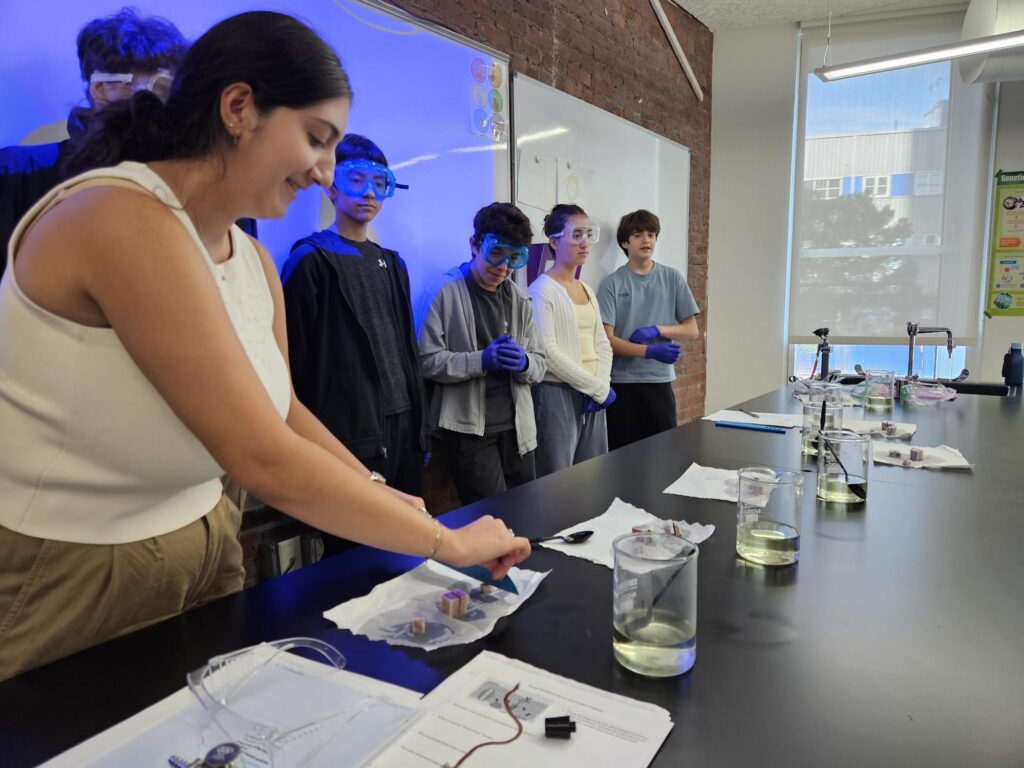
Two female students performing a dissection in biology class

Thinking Like a Scientist: Beyond Memorization

Once in high school at BASIS Independent Manhattan, students have already completed three years of physics, biology, and chemistry. With this preparation and budding passion for biology, Dr. C can immediately help grow her students’ intellectual curiosity. She also challenges them to take risks that go beyond just learning biology, helping them feel confident to “do biology.”

Dr. C is one of the best subject expert teachers in manhattan, demonstrating a hands-on learning lab for her students

From NYU PhD to Chelsea Classroom

To enable her students to be active participants, Dr. C emphasizes that they are scientists in training. She often brings her doctoral research into the classroom, sharing personal anecdotes about her work in the NYU lab studying Hirschsprung Disease. These stories help her students connect abstract concepts – like cellular signaling or genetics – and their real-world applications. Dr. C notes that this is when she really sees her students thinking like scientists: reasoning through how biological systems interact and discovering both the beauty and relevance of biology in everyday life.

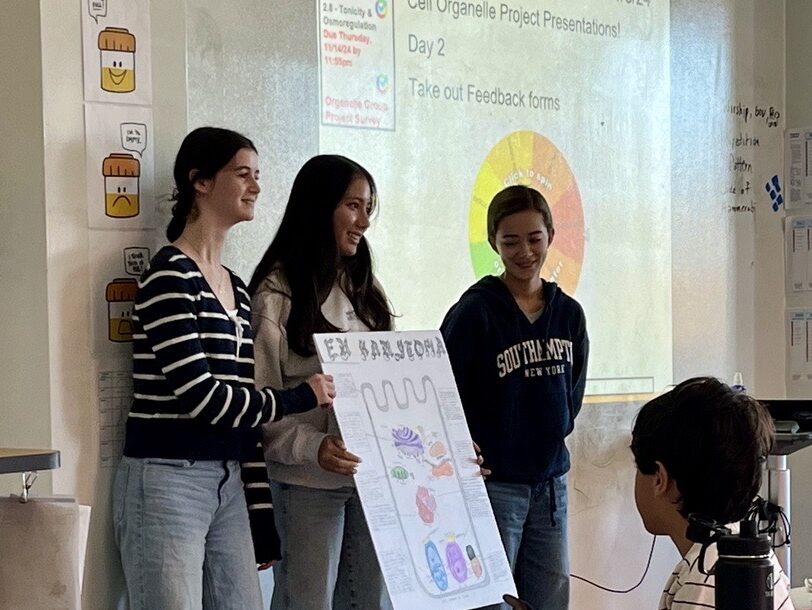
three female students present a biology poster on cell organelles

A Nurturing Academic Environment

When asked about their teacher, students immediately get wide-eyed and say she is great because of her duality. Dr. C’s teaching style is direct, but it is constantly peppered with personal anecdotes about her PhD studies that bring the subject to life. Students also appreciate how she holds them accountable, but does so by consistently performing “checks for understanding” to ensure every student feels supported. This exemplifies the nurturing academic environment at BASIS Independent Manhattan, where students feel inspired to safely take intellectual risks and achieve their highest potential.

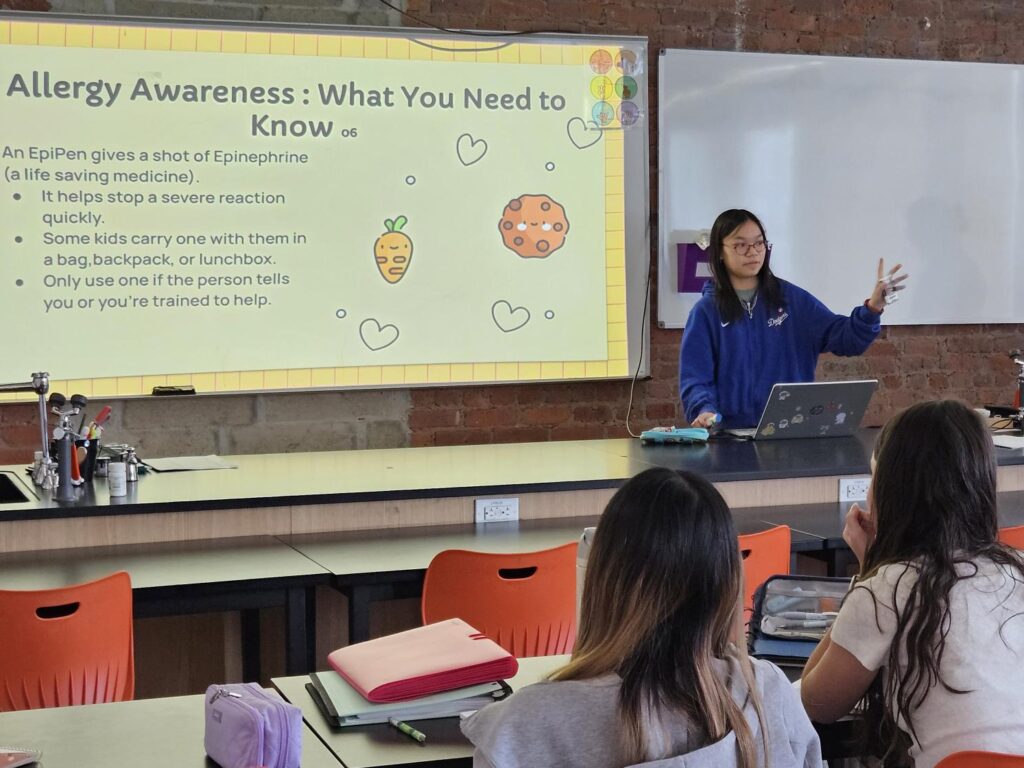
student presenting to her peers in the classroom

The Takeaway

BASIS Independent Manhattan’s unique model, featuring passionate Subject Expert Teachers who deliver an advanced curriculum in a nurturing environment, is why we are recognized among the best NYC private schools. It’s designed to empower students to think critically and achieve great success.

Experience the BASIS Independent Manhattan difference!

Join us at one of our upcoming Fall Open Houses to meet Dr. C and the rest of our incredible teachers.
Upper School
Sunday, October 26
Grades 6–12, Chelsea Campus
10:00 AM–12:00 PM

Lower School
Saturday, October 25
PreK–5, UWS Campus
10:00 AM–12:00 PM

Save Your Spot Today

Filed Under: Academics, Admissions Events, Faculty & Staff, High School, Science, STEM, Student Learning

  • Page 1
  • Page 2
  • Go to Next Page »

© BASIS Independent Schools

  • Contact Us
  • Media Recognition
  • Careers
  • Privacy Policy
  • CA Privacy
  • Terms of Use

Headquartered in Campbell, California, Spring Education Group is majority-owned by investment funds administered by Primavera Holdings Limited, an investment firm owned by Chinese persons and principally based in Hong Kong with operations in the United States, China and Singapore.

Sitemap