
• Skip to primary navigation
  • Skip to main content

BASIS Independent Schools

BASIS Independent SchoolsBASIS Independent Schools
  • About
    • Why BASIS Independent Schools?
    • Mission & Philosophy
    • Diversity & Citizenship
    • History
  • Academics
    • Curriculum
    • Early Learning Program
    • Primary Program
    • Middle School Program
    • High School Program
    • The Senior Year
    • Summer Programs
    • International Student Program
  • Achievements
    • International Performance
    • College Admissions
    • Advanced Placement
    • National Merit
  • Find Your School
Inquire

Featured

Leadership Spotlight: Director Cameron, Middle School Program

January 26, 2026 by jogoldfarb Leave a Comment

The Middle School Program at BASIS Independent Brooklyn is carefully designed both to challenge and support students during a very impressionable time. We believe middle school is a time for building strong foundational knowledge in a wide variety of subjects while growing a student’s autonomy and self-discipline needed for critical inquiry.

Pairing challenge with the right support is core to our Middle School Program. Leading the charge is Director Shantell Cameron. For the past three years, she has worked tirelessly to complement the internationally benchmarked academics with joy in learning and excitement in community. With roots in the classroom, Ms. Cameron first joined our school as a Gr. 2 Learning Expert Teacher nearly eight years ago before moving into school leadership, first as a Dean of Students, then as a Director at our Upper School campus.
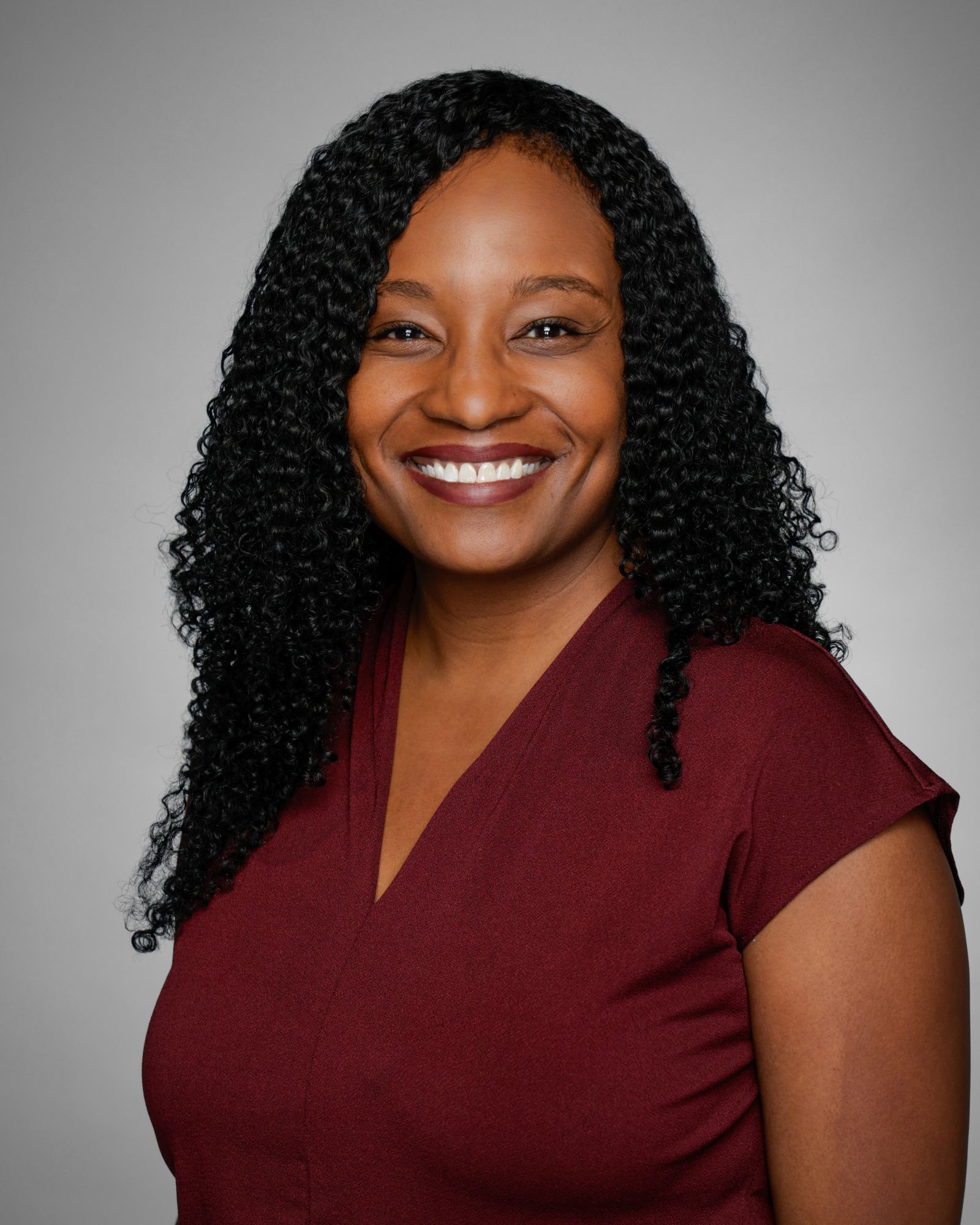
Ms. Cameron has been educating young minds for nearly two decades. She obtained her master’s degree in education in 2014, and previously taught and worked in administration at another private school before joining our community. We sat down with her to ask some questions that might help convey all that Ms. Cameron manages at our school and her vision for the Middle School Program.

What is a typical day for you as Director of the Middle School?

As the Middle School Director, I work closely with teachers to ensure they have the support they need to thrive in the classroom. I collaborate with my team daily to continue building a positive Middle School culture—one that is not only academically strong but also fun and engaging for students. My days include observing classes, providing meaningful feedback to teachers, and managing escalated situations with students or staff as they arise. I also partner with families to make sure we are supporting their children both in school and at home, reinforcing our commitment to developing well-rounded students.

Our Middle School Program is known for challenging students to the highest international levels. How do you support the whole student in these critical years?

Middle School is one of the most challenging stages in a student’s life. It’s a pivotal time for both cognitive and emotional growth. At our school, the curriculum is intentionally rigorous, which can sometimes feel overwhelming for students and families. Because of this, I believe it’s essential to balance high academic expectations with meaningful social and emotional support.

To support students academically, we provide multiple layers of help. In addition to weekly student hours, students can work with peer tutors from our High School Program when they need extra reinforcement in specific subjects. We also offer a student support program where students collaborate with their advisor, the Dean, and their teachers to create an individualized plan that helps them navigate our demanding curriculum. We know that academic rigor and accountability can be challenging for middle schoolers as they learn to manage their grades and keep up with the pace of coursework.

Equally important is supporting our students’ social-emotional development. I am a strong believer in building and maintaining a positive school culture where students feel a genuine sense of belonging and have things to look forward to beyond academics. When a student has a passion, whether it’s a club, sport, or committee, I strongly encourage them to participate. Those are the opportunities that help them grow socially and build confidence.

What do you think stands apart about our Middle School program?

Our Middle School Program is truly unique; saying it stands out among other middle schools across the city and state is an understatement. We are a community that strives to support every student and partner closely with every family. When I think about what sets us apart, a few key pillars come to mind:

• Belonging: Our students and families consistently feel a strong sense of belonging because we operate not only as a school community but as a family. As Director, I value maintaining an open-door policy where students can stop by to share feedback, ask questions, or simply say hello. I avoid a strict “by appointment only” approach because it’s important that students and teachers feel heard and know their voice matters

• Support System: Our support system is exceptional and truly caters to teachers, students, and families. We approach every situation with flexibility, an open mind, and a commitment to keeping students at the center. This not only strengthens the sense of belonging but also creates a warm, family-oriented environment. The level of support provided by our administrative team is unlike that of many middle schools. Here, no teacher or student is “just a number.” We work tirelessly to make sure everyone feels valued, heard, and fully supported.

• Curriculum: Our curriculum is “first class” and speaks for itself. Our Middle School students are preparing for high school in ways many schools don’t even consider. By the time they complete our program, students are ready for college-level coursework, perform extremely well on standardized tests in high school (PSAT, SAT, and Advanced Placement exams), and show strong results on our midterms and final exams (Pre-Comps and Comps). Our elective offerings give students opportunities to explore passions and potential career interests early on. In short, our curriculum prepares students not just for our high school but for future success beyond the classroom.

• Teachers: Most importantly, our teachers are a defining strength of our program. We don’t just have educators; we have experts who truly love what they do. I witness daily how our teachers bring rigor to life through games, hands-on labs, debates that spark critical thinking, and culminating projects that connect learning to the real world. They give students the opportunity to take ownership of their learning, and that is not something found everywhere. Our teachers plan with every student in mind, rather than simply following a standard state-provided curriculum, allowing them to reach multiple learning styles in meaningful ways. I am honored to lead a program that demonstrates consistent growth, care, and respect.

You have been a big proponent of building a strong school culture during your years at the school. What programs have you started to build a great culture supporting students and teachers in Middle School?

Due to my firm belief in creating well-rounded students, I am constantly seeking ways to strengthen our school’s culture. Middle school students thrive when they have opportunities to collaborate and engage outside the classroom. Over my five years on the Administration team, both in Primary and Middle School, I have started and supported numerous programs to foster community, connection, and tradition:

  • Grade 8 Overnight/Lock-In: In my first year as Middle School Director, I established the Grade 8 Overnight, where students spend the night at school, enjoying games and fun activities. This December will mark our third Overnight.
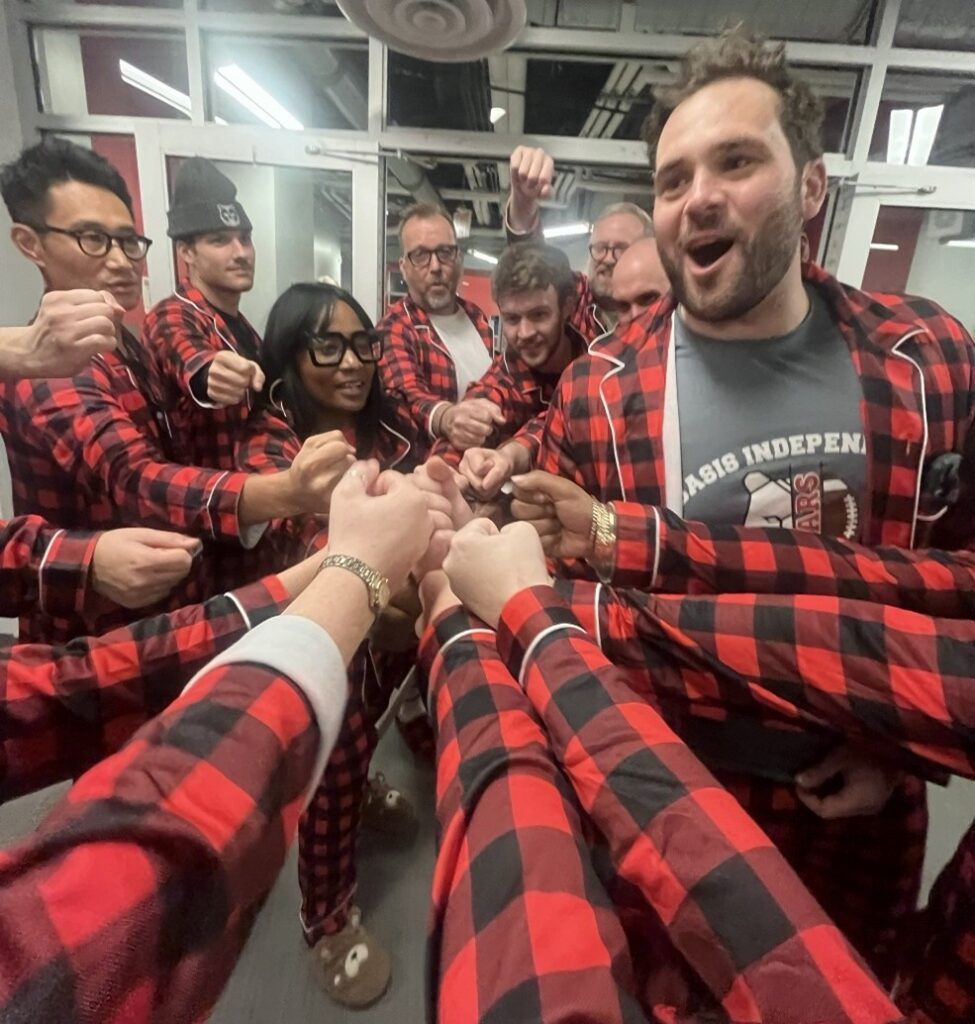
Our Gr. 8 Lock In chaperones bonded in their matching PJs and bear slippers, which Director Cameron ordered.
  • Grade 8 Washington, D.C./Charlottesville Trip: Alongside Mr. Piel (U.S. History SET), I led the creation of this trip, which provides students with hands-on historical and civic learning experiences. It has become an annual tradition in March.
  • Grade 8 Celebration: I created a celebration to honor our eighth graders for completing the Middle School program. While not a formal graduation, this event recognizes students’ achievements and brings families together to celebrate their successes. This year will be the third celebration.
  • Grade 6 Ice-Skating Trip: To reward students after completing Pre-Comps, I started a fun Ice-Skating trip for Grade 6 students. This social tradition helps students celebrate academic milestones and connect with peers.
  • Parent University-Style Forums: I collaborated with administration and external partners to create forums supporting families, including the “Inside Scoop to Pre-Comps and Comps” for Grade 6 families and an Executive Functioning Workshop for parents in Grades 5–8. These forums help families support their students academically and socially at home.
  • Recess for Middle School Students: Working with the Dean, we introduced AE Recess, giving students the option for downtime and socialization three times a week. This initiative was based on student and parent feedback and strengthens our supportive community.
  • Increased Teacher Collaboration: I encouraged a schedule (weekly team meetings) that allows teachers to collaborate more effectively, share best practices, and strengthen professional partnerships across departments.
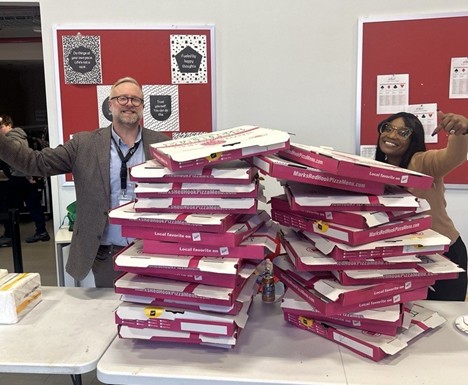
Head of School Josh Harmon and Director Cameron marveling at how many pizzas were consumed at our Pre-Comp Student Session and Pizza Party.

All of these initiatives are designed to build and improve culture in the Middle School, providing students, teachers, and families with a fuller, more meaningful school experience. I am committed to continuing to create traditions and opportunities that positively impact both academics and student life.

Our school integrated a “no cell phone” policy last school year. From your perspective as the Director, how has that changed the school day or experience for students in the Middle School Program?

Our no cell phone policy has drastically changed the dynamics of Middle School. I have observed students becoming more focused in the classroom, more socially engaged with their peers, and building stronger self-advocacy skills. Over the past few years, cell phones and other personal devices played a significant role in students’ daily lives. While these technologies have positive attributes, they often disrupted the traditional school experience, a structure that, in my view, is essential for holding students accountable for their learning.

Since implementing this policy, I have seen students conversing more with peers in classrooms, cafeterias, and hallways, participating more actively in lessons, and choosing to be fully involved in the school community. Additionally, we have seen a significant decrease in suspensions related to cyberbullying or inappropriate phone use during school hours. Overall, this policy has strengthened both the academic and social-emotional environment of our Middle School.

You have been at our school for many years, first as a Learning Expert Teacher (LET), then as a Dean, and now as Director. What drew you to BASIS Independent Brooklyn (and keeps you coming back)?

This is my eighth school year here at BASIS Independent Brooklyn, and each year truly gets better. I was initially drawn to this school because of its commitment to genuine skill mastery rather than simply teaching to a test. I also value the strong support system in place for teachers, students, and families, as it consistently leads to positive experiences and outcomes.

Before joining our school, I taught at a small private school on Long Island that held similar beliefs and standards, which made the transition here feel natural. One of the things I appreciate most is that teaching is not the end of the road; there are always meaningful opportunities for professional growth, supported by people who genuinely want to see you thrive. I’m proud to be an example of that, having grown from a classroom teacher (Learning Expert Teacher) to Primary School Dean of Students, Primary School Director, and now Middle School Director.

Each role has reinforced what makes BASIS Independent Brooklyn truly special: a community that strives for excellence, a culture of care, and a curriculum that stands apart from other schools. Our teachers and students are deeply passionate about their work, and together they create the warm, supportive environment that defines who we are.

To me, BASIS Independent Brooklyn feels like family more than just a school, and that is what brings me back year after year. It keeps getting better, and we continue to grow stronger together.

What is something families might not know about you that you want to share?

I travel quite a distance each day to get to work, coming from Freeport, Long Island. I do it wholeheartedly because I truly love my job and the people I get to collaborate with. My colleagues make each day meaningful and fun.

I also have a musical background. I play the clarinet, saxophone, and flute, and I originally attended SUNY Potsdam for music education and performance before shifting my focus to teaching. Once my youngest son is a bit older, I hope to join a band or orchestra again as a personal passion project.

Education runs in my family. My relatives owned early learning schools on Long Island, where I worked as a teenager. I also tutored many of their students. That early exposure is where my love for education really began.

Before coming to BASIS Independent Brooklyn, I had the opportunity to serve as the interim Head of School at my previous school while the Head of School was on long-term medical leave. That experience gave me my first hands-on introduction to school leadership.

And last but certainly not least, I am a single mom to three wonderful children, a daughter who is 19, and two sons who are 14 and 5. Because of them, I get to experience all levels of childhood and adolescence at home, which adds a meaningful perspective to my work in school.

# # #

BASIS Independent Brooklyn is a PreK–Grade 12 private school, providing students with an internationally benchmarked liberal arts and sciences curriculum, with advanced STEM offerings. Considering joining the Bears community? To join our interest list for the next school year and receive admissions updates and more, please click here.

Filed Under: Administration & Staff, Community Events, Community Values, Current Events, Featured, Leadership, Meet School Leadership, Middle School, School Community

Rolling Admissions for Fall 2026: Everything Families Need to Know

January 22, 2026 by abisoyetaylor Leave a Comment

Rolling Admissions for Fall 2026 Opens January 24, 2026

Our Rolling Admissions cycle for Fall 2026 opens on Saturday, January 24, 2026. Families interested in joining our vibrant, academically focused community can begin submitting applications on that date. Below, you’ll find everything you need to navigate our admissions process successfully.

Rolling Admissions Timeline

Application Opens — January 24, 2026

  • Applications for all grade levels open on this date.

Application Deadline

  • Applications remain open until a grade reaches capacity. Once a grade closes, qualified applicants will be placed into a wait pool and reviewed as space becomes available.

Decision Notification

  • Families receive an admissions decision within 10 business days of completing their application. This provides a fast, transparent experience for families seeking timely enrollment options.

Commitment Deadline & Enrollment Details

Applying during Rolling Admissions is not immediately binding. To officially secure a seat, families must:

  • Submit a signed Enrollment Agreement
  • Pay a non‑refundable $1,750 deposit by the Commitment Deadline listed in their offer

How to Apply for Rolling Admissions

Starting your application is simple. Families can begin their Rolling Admissions process here. Our Admissions Team is available to support you at every step of the process.

Frequently Asked Questions (FAQs)

What is Rolling Admissions?

Rolling Admissions is an ongoing application process in which applications are reviewed as they are completed. Decisions are released on a rolling basis, typically within 10 business days.

Are all grade levels open during Rolling Admissions?

Yes. All grade levels remain open until they reach capacity. After that point, applicants are moved into a wait pool.

What counts as a “completed application”?

A completed application includes the online application form, and all required supplemental materials. Your admissions portal will display outstanding items.

How soon will we receive an admissions decision?

You will receive a decision within 10 business days after the application is complete.

Is applying during Rolling Admissions binding?

No. Applying is not binding. Only those who sign the Enrollment Agreement and pay the $1,750 deposit secure a seat.

What if a grade is already full when we apply?

Your student will be placed into a wait pool and considered if space becomes available.

Can current families apply for siblings?

Yes. Sibling applications are welcome and follow the same Rolling Admissions process. Space is not guaranteed, so early submission is recommended.

How long do families have to accept an offer?

Families must review their offer letter for the Commitment Deadline, then sign the Enrollment Agreement and submit the deposit by that date.

APPLY NOW

BASIS Independent Bothell is a PreK – Grade 12 private school, providing students with an internationally benchmarked liberal arts and sciences curriculum, with advanced STEM offerings. Considering joining the BASIS Independent Bothell community? To join our interest list for the next school year and receive admissions updates and more, please click here.

Filed Under: Admissions, Admissions Process, Early Learning Program, Featured, High School, Lower School, Middle School, Primary Program, School Community

Real Questions, Real Investigations: How BASIS Independent Fremont Students Develop Scientific Thinking Skills

January 22, 2026 by sarahpeterson Leave a Comment

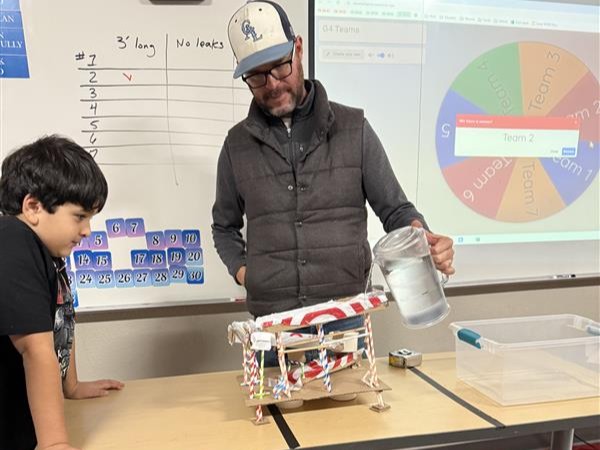
Real scientists don’t start with textbooks. They start with questions about the world around them. At BASIS Independent Fremont (BIF), our Lower School students learn the same way: by investigating real phenomena, testing their ideas, and using evidence to support their conclusions. From engineering solutions to ancient problems to exploring why oil and vinegar refuse to mix, BIF students practice thinking like the scientists and engineers they may one day become.

Learning Through Real-World Investigation

At BIF, science education is phenomena-based, meaning students begin with observable events and real-world questions rather than memorization. Our approach develops three essential skills: active investigation (students doing, not just watching), scientific communication (reading, writing, and discussing like scientists do), and evidence-based reasoning (supporting conclusions with data).

This matters because these skills extend far beyond the science classroom. Whatever our students choose to become in life, they need to ask thoughtful questions, analyze information, and solve complex problems. Science at BIF is preparation for thinking critically about the world.

What Scientific Thinking Looks Like at BASIS Independent Fremont

Students Observe and Question

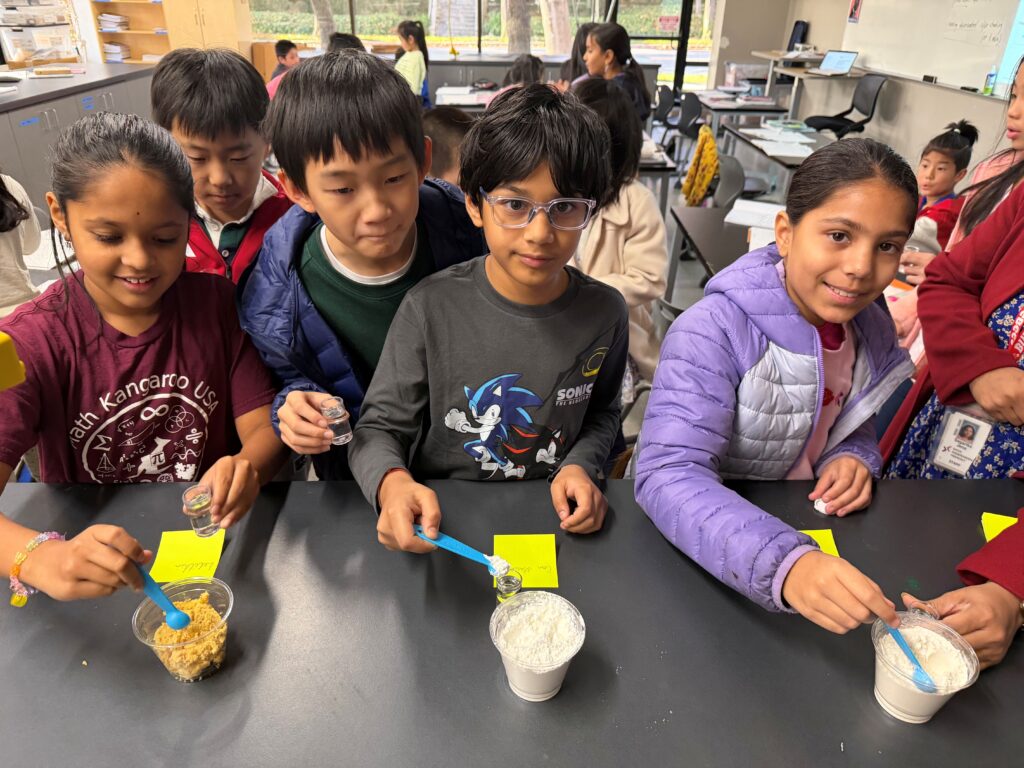
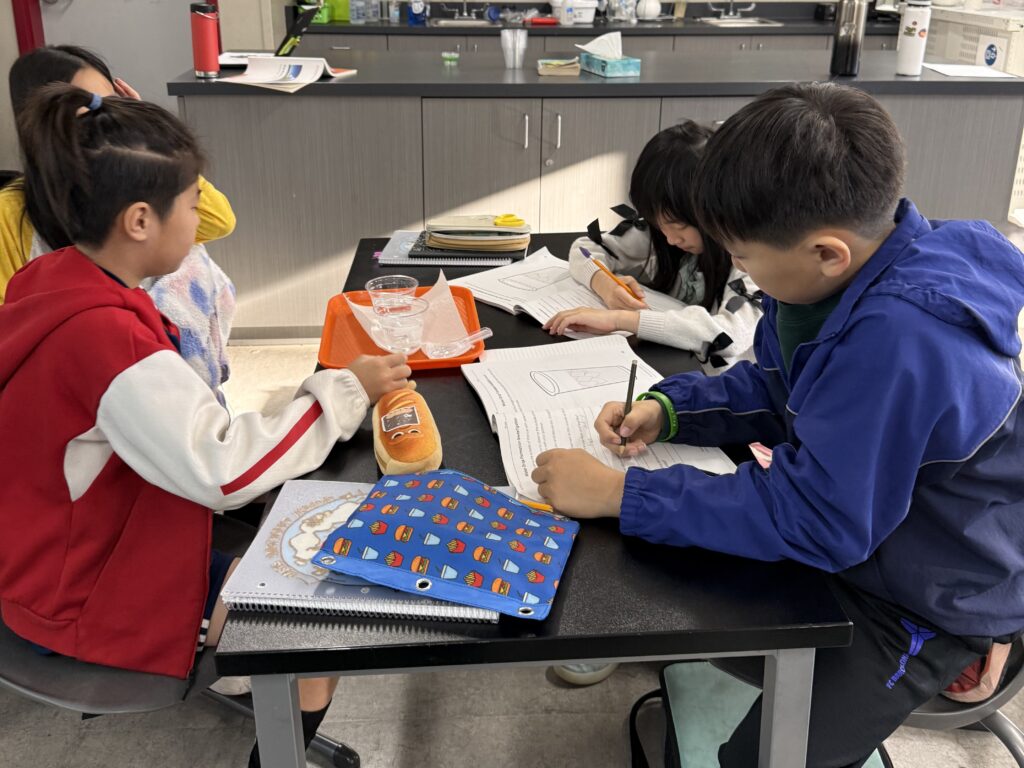
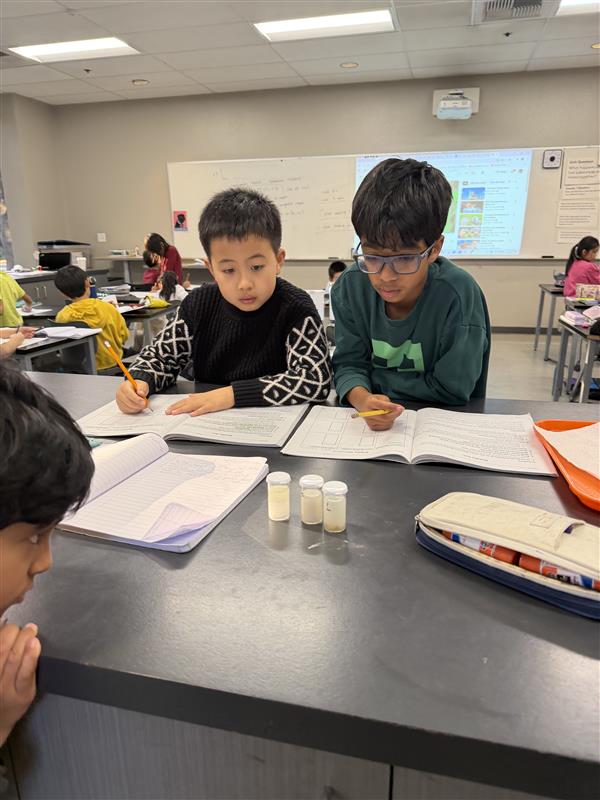
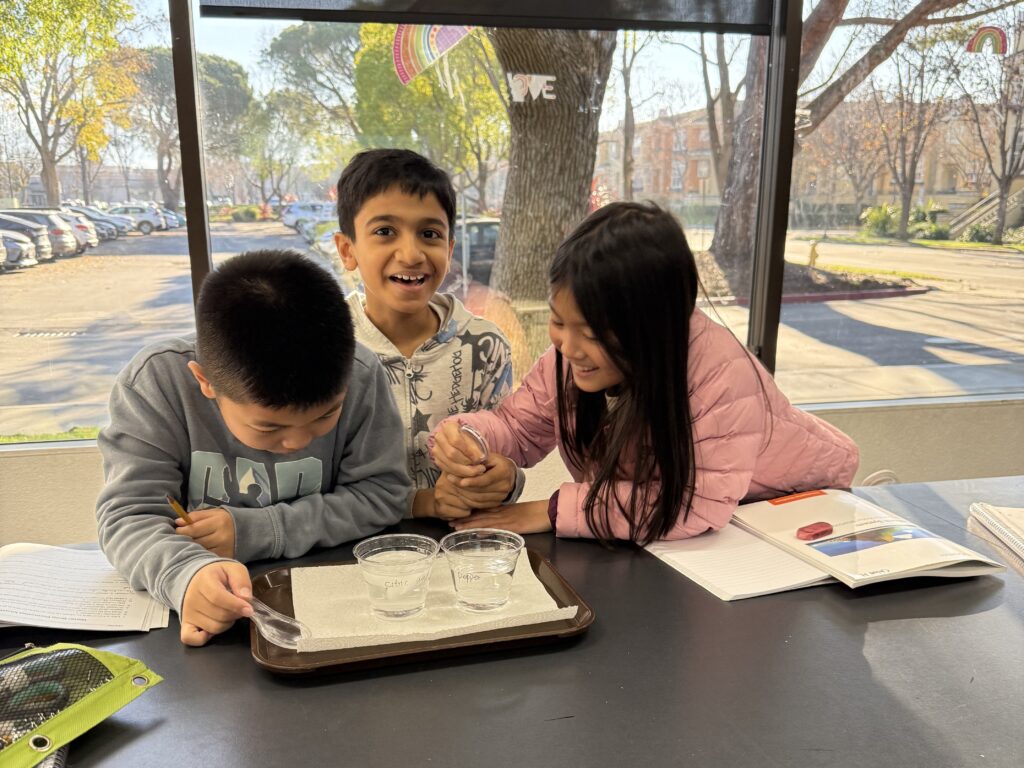
In Dr. Luo’s grade 4 science class, students recently tackled a deceptively simple question: why do oil and vinegar sometimes mix instead of separating into layers? “We started at the observable scale by having students mix oil and vinegar and notice that they don’t mix and instead form layers,” Dr. Luo explains. From that initial observation, students generated their own questions about what was happening at a molecular level—questions that would drive their entire investigation.

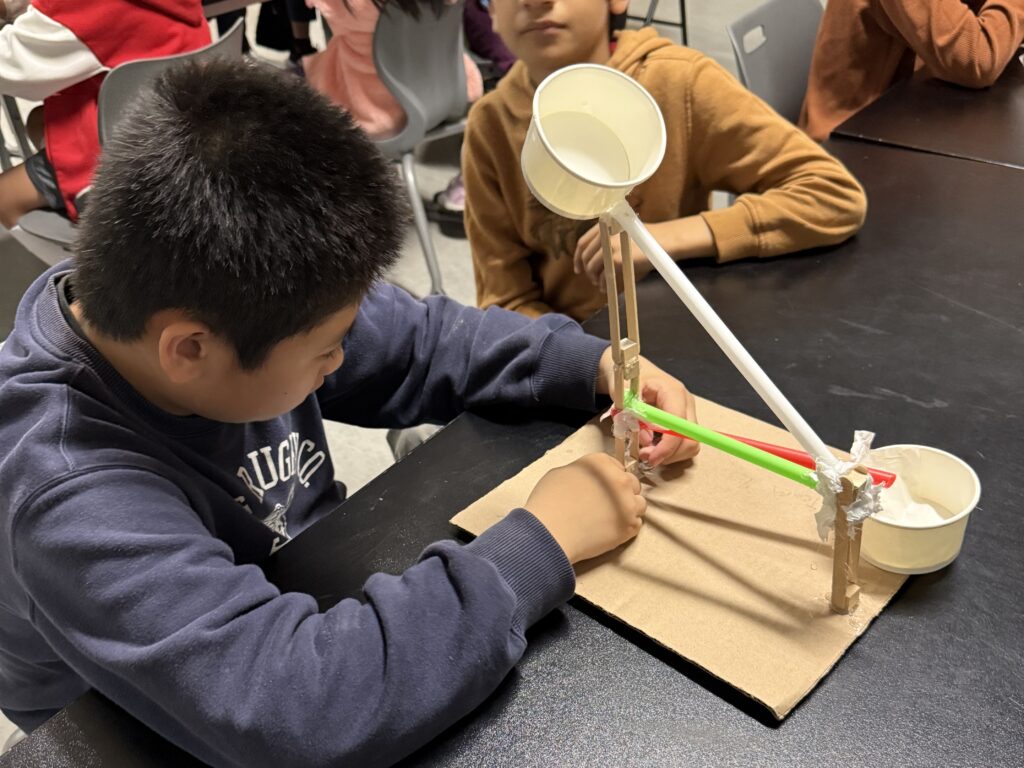
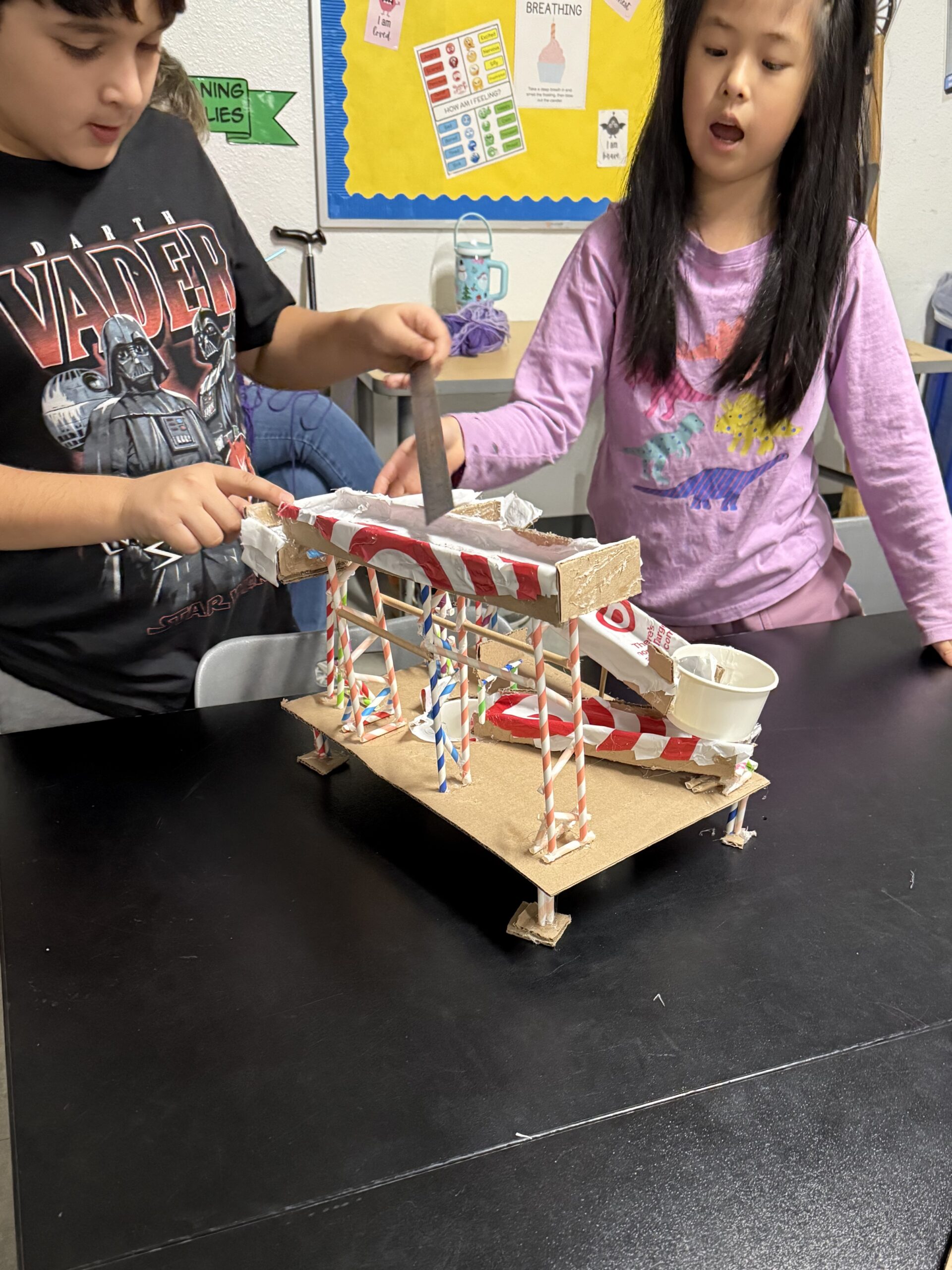
Similarly, in Mr. Kasper’s engineering class, the students face a historical challenge: How did ancient Rome transport fresh water to support its growing population? “Students are guided to ask essential questions such as: Why is this a problem? Who is being affected? What are the possible causes of the water shortage?” Mr. Kasper notes. “Students are encouraged to ask additional questions of their own, deepening their understanding of the challenge.”

Students Investigate and Test

Scientific thinking requires more than curiosity—it demands action. Dr. Luo’s students moved from observation to experimentation, testing various substances to see what would help oil and vinegar combine. “Students experimented with adding lecithin, flour, and cornstarch to oil and vinegar. They discovered that lecithin helps oil and vinegar mix by acting as an emulsifier.”

In engineering, Mr. Kasper’s students design and build prototypes of aqueducts, working within budgets and material constraints just as real engineers do. “During construction, they test their structures for strength and for their ability to successfully transport water,” he explains. “Testing is an ongoing process, and students carefully record not only how their prototypes perform, but also the results of each test and the improvements they believe will fix any issues.”

Students Read, Write, and Communicate Like Scientists

Scientific literacy is just as important as hands-on experimentation. Dr. Luo’s students didn’t just conduct experiments—they read scientific texts to deepen their understanding. “Students built their own online models and read texts like Handbook of Food Science and Solving Dissolving to learn about molecular structure and how molecules attract themselves and other molecules,” she shares.

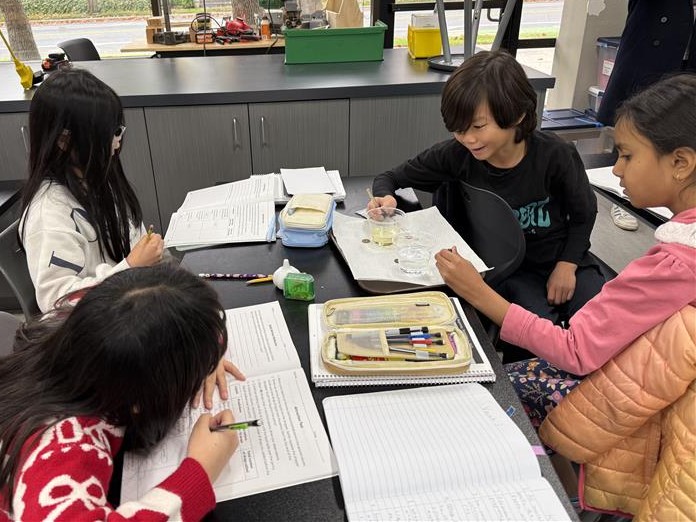
Throughout their investigations, students document their findings in science journals, write lab reports, and present their conclusions to classmates. This mirrors how real scientists communicate their discoveries to the broader scientific community.

Students Use Evidence to Support Their Ideas

Perhaps most importantly, BIF students learn that good ideas must be backed by evidence. When Dr. Luo’s students concluded that lecithin acts as an emulsifier, they could point to specific experimental results and molecular models that supported their claim. They learned about emulsifiers’ special structure—one that can attach to both oil and vinegar molecules—through both reading and hands-on observation.

Mr. Kasper’s engineering students practice the same evidence-based thinking. “Each idea is discussed and evaluated based on the identified constraints and goals, such as efficiency, cost, available materials, and the ability to successfully transport water,” he explains. “Through this process, students learn that engineering is not about choosing the first idea, but about carefully comparing options to determine the best possible solution.”

Building Skills That Last

The sophistication of scientific thinking grows as students do. By grades 4 and 5, students are working with complex concepts like molecular structure and engineering design processes, but the foundation begins much earlier—with kindergarteners observing how materials change and grade 1 students exploring the natural world.

These investigations teach students to approach problems with confidence. They learn that failure is part of the process, that questions are more valuable than quick answers, and that evidence matters more than opinions. As Mr. Kasper notes, “This reflection reinforces the idea that engineering is iterative and that failure is an important part of learning and improvement.”

By the time BIF students reach Upper School, they’ve spent years practicing how to think, not just what to think. They carry forward skills they’ll use for life: asking thoughtful questions, designing investigations, using evidence to support ideas, and communicating findings clearly.

Science as a Way of Thinking

At BASIS Independent Fremont, science isn’t a subject students study. It’s a way of thinking to practice every day. From our youngest Bumblebees to our grade 5 students preparing for middle school, students learn to approach problems like scientists and engineers: with curiosity, creativity, and evidence.

Want to see scientific thinking in action? Schedule a campus tour to visit our Lower School classrooms and discover how BIF students are learning to investigate, question, and solve the problems that matter.

BASIS Independent Fremont is a TK – Grade 12 private school, providing students with an internationally benchmarked liberal arts and sciences curriculum, with advanced STEM offerings. Considering joining the BASIS Independent Fremont community? To join our interest list for the next school year and receive admissions updates and more, please click here.

Filed Under: Academics, Featured, Lower School, Science, STEM, Uncategorized

Staffing Progress & Opening Readiness

January 15, 2026 by mirandamartinez Leave a Comment

As of Thursday, January 15, BASIS Independent Dublin is on track to open fully staffed, with more than half of all faculty and staff already secured months ahead of opening. 

Staffing Progress at a Glance

  • 54% of total faculty and staff positions secured
  • 59% of leadership and operational roles confirmed
  • 50% of teaching positions in place
  • Experienced BASIS Independent educators joining through internal transfers
  • All remaining roles are planned, budgeted, and actively recruiting

BASIS Independent Dublin is well on track for a strong opening year. More than half of all faculty and staff positions have already been filled or are in final transfer stages, including nearly 60% of leadership and support roles. Our academic team is also taking shape, with half of our Subject Expert Teaching positions already secured, including priority grade-level roles. Several positions are being filled by experienced BASIS Independent educators transferring from within the BASIS Independent network, ensuring continuity, quality, and a smooth start for students. With a clear hiring plan and active recruitment underway, we are confident Dublin will open fully staffed and fully prepared to deliver the exceptional education families expect.

Newly Announced Leadership

Administrators
Supporting teachers and students on their paths toward excellence.

Academic Programs

  • Director of Academic Programs, Ms. Suguna Haranahalli

College Counseling

  • College Counselor, Ms. Niyati Shah

Operations

  • Front Office Coordinator, Ms. Carolinna Dievendorf
  • Operations Manager, Mr. Daniel Furukawa
  • Facilities Manager, Mr. Jarred Thorp

Student Affairs

  • Director of Student Affairs, Teacher Jasica Gill
Click Here to View Leadership

Newly Announced Faculty

Subject Expert Teachers
Passionate, expert teachers who believe that with the right support and encouragement, any student can excel.

  • Subject Expert Art Teacher, Teacher Danae Digiacomo
  • Subject Expert Biology Teacher, Ms. Taylor Goldschmiedt
  • Subject Expert Chemistry Teacher, Ms. Ilona Covert
  • Subject Expert Computer Science Teacher, Ms. Nasira Shahin
  • Subject Expert English Teacher, Mr. Scott Dievendorf
  • Subject Expert French Teacher, Ms. Kira Laquidara

Click Here to View Faculty

BASIS Independent Dublin is a Grades 6 – 12 private school, providing students with an internationally benchmarked liberal arts and sciences curriculum, with advanced STEM offerings. Considering joining the BASIS Independent Dublin community? To join our interest list for the next school year and receive admissions updates and more, please click here.

Filed Under: Administration & Staff, Faculty & Staff, Featured, Leadership, Meet School Leadership

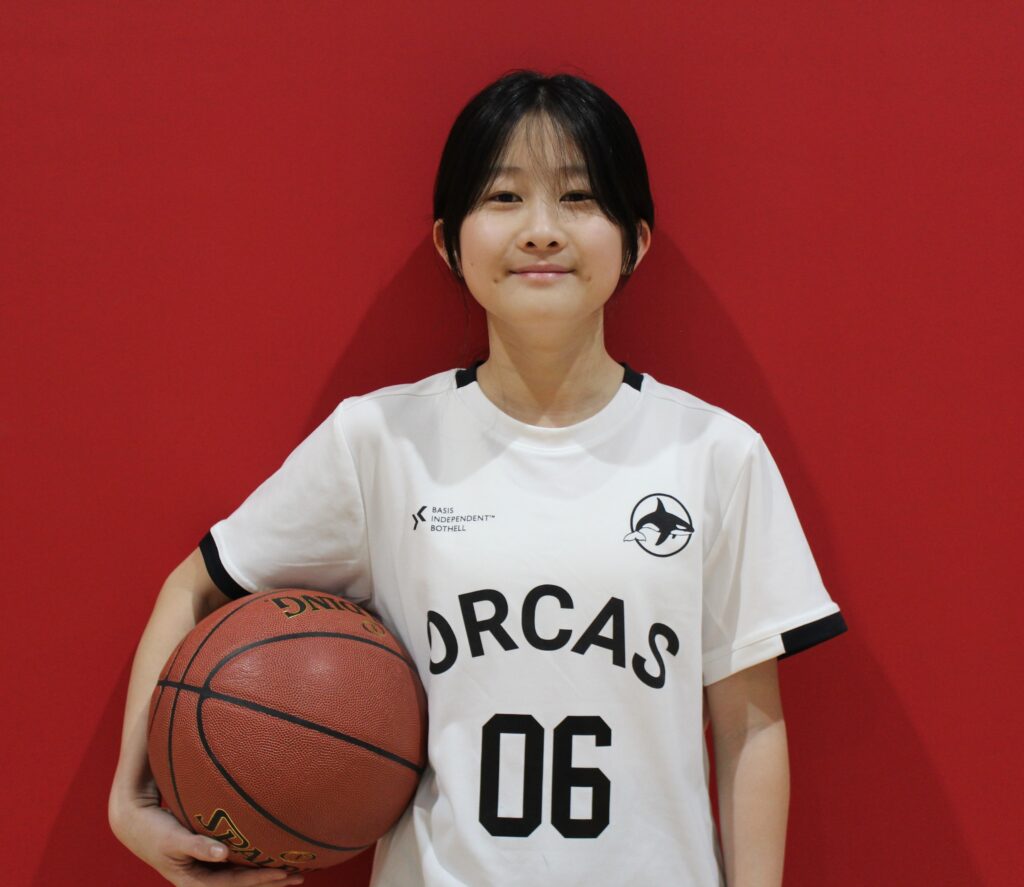
Grade 6 at BASIS Independent Bothell: Student Ambassador Linyue’s Experience

January 13, 2026 by abisoyetaylor Leave a Comment

Discover how Linyue thrives in academics, builds friendships, and makes the most of middle school life at BASIS Independent Bothell.

Meet Linyue,
Grade 6 Student Ambassador

Starting middle school is an exciting milestone, and at BASIS Independent Bothell, we make sure every student feels supported as they take on new challenges.

To give you an inside look at life in Grade 6, we spoke with one of our Student Ambassadors, Linyue, who shared her favorite parts of school, how she adjusted to academics, and her advice for new students.

Q: What do you love most about Grade 6 at BASIS Independent Bothell?

A: Definitely the community! It feels like being part of a big family where everyone is supportive and kind. Teachers and classmates are always ready to help, and that makes learning so much more enjoyable.

Q: How did you adjust to middle school academics?

A: At first, it was a big change, but I found a routine that works for me: study for about an hour and review every day. It keeps me on track and makes learning feel less overwhelming. It’s amazing how much easier things feel when you stay consistent. Plus, our teachers make learning fun and interactive, so it never feels boring!

Q: What’s your favorite subject and why?

A: I love Chemistry and Physics because they challenge me to think in new ways. English is also a favorite because it pushes me to think creatively and express myself better.

Q: What extracurricular activities do you enjoy?

A: Basketball! I love the energy of the game and how it brings everyone together after school. It’s the perfect way to connect with friends outside the classroom.

Q: Any advice for new students joining Grade 6?

A: Stay focused and listen to your teachers. They’re here to help you succeed. And don’t forget to enjoy the experience and explore! Join clubs, try new activities, and don’t be afraid to ask questions. Middle school is full of opportunities to learn and grow, so make the most of it!

“Basketball isn’t just a game. It’s where teamwork, energy, and fun come together. Every time I step on the court, I feel connected and ready to give my best!”

Why Student Ambassadors Matter

Student Ambassadors like Linyue help create a welcoming environment for new families and peers. Their experiences highlight what makes BASIS Independent Bothell unique: a strong academic foundation, a vibrant community, and opportunities to grow both inside and outside the classroom.

Are you considering joining BASIS Independent Bothell’s vibrant school community? Schedule a tour or attend an upcoming admissions event to learn more about our program.

Filed Under: Admissions, Admissions Events, Clubs & Activities, Culture of Support, Extracurriculars, Featured, Middle School, School Community, Sports & Athletics, Student Life, Student Perspectives, Student Spotlight

Rolling Admissions for 2026–2027 Is Now Open at BASIS Independent Manhattan!

January 9, 2026 by anjalijoshi Leave a Comment

We are excited to share that the Rolling Admissions Application Cycle for BASIS Independent Manhattan, a PreK-12 private school in NYC, is officially open for the 2026-2027 school year.

As the Home of the Wildcats, our community is eager to welcome new families who are ready to join a school environment where intellectual curiosity builds subject mastery.

Applications for the 2026–2027 school year are now being accepted on an ongoing basis until all remaining seats are filled. Families may continue to apply for PreK through Grade 10.


What Rolling Admissions Means for Your Family

Admissions Decisions this Winter and Spring
After Regular Admissions Notifications are released in February, completed Rolling Admissions applications will receive an admissions decision within five business days. This allows families to plan ahead with clarity and confidence for the upcoming school year.

A Greater Chance to Secure a Seat
Rolling Admissions operates on a first-come, first-served basis, which means early applicants have the best opportunity to secure a spot in our program. If you are considering joining the Wildcat community, applying early truly matters!

How to Get Started

1. Submit Your Application
Submit your application on Ravenna to begin the admissions process.

2. Review the Rolling Admissions Application Checklist
Review our Rolling Admissions application process here to prepare you and your family for the application steps and requirements.

3. Join Us for an Admissions Event
We continue to offer Campus Tours and a variety of in-person and virtual admissions events. These experiences give families the opportunity to meet members of our school leadership, explore our campus, and see our world-class program in action. We invite you to register for an upcoming event!

We are excited to begin this process with you and look forward to meeting you and your family, and introducing you to the Wildcat Community!  

If you have any questions, be sure to reach out to our Admissions team at manhattan-admissions@basisindependent.com

Filed Under: Academics, Administration & Staff, Admissions, Admissions Events, Admissions Process, Featured, Uncategorized

From Curious and Passionate Students to the Ivy League: 5 Takeaways from our 2025 Alumni Panel

January 7, 2026 by christineklayman Leave a Comment

The Full Circle Moment

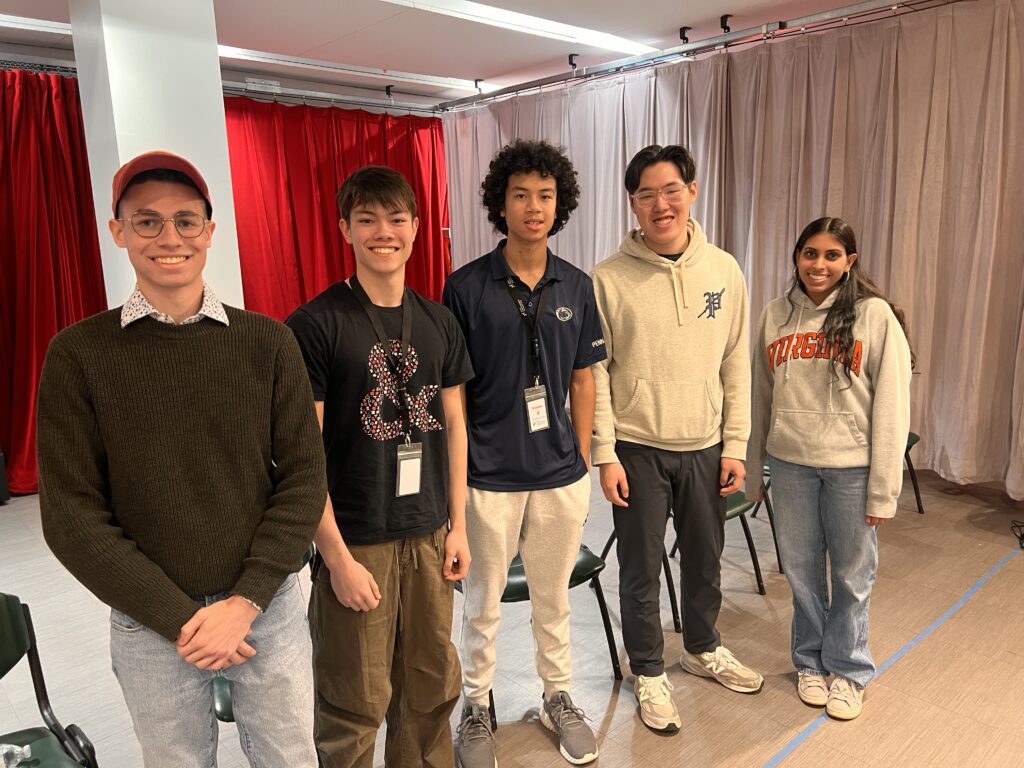
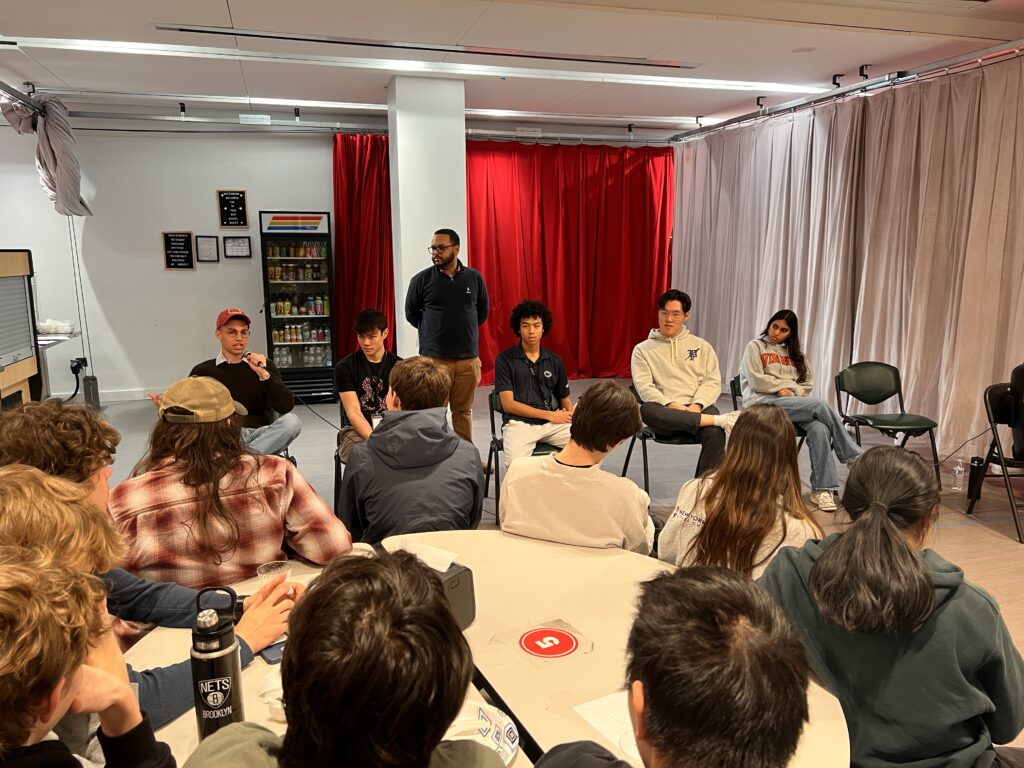
There is no better testament to a school’s mission than the success of its graduates. Recently, the BASIS Independent Manhattan Upper School hosted five alumni (representing Cornell, UVA, Penn State, and Boston University) to share their insights with our current students.

From the “flawless transition” to university-level rigor to the emotional intelligence required to navigate a 20,000-person campus, here are the highlights from our 2025 panel.

the five alumni panelists before they spoke to students
The panel consisted of four BASIS Independent Manhattan alumni and one graduate from BASIS Independent Brooklyn.

1. Small School, Big Advantage

A common theme among the panelists was the value of BASIS Independent Manhattan’s small class sizes. One alum noted that moving from a class of 20 to a lecture hall of 200 made them truly appreciate the deep teacher relationships and personalized letters of recommendation they received. “You have a support system here that is set in stone,” noted Charles D. (Penn State ’25).

2. The “Flawless” Academic Transition

When asked about the jump to college-level work, the consensus was clear: BASIS Independent Manhattan students are ready. One panelist described college as “AP season every week,” but noted that the work ethic they developed in middle and high school made the transition feel manageable and rewarding.

alumni panel

3. Passion Over “Extracurricular Inflation”

In a world of “try-hards” and “sweats,” our alumni gave refreshing advice: Do what you love. Colleges can see through a million superficial activities. Our alumni encouraged students to find 1–2 things they are genuinely passionate about—like the DECA Business Club or running the Pan-Asian Union affinity group—and lead them well.

4. Your Major Isn’t Set in Stone

Mila K. (UVA ’24) shared her journey from being a “Humanities kid” to declaring an Economics major. The takeaway? Use your first year of college to explore. BASIS Independent Manhattan gives you the foundation to be a “math kid,” a “humanities kid,” or both—allowing you to evolve as your interests do.

5. Advice for the Admissions Journey

  • For 8th Graders: Don’t shy away from the challenge; the foundation you build now is what makes college feel easy later.
  • For 11th Graders: Start dialing into your specific interests.
  • For Seniors: Enjoy the ride. “There is a light at the end of the tunnel,” the panelists reminded our current seniors. “Have a plan you love, but keep your hope high.”
Are you looking for a school that prepares students for the world’s top universities?

Visit our school, join our interest list, or meet with our Admissions team!

Learn More

Filed Under: Academics, Alumni, College Acceptances, College Counseling, College Preparation & The Senior Year, Featured, High School, Student Achievement, Student Perspectives

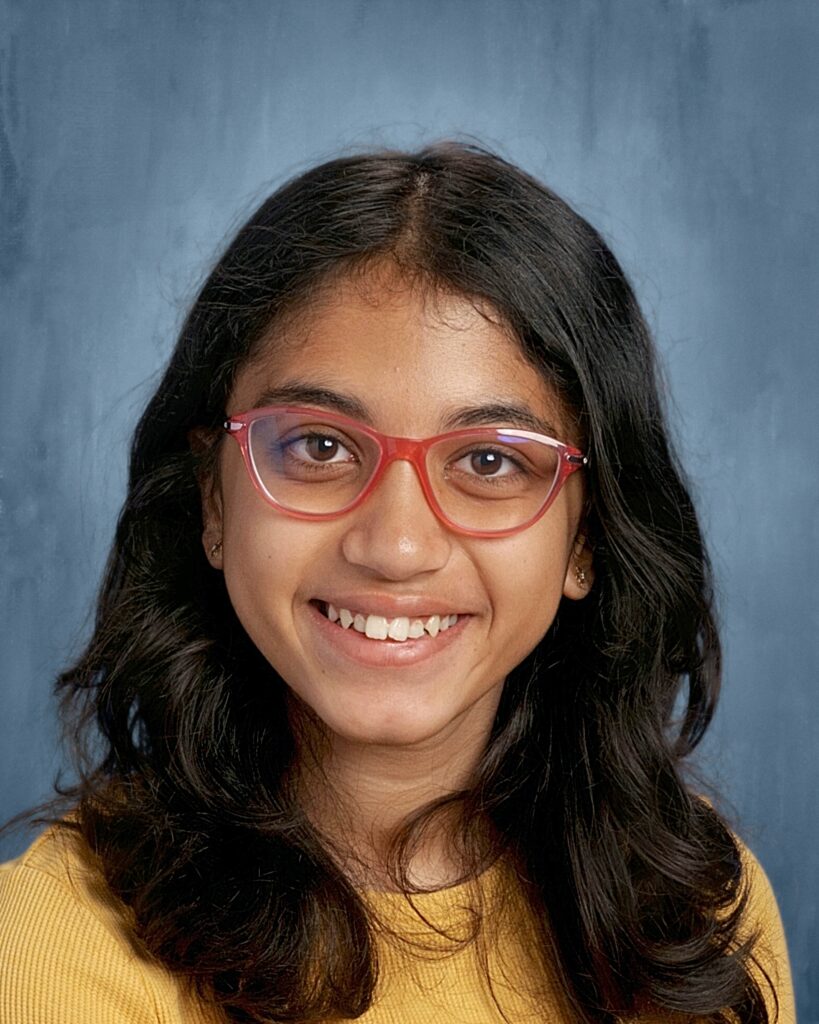
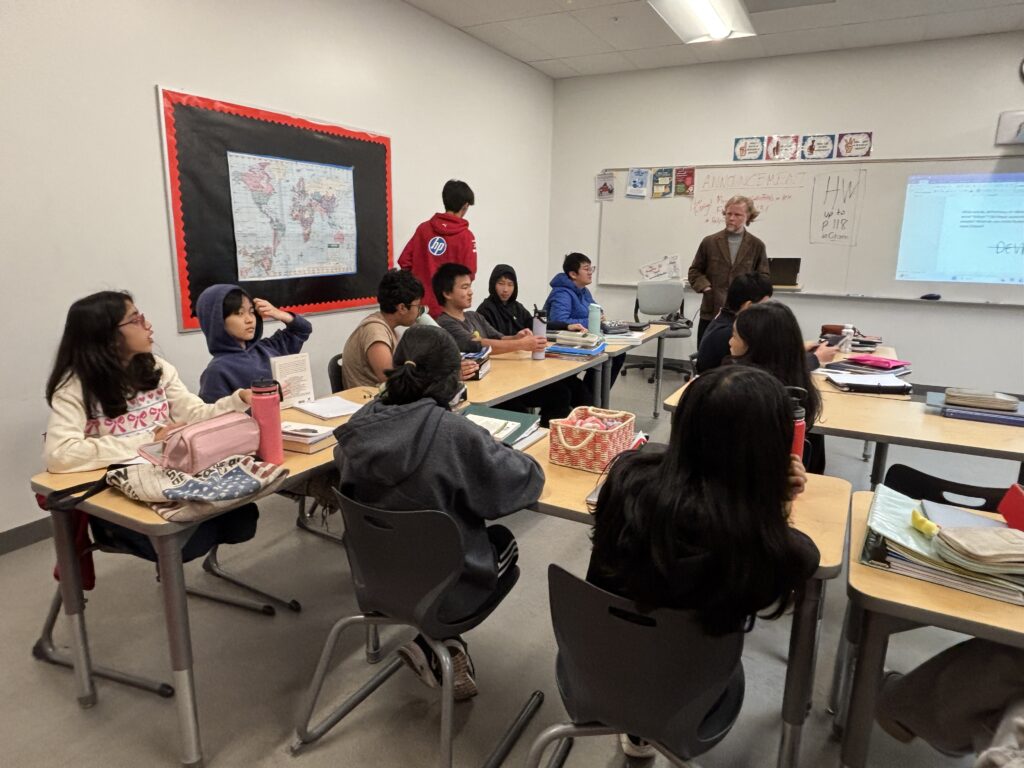
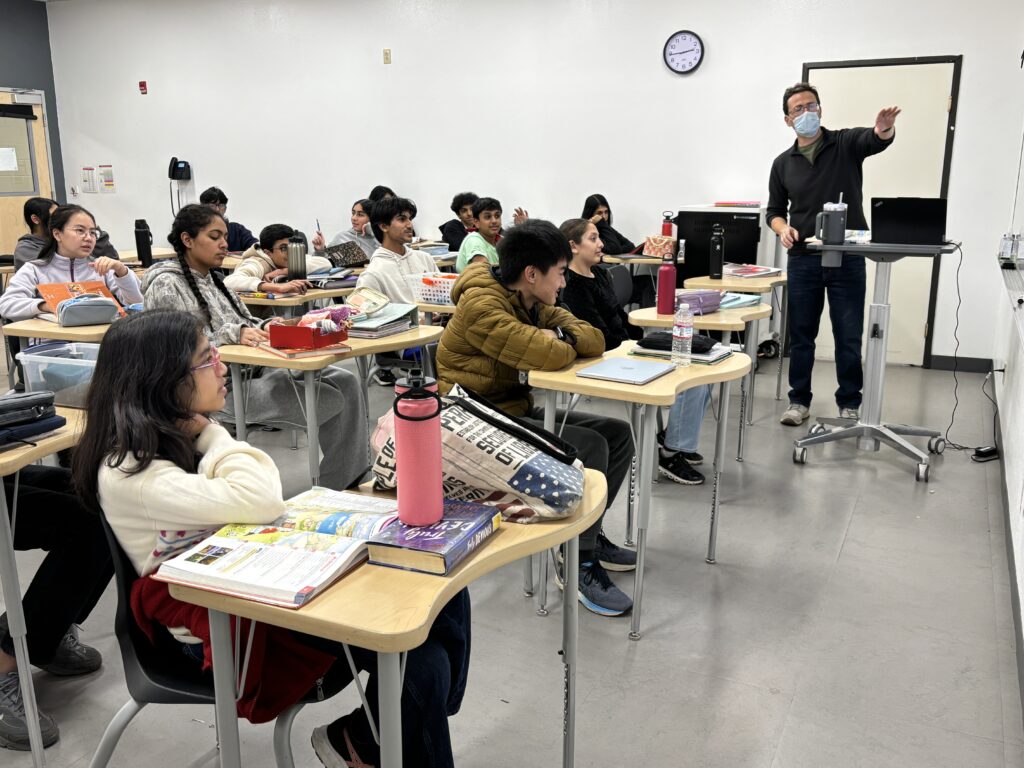
A Day in the Life: Siddhi J., Grade 9

January 6, 2026 by sarahpeterson Leave a Comment

Changing schools is never easy—but joining a rigorous high school where AP courses and college-level expectations are standard starting in grade 9? That can feel especially daunting. At BASIS Independent Fremont, grade 9 students dive into college-level coursework, manage demanding schedules, and navigate new social dynamics. But as Siddhi J. discovered this year, the reality is far less intimidating than the reputation suggests.

Meet Siddhi

Siddhi joined BIF this year in grade 9, coming from a private school in the area after attending several schools throughout her academic journey. Outside the classroom, she’s an avid badminton player and has a particular passion for murder mysteries—she reads them “excessively,” in her own words. At BIF, she’s already deeply involved in Student Council, Speech Club, and Math Club.

Coming into grade 9 at a school known for academic rigor brought natural concerns. “I originally thought that it’d be really scary because everybody thinks that BIF is extremely academically challenging, but it’s actually not that bad,” Siddhi reflects. “There’s more homework than I’m used to, but I think that’s just mainly the middle school to high school jump.”

The adjustment required some recalibration, particularly around time management. “I was able to handle it. I just needed help with time management, but after I figured that out, I was able to go from there.” The growth has been noticeable: “Academically, before I used to procrastinate everything until the last minute, but now, in high school and in BIF, I need to time manage things better. So I’ve gotten a lot more organized.”

Perhaps most surprising? The community itself. “On my first day, I’d already made a lot of friends. It’s a really close-knit community since there are only 40 [grade 9] students in total, so everyone knows everyone.” The reality proved very different from her expectations. “Most people think it’s really cutthroat and really competitive, because that’s what I thought before I joined here. I thought it would be everybody focused on academics and everyone hates each other, but the community is actually really friendly. Everyone talks a lot, jokes a lot. It’s a lot more friendly than I thought.”

Her advice for families considering joining the BASIS Independent Fremont community in grade 9? “It may seem incredibly scary, but the teachers are really helpful, and they explain the AP things really well, so it’s not that scary.”

Let’s follow Siddhi through a typical day to see what grade 9 at BIF really looks like in action.


Period 0 (7:35-8:20): Computer Science & Programming with Ms. Shahin

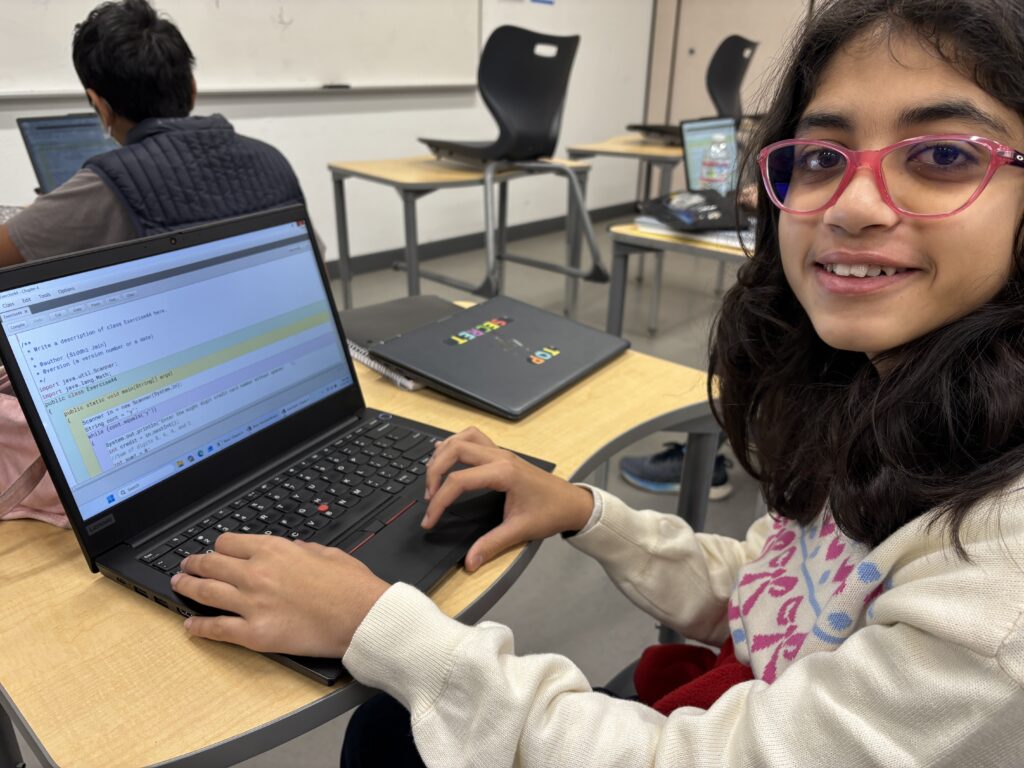
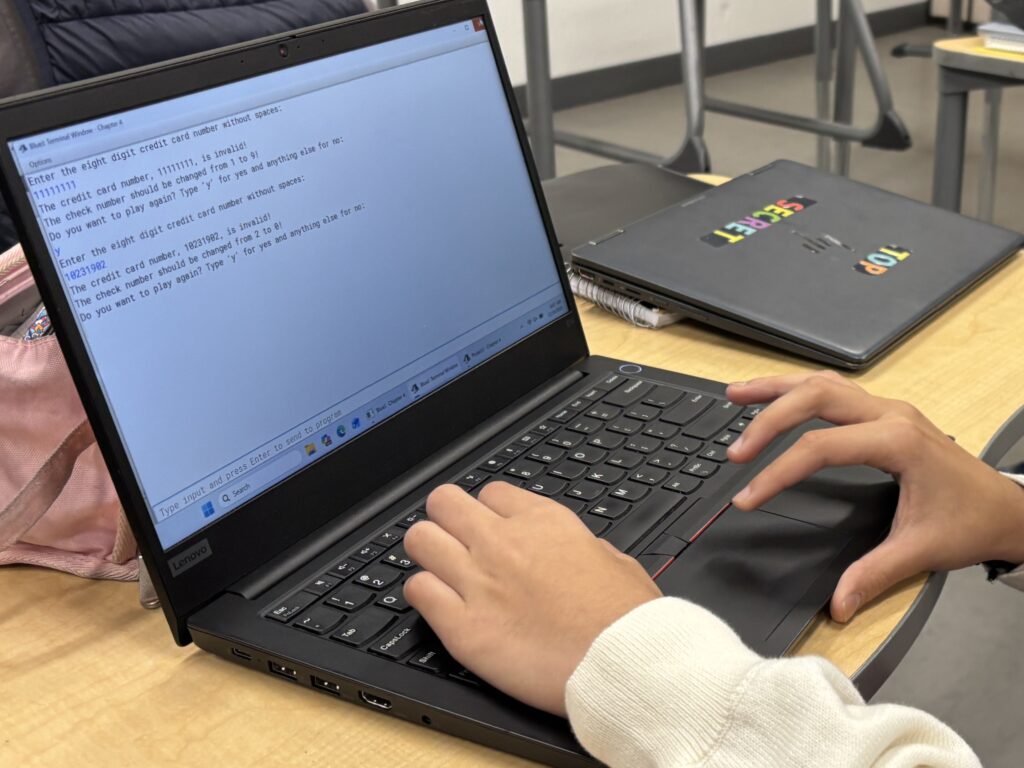
Siddhi starts her day early—before most students arrive on campus. Computer Science & Programming is an elective course that teaches Java, introducing students to the Java development cycle, object-orientation, and control structures. Students work with primitive data types, operators, and data structures such as arrays and lists, with a strong emphasis on the problem-solving aspects of programming.

Today, students are finishing individual coding projects, using Java to write a program that calculates loan payment amounts and payment durations. “I really like computer science, so I thought it was worth it to wake up a bit early and participate in programming,” Siddhi explains. “Principles is more focused on exactly how computers work and different components—the CPU, binary, that stuff. Programming is more focused on the actual Java–loops and different things to get code done. And that’s more interesting to me.”

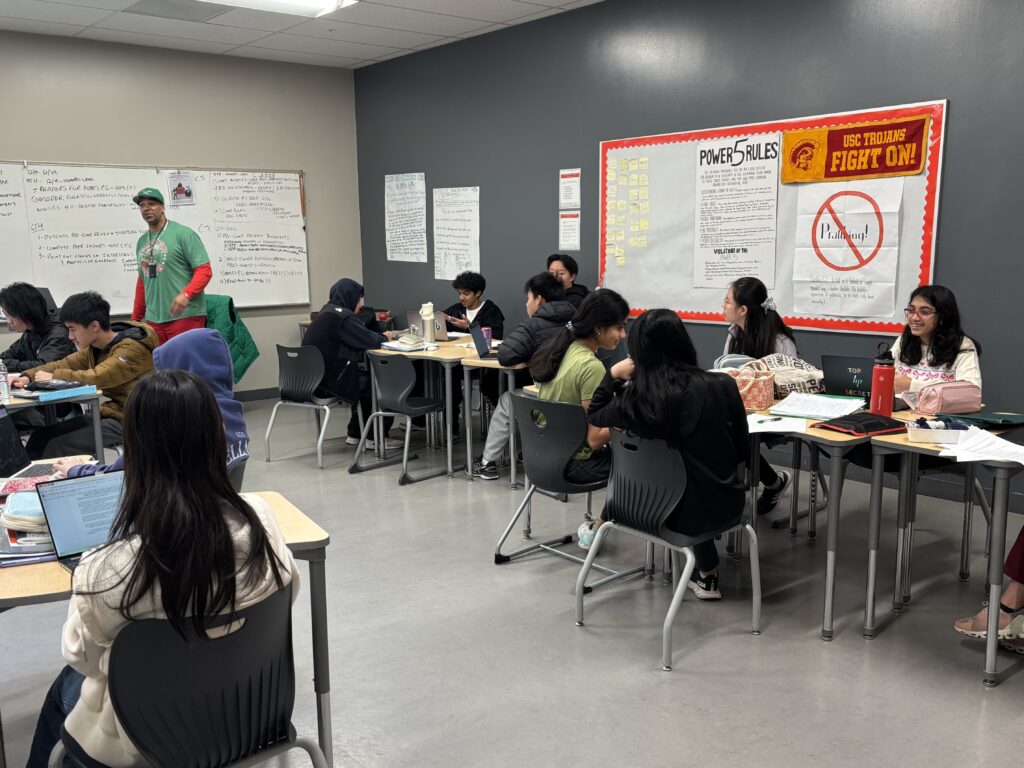
Period 1 (8:25-9:10): Honors English Language & Composition with Mr. Gailliard

Honors English Language & Composition provides an introduction to rhetoric, research, and composition. Students analyze nonfiction texts, develop evidence-based analytical and argumentative writing, and learn to evaluate and cite sources. The course deepens understanding of how communicators make choices based on rhetorical situation and audience.

Today, students split into teams to research and debate: Is AI Beneficial in Education? After researching in groups, teams face off with opposing arguments, delivering opening statements, rebuttals, and closing arguments. At the end, the class votes on which group successfully swayed their opinion—rhetoric and persuasion in action.

Academic Enrichment (9:15-9:25)

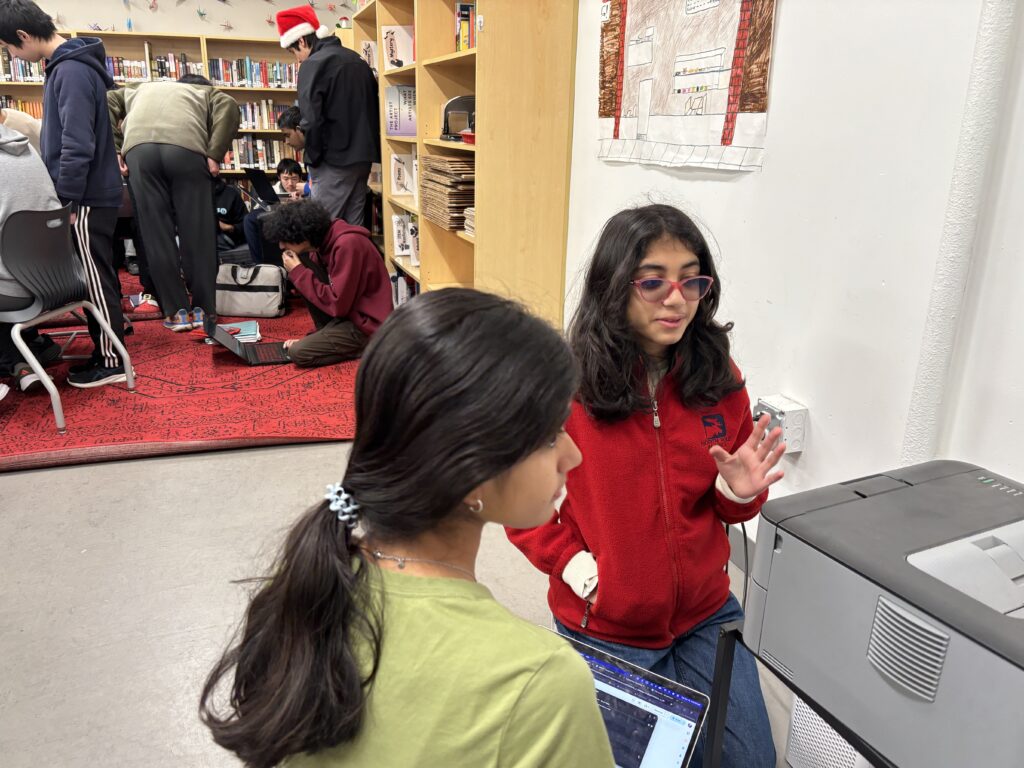
Siddhi and a classmate head to the student library to catch up on work and print materials for their next class. This brief period gives students flexibility to prepare for their day however they need.

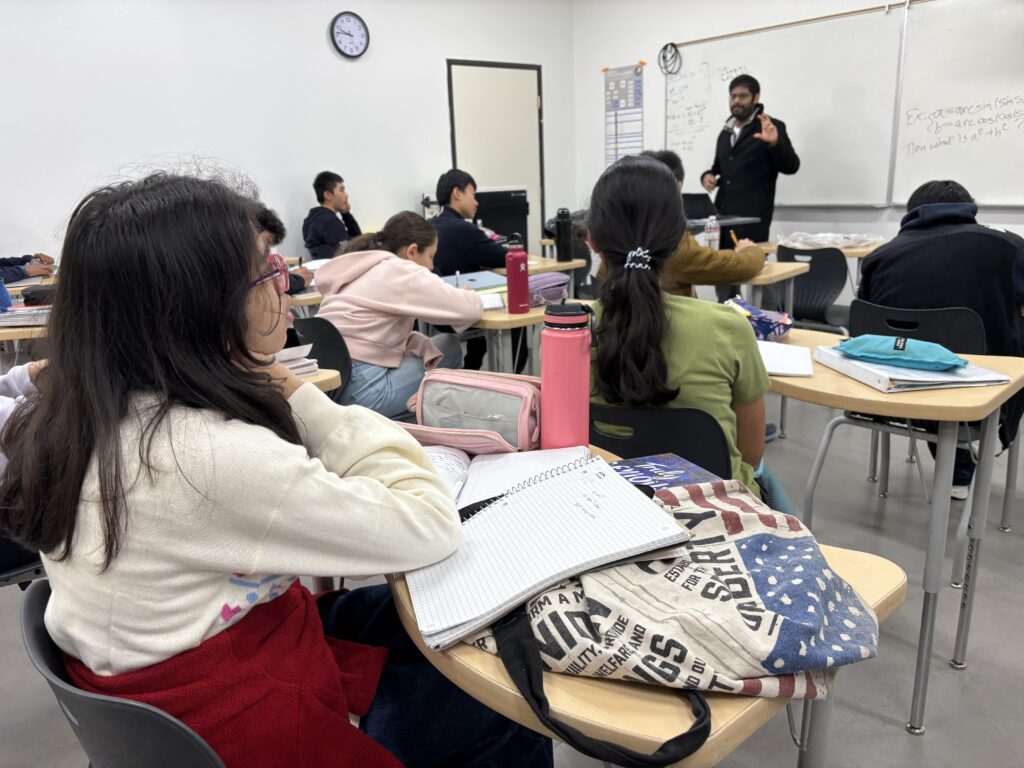
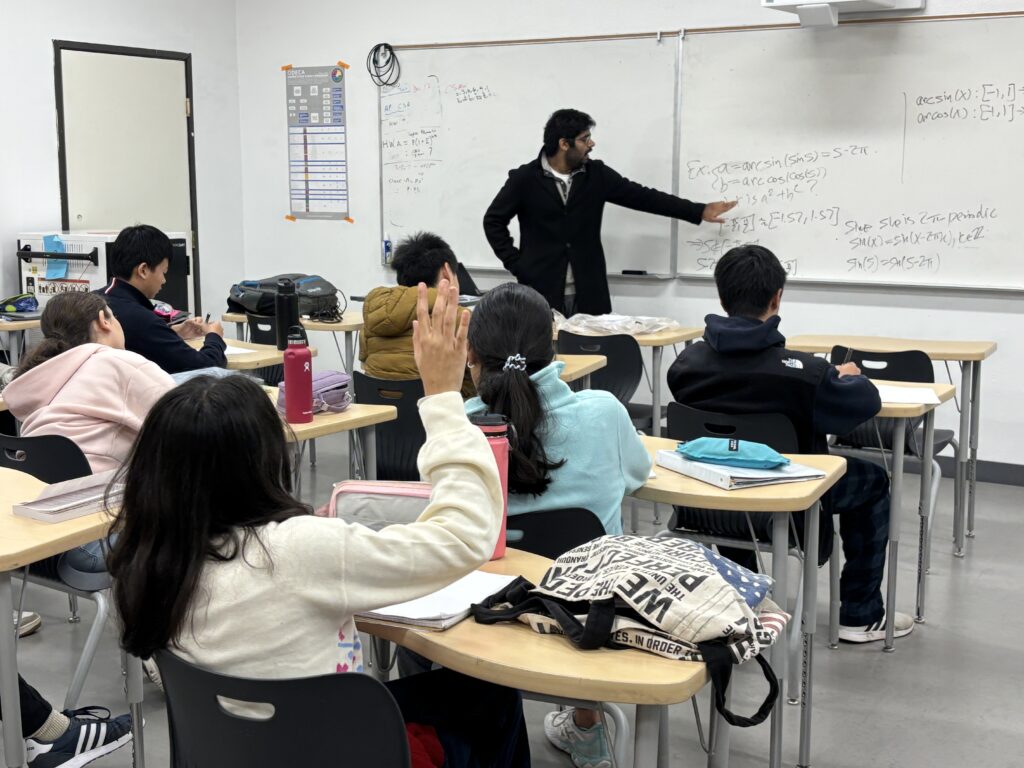
Period 2 (9:30-10:15): Pre-Calculus AB with Mr. Sharma

Pre-Calculus provides in-depth coverage of major functions, including polynomial, exponential, and trigonometric functions, before moving into matrices, discrete mathematics, and statistics. The course concludes with an introduction to calculus concepts—limits, derivatives, and integrals.

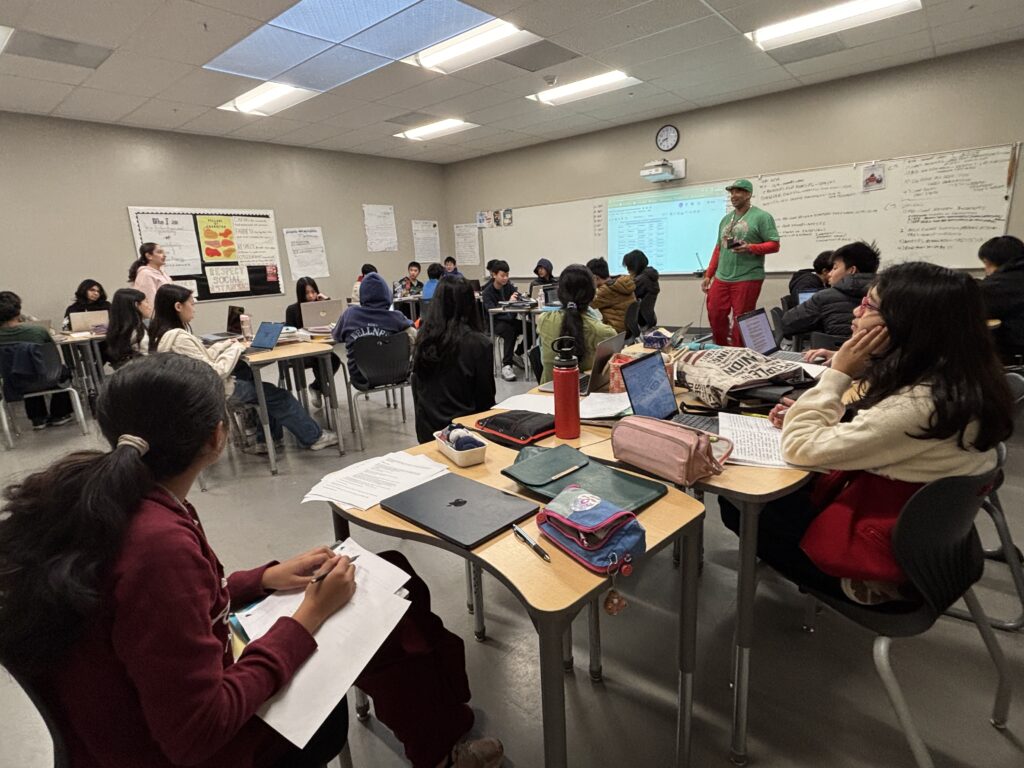
Today, students review for their upcoming Pre-Comprehensive Exams, going over questions and topics from a recent practice exam. They work through problems involving properties of inverse trigonometric functions, domain, and range. Another example has students applying trigonometric identities—including product-to-sum formulas—to simplify expressions in order to find an upper bound, then solving trigonometric equations. It’s a focused preparation for the assessments that measure student progress throughout the year.

Period 3 (10:20-11:05): AP Physics 1 with Dr. Dixit

AP Physics 1 is an algebra-based, introductory college-level physics course where students explore kinematics, dynamics, circular motion and gravitation, energy, momentum, simple harmonic motion, torque and rotational motion, electric charge and force, DC circuits, and mechanical waves and sound through inquiry-based investigations.

Today is test day—students demonstrate their understanding of energy, work, and power. “Dr. Dixit and AP Physics are my favorite,” Siddhi says. “She’s really fun, and she makes sure everybody has everything and is up to speed.”

Period 4 (11:10-11:55): AP Environmental Science with Ms. Covert

AP Environmental Science cultivates an understanding of the interrelationships of the natural world through inquiry-based lab investigations and fieldwork. Students explore energy transfer, interactions between earth systems, interactions between species and the environment, and sustainability.

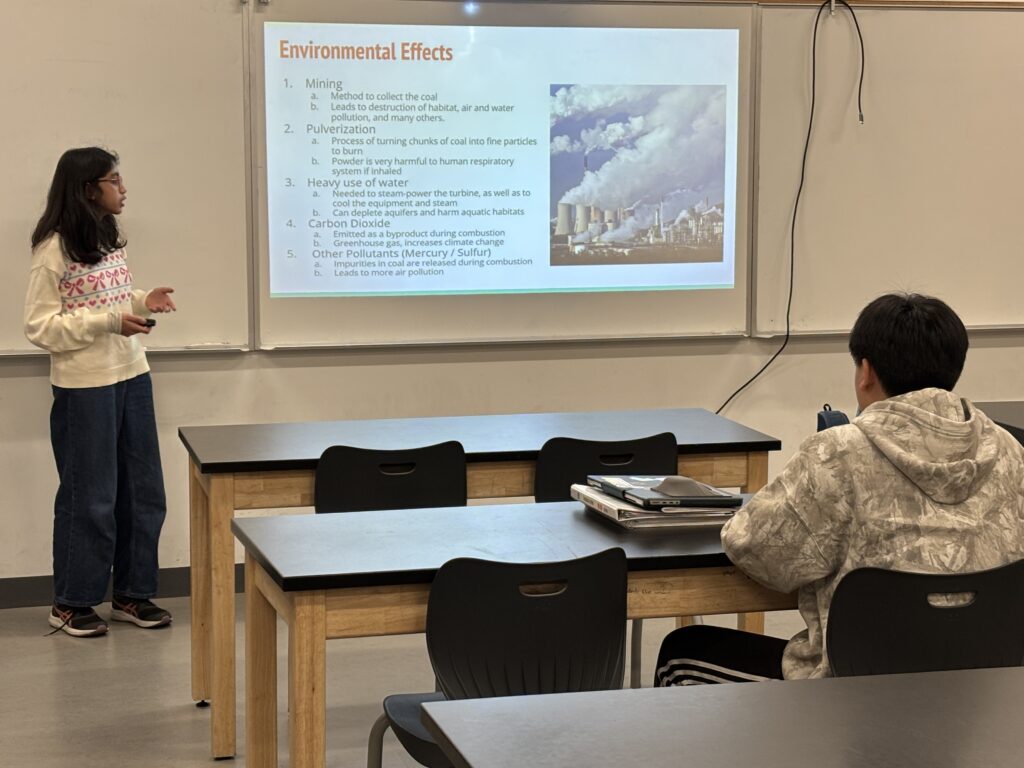
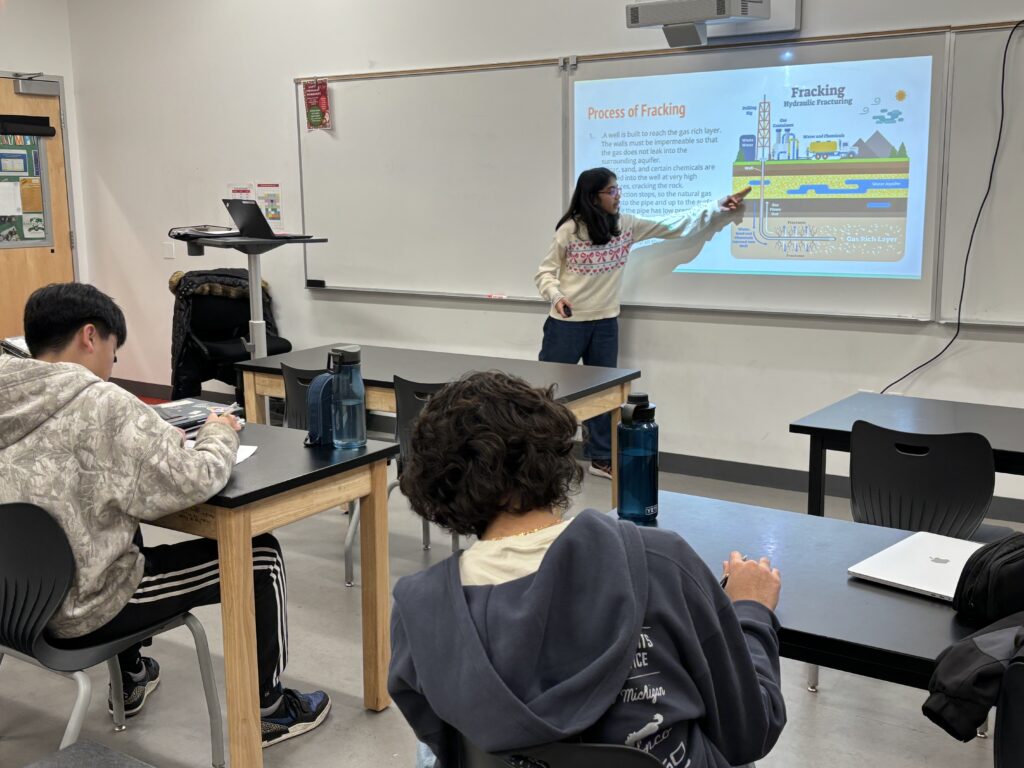
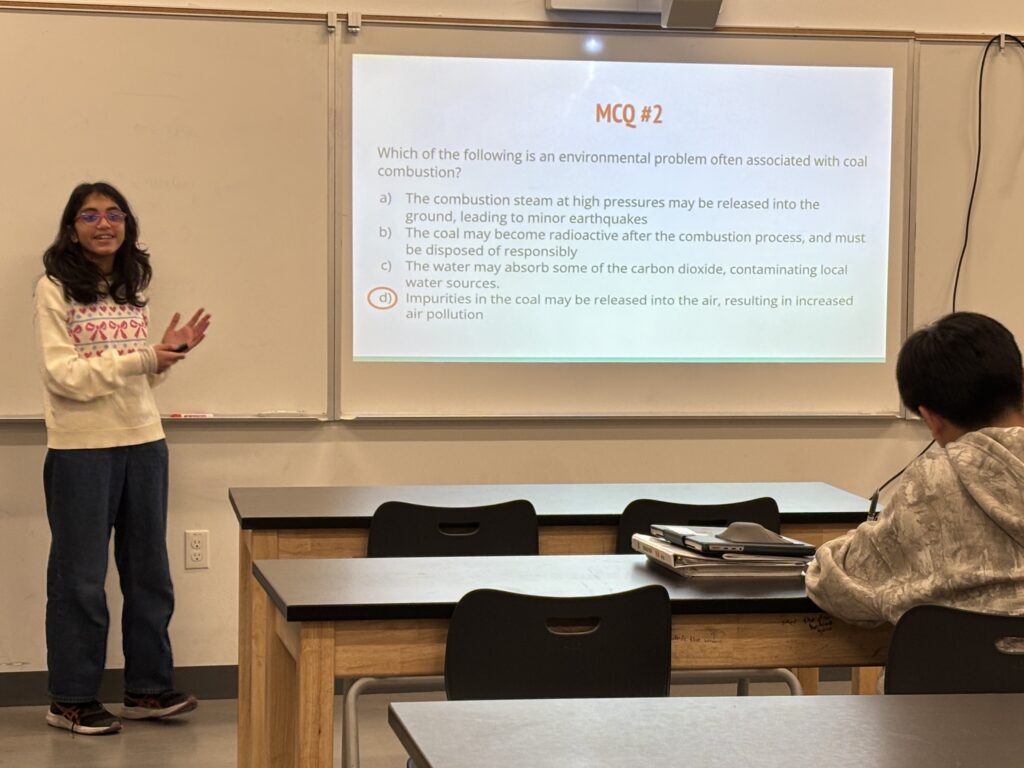
Today, students become teachers. Each student researches one section from the current unit and teaches it to their classmates. Siddhi presents on fossil fuels, diving deep into the topic before sharing her expertise. “It was really fun. Teaching your classmates—you also get to research really in-depth on certain topics, so it feels like you’re really smart and you know a lot. Teaching is fun.”

Period 5 (12:00-12:45): Lunch

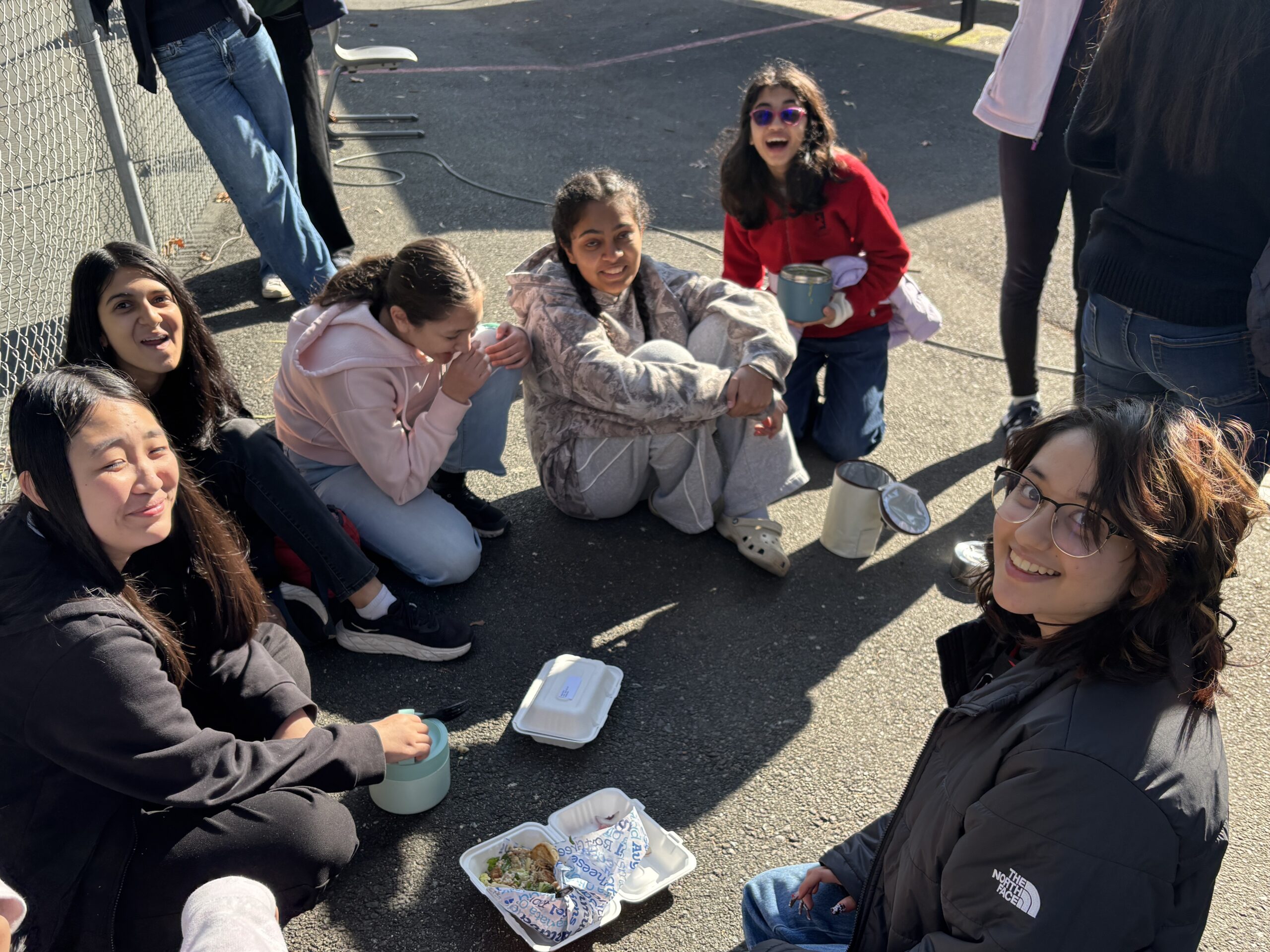
Siddhi eats her packed lunch and chats with friends—a chance to recharge before afternoon classes.

Period 6 (12:50-1:35): Honors English Literature & Composition with Mr. Bradshaw

Honors English Literature & Composition prepares students for AP English Literature. Students analyze various literary forms—short stories, poetry, plays, novels, and nonfiction—assessing character, setting, structure, narration, figurative language, and historical context.

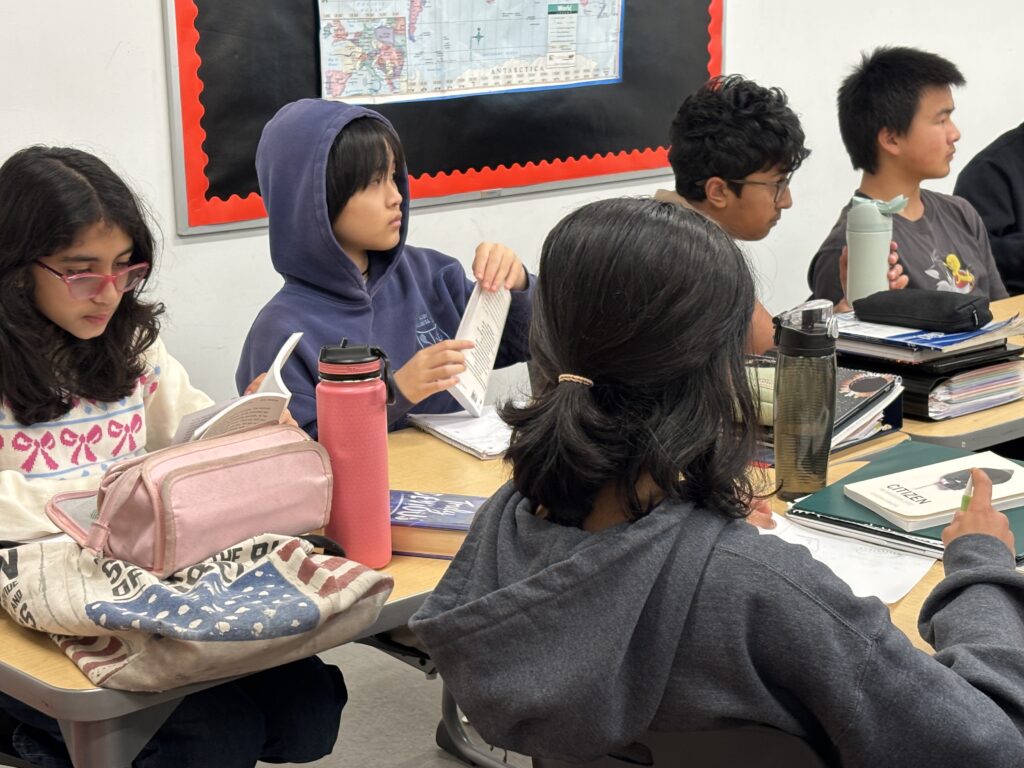
Students are reading “Citizen,” by American poet Claudia Rankine. Class begins with a discussion of words and ideas they associate with the term “citizen” and how these associations align with particular groups. They explore Rankine’s intention in titling the work, then tackle a writing prompt: “How does ‘Citizen’ relate to ongoing debates about race and policing?” Literature meets contemporary social issues.

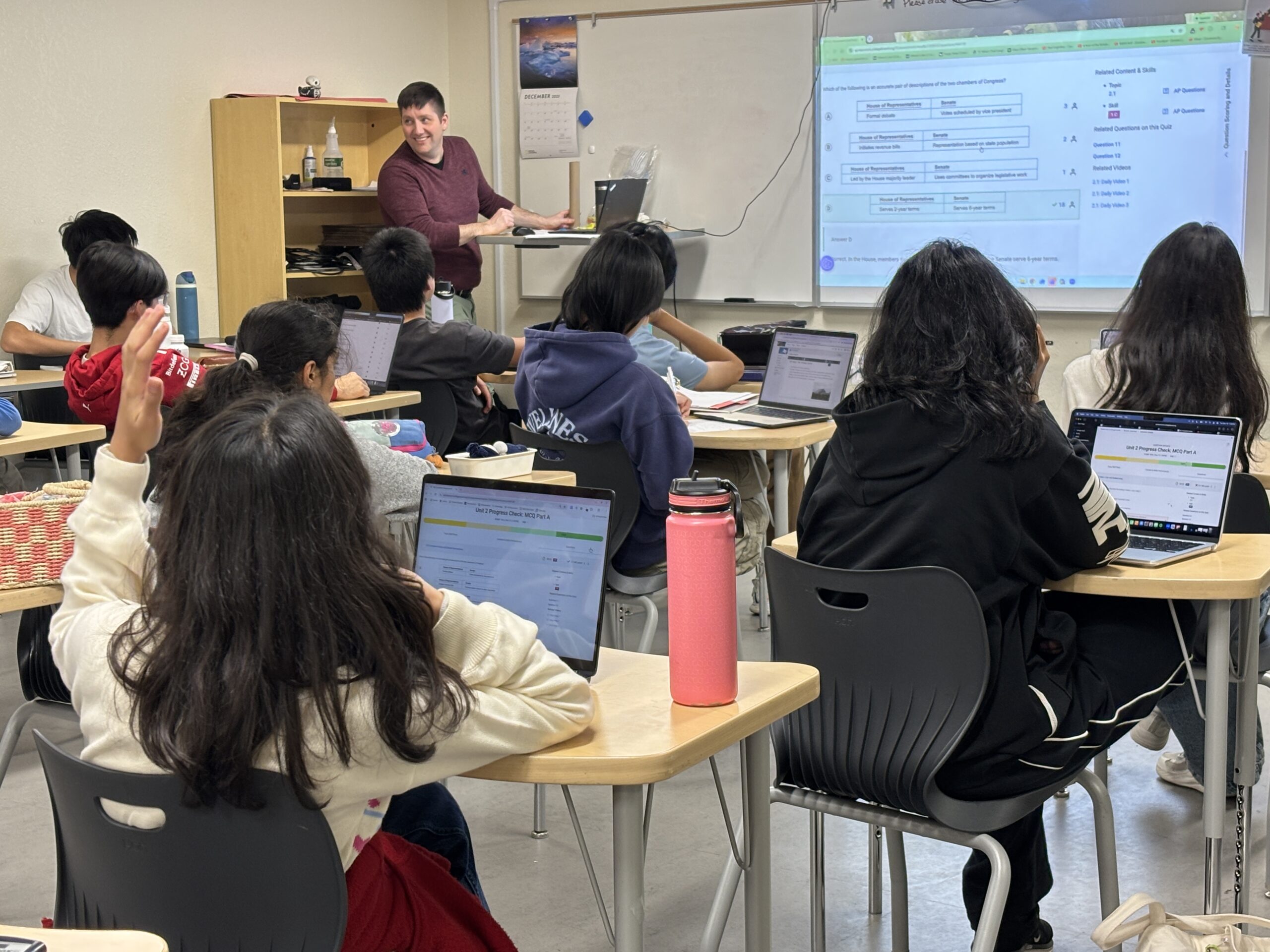
Period 7 (1:40-2:25): AP U.S. Government & Politics with Mr. Loero

AP U.S. Government & Politics provides a college-level, nonpartisan introduction to key political concepts, institutions, policies, and behaviors that characterize the U.S. constitutional system. Students study foundational documents, Supreme Court decisions, and other texts to understand relationships among political institutions and processes.

Today’s unit review covers the relationship between the president and Congress, the descriptions and powers of the two chambers, and the constitutional responsibilities of the House and Senate. 

With three AP classes and two honors courses, Siddhi has learned to manage the workload. “It’s slightly more difficult, but the teachers usually stagger things. Most of the homework I’m used to being due the next day, but now most of it’s long-term, or at least due a week later. So you have more time to organize things out and plan to get everything done.”

Period 8 (2:30-3:15): Spanish II with Mr. Sanders

Spanish II builds on skills from the previous year, developing mastery in listening, speaking, reading, and writing. Students expand vocabulary and grammar while exploring Hispanic cultures, geography, and history through authentic resources, including literary works, audio recordings, videos, songs, and articles.

Today, students submit photos displayed on the whiteboard, then practice describing what each depicts to the class—working on vocabulary and pronunciation. Depending on the photos chosen, some silliness and giggles follow. Language learning doesn’t have to be serious all the time.

Office Hours (3:20-4:00)

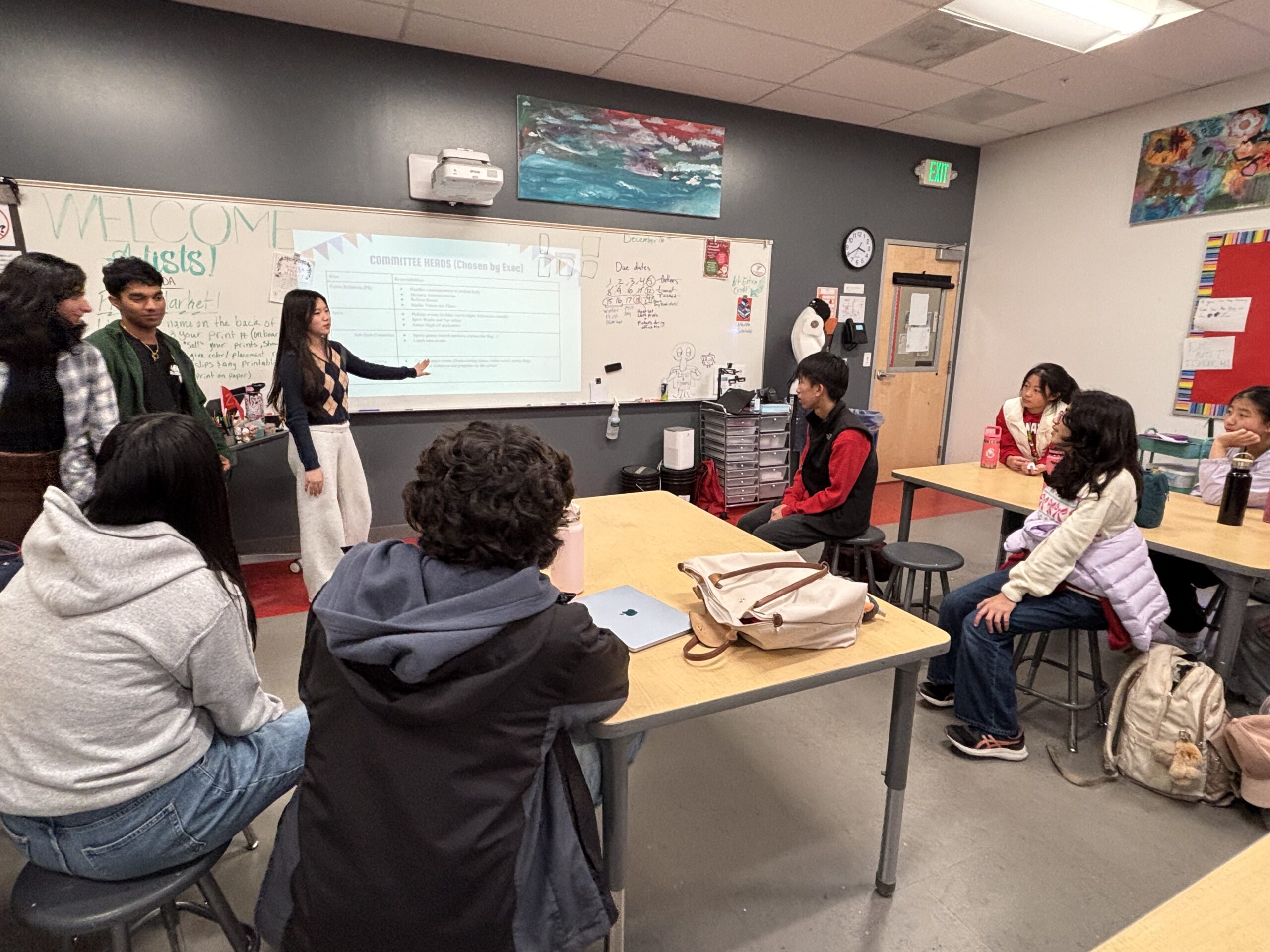
Today, Siddhi uses Office Hours to attend a Student Council meeting, where members advocate for their peers and organize meaningful campus events. The agenda includes preparing materials for an upcoming school holiday celebration and reviewing committee head elections.

Most days, though, Siddhi uses this time strategically. “I normally spend them doing tasks that don’t require textbooks, because I prefer to finish those and then just leave my notebooks in my locker. So I prefer to do the small assignments during Office Hours and the longer ones at home. I used to spend them in Dr. Dixit’s class because that was the class that I needed the most help in.”

After School: Leadership and Competition

Siddhi’s involvement extends beyond Student Council. In Speech Club, she practices as an impromptu speaker and competes in tournaments with a team she describes as “excessively spirited.” The Math Club focuses on preparing for competitions and sharpening problem-solving skills in collaborative settings.


From AP Physics to English Literature, from teaching her peers about fossil fuels to competing in speech tournaments, Siddhi’s first year at BIF showcases what’s possible when students join a supportive academic community. The coursework is demanding, yes—but the teachers are helpful, the community is welcoming, and the skills students develop extend far beyond any single subject.

As Siddhi discovered, stepping into BIF’s academically rigorous environment was far less overwhelming than she’d anticipated. With organization, engaged teachers, and a close-knit community, grade 9 at BIF isn’t about surviving—it’s about thriving.

Curious about what your student’s day could look like at BIF? Schedule a campus tour or contact our admissions team to learn more about high school at BASIS Independent Fremont.

BASIS Independent Fremont is a TK – Grade 12 private school, providing students with an internationally benchmarked liberal arts and sciences curriculum, with advanced STEM offerings. Considering joining the BASIS Independent Fremont community? To join our interest list for the next school year and receive admissions updates and more, please click here.

Filed Under: Academics, Extracurriculars, Featured, High School, Student Life, Student Spotlight, Uncategorized

Student Spotlight: Hera L-Y—Researching Forever Chemicals in Our Water

December 6, 2025 by aixuanwang Leave a Comment

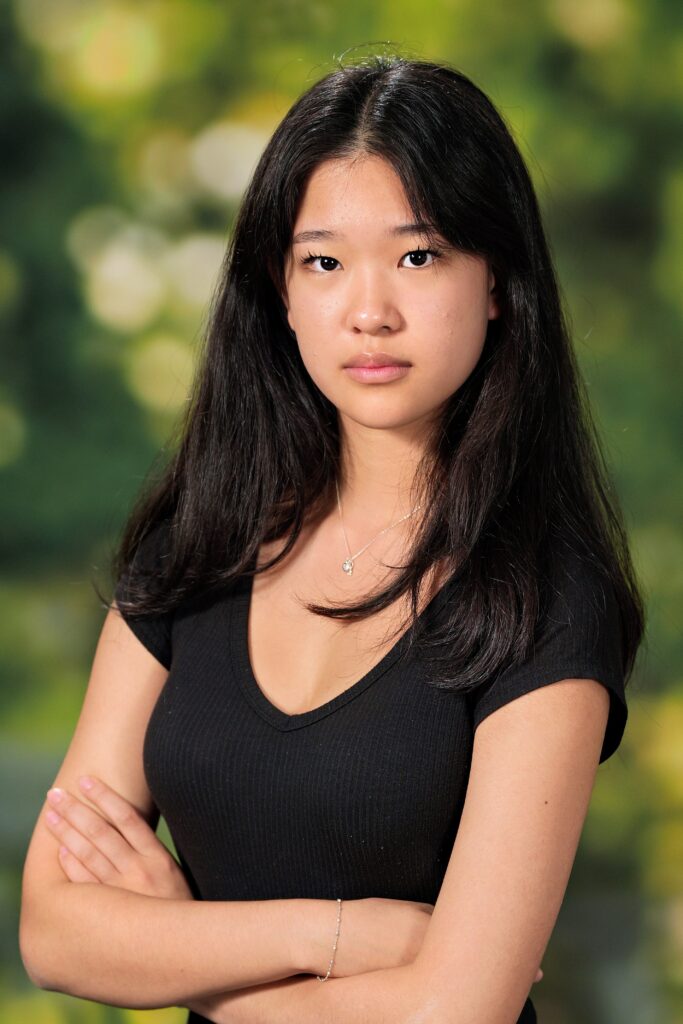
Hera L-Y, a senior at BIM, conducted a series of water-quality analyses on samples collected from several local areas during her free time. After testing samples from Falls Church, Loudoun County, Washington, D.C., Montgomery County (MD), and Alexandria, VA, she discovered a significant discrepancy between Alexandria’s results and those of the other regions. Dr. Hight recently interviewed her about her process and findings.


Hera, I know you’ve been doing your own research on Polyfluoroalkyl substances (PFAS) in our water, and it was recently written about in the Alexandria Times. How did you get started looking into forever chemicals?

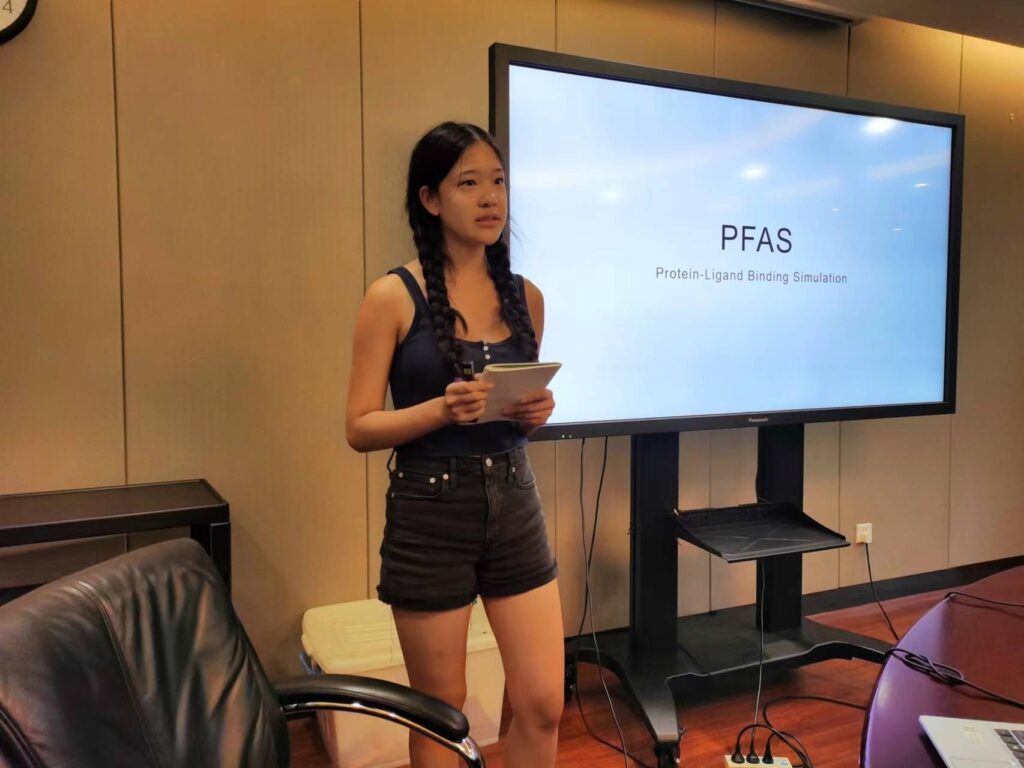
In the summer after my sophomore year, I did an internship in a chemistry lab in China, and the professor who was mentoring me introduced me to PFAS and gave me a project to work on with the help of some graduate students. I learned a bunch of different simulation software and then simulated the interactions between PFAS and proteins. We used Perfluorooctanoic acid (PFOA), which is really common. We studied its interaction with bovine serum albumin, which is a protein in cows very similar to human serum albumin but a bit less complicated.

We found that the binding energy was really strong, which told us that PFOA was really likely to bind to the protein. And then we calculated how much the protein changed after interaction with PFOA and found it hadn’t changed much at all. We realized that because the interaction was so stable, the body wasn’t recognizing it as a foreign particle. But binding to the protein could still knock it out of service.

Hera presenting on PFAS during her internship.

It harms protein function without triggering any sort of immune response? That doesn’t sound good.

Not good.

So your lab work got you interested in PFAS. How did you get from there to testing local water?

After that summer, I knew that this was something that I wanted to continue looking into. I built my own website about PFAS, trying to, like, educate people as much as possible about products that contain them. And then in March or April of 2024, I started this project. What sparked the whole thing was that I found these filters online that let you test your own tap water’s PFAS level. So I bought two and tested my tap water, and then also tested boiled water, because my family drinks a lot of tea.

Then I wondered if the concentration in my home would be different from my friends’ homes. So I tested in a bunch of different towns: Arlington, Alexandria, Loudoun, and Falls Church. The average was around 9-10 PPT, but there were two outliers. Loudoun was really low, around 3.5 PPT. And I actually expected that to happen because they advertised that they are implementing things to filter out PFAS. So I knew Loudoun was going to be lower than the rest, but then I found that my first result for Alexandria was 22 PPT, more than twice the average. At first, I thought it might have been an experimental error, so I tested again at a different location in Alexandria. That one came back 17 PPT, so less, but still way more than average.

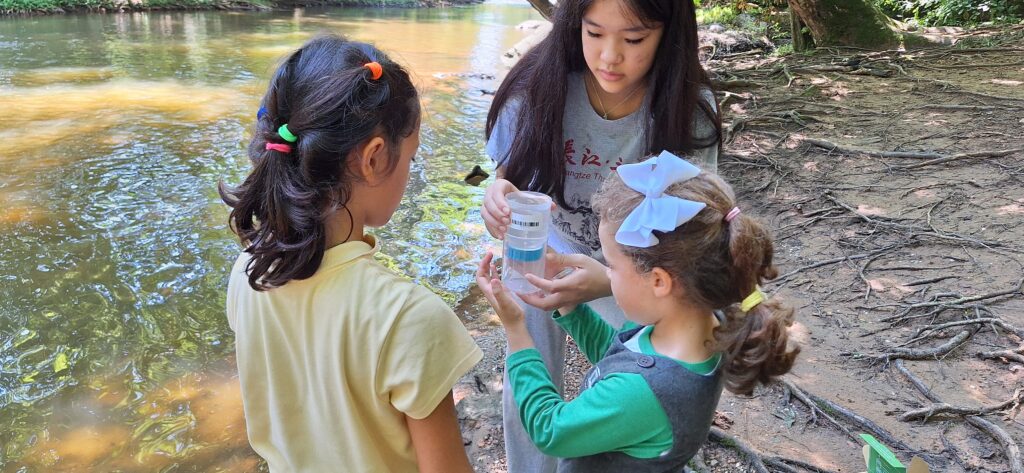
Hera collecting water samples with young campers during the Environmental Science summer camp she led.

So what was going on with Alexandria’s water?

What I did was look into the water sources for all the counties. So I tested the Potomac River and the Occoquan Reservoir, because those are the two main sources of water in Northern Virginia. Both were in double digits. The Potomac was around 15 PPT, and the Occoquan was 21 PPT, both of which are lower than the first Alexandria reading, which was a little confusing. But concentrations do vary with rainfall.

I reached out to a few newspapers because I’ve never seen this covered before, and I got connected with the journalist who wrote the article. We did some research and found an article from 2023 that talked about how Alexandria had an actionable level of PFAS. The mayor at the time was talking about how they were going to do something to stop it, but their levels are actually higher now. So clearly, they didn’t really do anything.

What’s next with this project?

It’s kind of on pause right now for college applications, but I definitely want to continue it in college. Because we know PFAS are bad for us, but we don’t know the extent of how bad. There’s a strong correlation between the concentration of PFAS in someone’s body and liver cancer. I do know that the liver is the main thing that detoxes your body. Because PFAS are so non-degradable, they kind of build up in your liver over time. I’m curious about the biochemistry there.

Sounds fascinating. I look forward to hearing more about it in the future. Thanks, Hera!

You can also read about Hera’s findings in the Alexandria Times.

BASIS Independent McLean is an Age 2–Grade 12 private school, providing students with an internationally benchmarked liberal arts and sciences curriculum, with advanced STEM offerings. Considering joining the Red-Tailed Hawks community? To join our interest list for the next school year and receive admissions updates and more, please click here.
Filed Under: Featured, Science, STEM, Student Achievement, Student Spotlight

BASIS Independent Schools Earn Top 2026 Niche Best Schools Rankings and Record National Merit Scholar Achievements

September 29, 2025 by aloracooper Leave a Comment

BASIS Independent Schools has earned top recognition in the 2026 Niche Best Schools Rankings and set a new record with National Merit Scholarship Semifinalists, reinforcing its place among the best private and STEM high schools in the U.S.

2026 Niche Best Schools Rankings: BASIS Independent Schools Results

Our campuses earned standout placements in both state and national rankings:

• BASIS Independent McLean (VA): Rose to #4 Best High School for STEM in America, ranked #1 Best High School for STEM in Virginia, and named #1 Best College Prep High School in Virginia.

• BASIS Independent Brooklyn (NY): Ranked #5 Best Private High School for STEM in New York and #1 Best Private High School for STEM in Brooklyn.

• BASIS Independent Silicon Valley (CA): Recognized as #3 Best High School for STEM in America, continuing its leadership in STEM education nationwide.

• BASIS Independent Fremont (CA): Recognized as #6 Best High School for STEM in California, reinforcing the Bay Area campuses’ collective strength.

These 2026 Niche Best Schools Rankings underscore BASIS Independent Schools’ commitment to excellence and reflect the consistent upward trajectory of its campuses nationwide.

2026 National Merit Scholarship Results

Students across BASIS Independent Schools have set a new record in the 2026 National Merit Scholarship Program:

• 67% of seniors from the Class of 2026 were named National Merit Semifinalists and Commended Scholars

• 28% of seniors from the Class of 2026 were named National Merit Semifinalists

This represents nearly one-third of the combined graduating class across our five high schools in California, New York, and Virginia — up from 25% last year!

These students now advance in the competition for approximately 6,930 National Merit Scholarships, collectively worth nearly $26 million. National Merit Finalists will be announced in spring 2026.

“We are immensely proud of our students and faculty for their continued excellence,” said Toby Walker, Vice President of BASIS Independent Schools. “Our Niche rankings and National Merit results are not just achievements — they reflect the strength of our curriculum, the dedication of our expert teachers, and the hard work of our students. These results reaffirm our mission: to educate students to the highest international levels with an advanced curriculum benchmarked to the best education systems in the world.”

Learn more about the BASIS Curriculum here. 
Filed Under: Awards & Recognition, Featured, National Merit

  • « Go to Previous Page
  • Page 1
  • Page 2
  • Page 3
  • Go to Next Page »

© BASIS Independent Schools

  • Contact Us
  • Media Recognition
  • Careers
  • Privacy Policy
  • CA Privacy
  • Terms of Use

Headquartered in Campbell, California, Spring Education Group is majority-owned by investment funds administered by Primavera Holdings Limited, an investment firm owned by Chinese persons and principally based in Hong Kong with operations in the United States, China and Singapore.
Sitemap